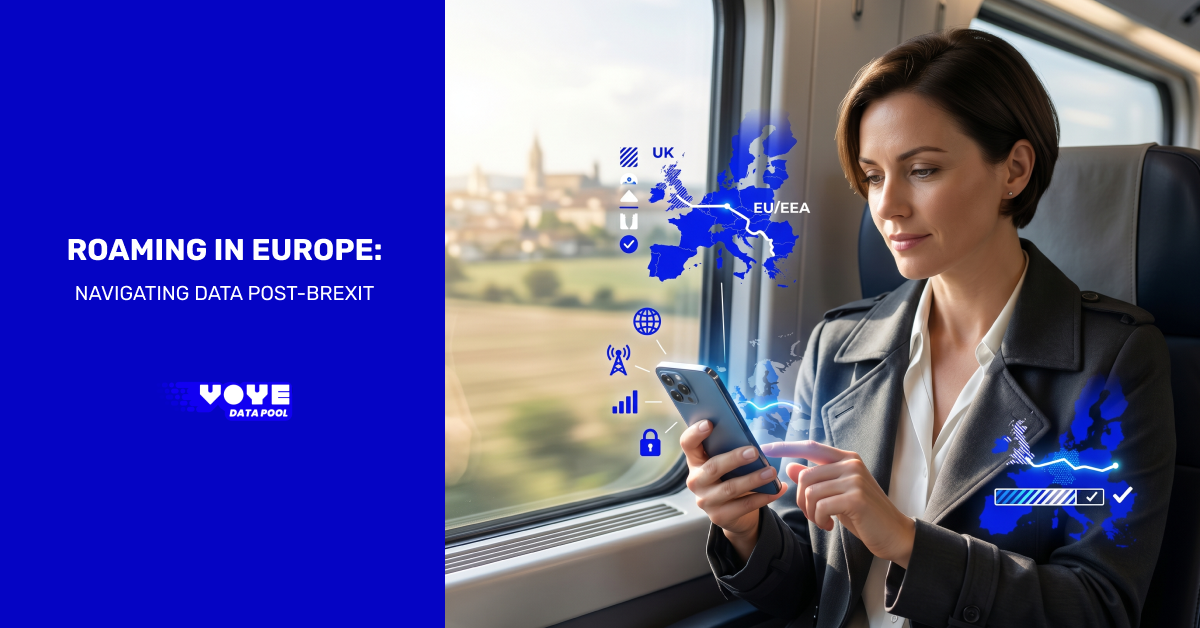
Roaming in Europe: Navigating Data Post-Brexit
Roaming in Europe after Brexit requires a more strategic approach to mobile connectivity, especially for business travelers. With changing regulations, inconsistent pricing, and varying network performance, managing data efficiently has become essential. This blog outlines key challenges, cost considerations, and modern solutions such as eSIM and custom data pool systems. It also highlights how Voye Data Pool simplifies cross-border connectivity, ensuring reliable, secure, and cost-effective internet access for professionals traveling across multiple European destinations.


 9 min read
 Share
Share
International travel across Europe has long been associated with seamless connectivity. For business travelers, uninterrupted mobile data is not a luxury but a necessity. The post-Brexit landscape has introduced new considerations when it comes to roaming, pricing, and data accessibility. These changes have made it increasingly important to understand how mobile connectivity works across borders and how to manage it efficiently.
Reliable internet access directly impacts communication, remote work, client interactions, and operational continuity. As a result, navigating roaming in Europe now requires a more strategic approach than ever before.
Understanding the Shift in European Roaming Policies
Following Brexit, the UK is no longer bound by the European Union’s “Roam Like at Home” regulations. This has led to a noticeable shift in how mobile roaming is handled between the UK and EU countries.
What Changed After Brexit?
Before Brexit, the United Kingdom participated in the European Union’s roaming regulation framework, which allowed users to access mobile services across EU countries at domestic rates. This framework simplified travel by removing additional roaming costs and ensuring consistency.
Following Brexit, the UK is no longer bound by these regulations. Mobile operators now have the flexibility to reintroduce roaming fees or modify fair usage policies. While some providers continue to offer inclusive roaming, others have implemented new pricing structures, leading to inconsistencies across the market.
Implications for Cross-Border Connectivity
The shift has created a fragmented roaming environment. Business travelers must now account for varying policies when moving between the UK and EU countries.
Key implications include:
- Lack of uniform pricing structures
- Differences in data allowances across regions
- Increased need for pre-travel planning
- Greater dependence on alternative connectivity solutions
These changes require a proactive approach to avoid unexpected disruptions.
Data Roaming Costs Across Europe
Understanding how pricing differs can help travelers avoid unexpected charges and make more informed decisions when choosing mobile plans for international travel.
Pricing Variability Across Regions
Roaming costs are no longer standardized and can differ widely based on several factors:
- Mobile carrier agreements
- Country-specific regulations
- Data usage levels
- Duration of travel
Even within Europe, distinctions between EU and non-EU countries can lead to significant pricing differences. However, as of January 1, 2026, the “Roam Like at Home” framework officially expanded to include Ukraine and Moldova. Travelers moving between the EU and these nations now enjoy domestic rates, though UK-based travelers should still verify if their specific provider includes these new territories in their “Europe Zone.”
Common Cost Triggers
Understanding what drives roaming expenses is essential for cost control. Key triggers include:
- Exceeding fair usage limits
- Background app data consumption
- Network switching near borders
- Premium services such as tethering
Without proper monitoring, these factors can lead to unexpectedly high bills.

Stay Connected Across Europe
Reliable data access for seamless travel across multiple European countries.
Connectivity Challenges in Multi-Country Travel
Maintaining stable connectivity across borders can be more complex than it appears, especially due to varying network standards, inconsistent coverage, and frequent transitions between service providers.
Network Transitions Across Borders
Frequent travel between countries often results in automatic network switching. While this process is designed to be seamless, it can introduce technical challenges such as:
- Temporary connectivity drops
- Delayed network registration
- Inconsistent signal strength
- Latency fluctuations
These disruptions can affect time-sensitive business activities, including virtual meetings and real-time collaboration.
Device and Network Compatibility
Although modern devices support multiple network bands, compatibility is not always guaranteed to deliver optimal performance. Factors influencing connectivity include:
- Local infrastructure quality
- Carrier partnerships
- Network congestion levels
This variability makes it difficult to rely solely on traditional roaming services for consistent performance.
Alternatives to Traditional Roaming
New solutions are making it easier to stay connected without relying on expensive roaming plans. They also provide greater flexibility and control, allowing users to choose options that best match their travel needs and usage patterns.
eSIM as a Flexible Solution
eSIM technology provides a modern alternative to physical SIM cards. It enables users to activate mobile plans digitally and switch between providers without changing hardware.
Key advantages include:
- Immediate activation upon arrival
- Ability to store multiple profiles
- Reduced dependency on a single carrier
- Enhanced flexibility for international travel
For business travelers, this translates into greater convenience and improved control over connectivity.
Limitations of Local SIM Cards
While local SIM cards can offer competitive rates, they come with practical challenges:
- Time required for purchase and activation
- Temporary loss of primary contact number
- Need to manage multiple SIMs across countries
- Limited efficiency for short stays
These limitations make them less suitable for professionals with demanding schedules.
The Role of Custom Data Solutions
Centralized data strategies are reshaping how businesses manage connectivity across borders by improving control, reducing complexity, and ensuring more consistent connectivity across regions.
Understanding Custom Data Pool Systems
A custom data pool enables centralized management of mobile data across multiple regions. Instead of relying on individual roaming agreements, users access a shared data allocation that functions across borders.
This approach provides:
- Predictable and transparent pricing
- Consolidated billing
- Flexible data distribution
- Consistent connectivity across locations
For business travelers, it eliminates much of the uncertainty associated with roaming.
Strategic Advantages for Businesses
Organizations that operate across multiple countries benefit significantly from adopting a custom data pool model. Advantages include:
- Efficient allocation of data resources
- Reduced operational complexity
- Improved visibility into usage trends
- Enhanced cost management
This model aligns with the needs of modern enterprises that prioritize scalability and efficiency.
Voye Data Pool for Seamless European Connectivity
Simplifying cross-border mobile data with a unified, flexible, and cost-efficient approach that ensures consistent connectivity, reduces complexity, and enhances the overall travel experience across multiple regions.
How Voye Data Pool Supports Travelers
Voye Data Pool offers centralized international connectivity, giving users access to mobile data across Europe without requiring a separate Europe data plan.
Key capabilities include:
- Unified data access across countries
- Single pool for multiple users and devices
- Transparent usage tracking
- Simplified management interface
This structure removes the unpredictability typically associated with roaming.
Supporting Business Mobility
For professionals traveling between major European cities, maintaining uninterrupted connectivity is essential. With Voye Data Pool, users can:
- Stay connected during transit and border crossings
- Access cloud-based tools without interruption
- Conduct video meetings with stable bandwidth
- Maintain secure communication channels
This level of reliability supports productivity in fast-paced business environments.
Managing Data Usage Efficiently While Traveling
Smart data management helps travelers stay connected longer, avoid unexpected charges, and maintain productivity across multiple networks.
Practical Optimization Techniques
Efficient data usage is critical when operating across multiple networks. Business travelers can optimize their usage by:
- Monitoring consumption through mobile dashboards
- Restricting background data for non-essential apps
- Scheduling updates over secure Wi-Fi connections
- Using data compression features where available
These strategies help extend data availability and improve cost efficiency.
Planning Based on Travel Needs
A structured approach to data planning involves evaluating:
- Length of the trip
- Number of destinations
- Nature of work activities
- Required bandwidth for applications
This ensures that the selected solution aligns with actual usage requirements.
Simplify Your Data Roaming
Avoid roaming charges with flexible and efficient mobile data solutions.
Security Considerations in International Roaming
Protecting your data and communications is critical when accessing networks across different countries and environments.
Risks Associated with Public Wi-Fi
Public networks are widely used but pose significant security risks. Common concerns include:
- Unauthorized data interception
- Exposure to malicious software
- Compromised login credentials
Business travelers handling sensitive information must remain cautious when using such networks.
Strengthening Data Security
Maintaining secure connectivity involves several best practices:
- Using encrypted connections through VPNs
- Avoiding sensitive transactions on open networks
- Keeping devices updated with the latest security patches
- Enabling multi-factor authentication
Using a reliable mobile data solution reduces reliance on unsecured networks, enhancing overall protection.
Global Connectivity Perspective
European roaming challenges reflect a broader global trend where connectivity varies across regions. Professionals traveling internationally often compare connectivity solutions across different markets. In this context, considerations similar to those in Dubai arise when evaluating reliability, cost, and accessibility in other parts of the world.
This highlights the importance of adopting flexible and scalable solutions that can adapt to different regulatory and technological environments.
Future Outlook for Roaming in Europe
Roaming in Europe is moving toward a more dynamic, technology-driven future shaped by regulation, innovation, and evolving user needs.
Evolving Regulatory Landscape
The European telecommunications environment continues to evolve. While EU regulations aim to maintain fair roaming practices, the UK operates independently, leading to ongoing divergence.
Future developments may include:
- Bilateral agreements between countries
- Enhanced transparency in pricing
- Broader digital service integration
Staying informed about these changes is essential for effective planning.
Technological Innovations
Advancements in mobile technology are reshaping connectivity. Key developments include:
- Expansion of 5G networks across Europe
- Improved eSIM adoption rates
- Smarter network management systems
- Growth of centralized data platforms
These innovations are expected to enhance user experience and reduce connectivity challenges over time.
Choosing the Right Connectivity Strategy
Selecting the right approach ensures reliable, cost-effective, and seamless connectivity across borders while adapting to changing travel and business needs.
Evaluating Key Requirements
Selecting an effective roaming solution requires careful consideration of:
- Travel frequency
- Budget limitations
- Data consumption patterns
- Need for reliability and security
A well-informed decision helps avoid disruptions and unnecessary costs.
Building a Scalable Approach
For businesses, a long-term connectivity strategy should include:
- Adoption of centralized data solutions
- Continuous monitoring of usage
- Employee awareness of best practices
- Regular evaluation of cost efficiency
This ensures that connectivity remains aligned with organizational goals.
Conclusion
Roaming in Europe post-Brexit presents a more complex and fragmented landscape than before. The absence of unified regulations has introduced variability in pricing, performance, and accessibility. For business travelers, this makes traditional roaming solutions less predictable and often less efficient.
Adopting modern alternatives, such as a custom data pool, provides a more structured and reliable approach to managing connectivity. Voye Data Pool enables seamless access to mobile data across multiple countries, ensuring consistency, transparency, and control.
By combining strategic planning with advanced connectivity solutions, business travelers can maintain productivity, reduce costs, and navigate Europe’s evolving roaming environment with confidence.
Upgrade Business Travel Connectivity
Ensure a secure and uninterrupted internet for work while traveling abroad.