

Connectivity in Singapore: The Hub of Asia
Singapore business travel combines global business opportunities with efficient transport, modern infrastructure and strong digital connectivity. As a leading business hub in Asia, Singapore attracts professionals for meetings, conferences, networking and regional business activities. This guide covers essential travel tips, key business districts, transport options, local etiquette and mobile connectivity. Learn how reliable internet access and eSIM technology can help business travellers stay productive, connected and flexible while moving between meetings, hotels, airports and business events.


 11 min read
 Share
Share
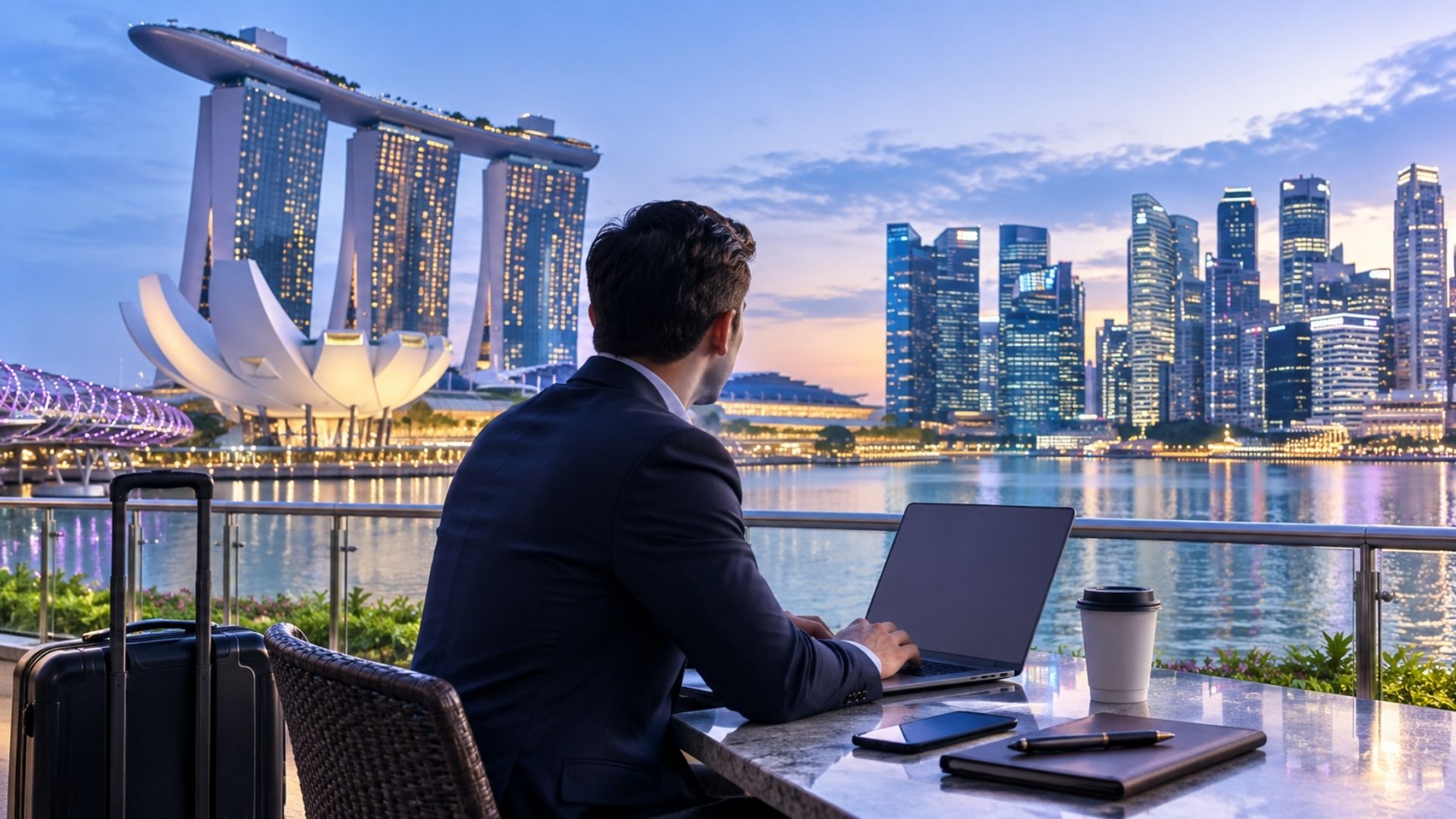
Singapore business travel is about more than attending meetings or closing deals. It is about moving quickly between airports, offices, hotels, conferences and client dinners while staying productive at every step. Singapore makes this easier with its strong transport network, global business links, modern infrastructure and reliable digital connectivity.
Located at the centre of Southeast Asia, Singapore has become a major gateway for companies operating across Asia-Pacific. Global businesses use the city as a regional headquarters, technology hub and launchpad for nearby markets. For business travellers, that means a trip to Singapore can involve meetings with clients from several countries within just a few days.
In 2026, connectivity is an important part of that experience. Email, video meetings, maps, ride-hailing apps, digital documents and authentication tools all depend on reliable internet access. A well-planned business trip should therefore consider mobile connectivity alongside flights, accommodation and transport.
Why Singapore Is a Major Business Hub in Asia?
Singapore combines location, infrastructure and a business-friendly environment in a way few cities can match.
The Singapore Economic Development Board says the country is the No. 1 regional headquarters destination in Asia and highlights its strategic connectivity, infrastructure, talent and business environment. Singapore connects to nearly 160 cities through 100 airlines, making it a practical base for regional business operations.

Stay Connected Across Singapore
Reliable connectivity for productive business travel in Singapore.
The country also supports a wide range of industries. Finance, technology, manufacturing, logistics, healthcare, professional services and advanced manufacturing all play important roles in the economy.
This makes Singapore useful for more than traditional corporate meetings. Business travellers may visit for:
- Client meetings
- Industry conferences
- Trade exhibitions
- Investor meetings
- Regional office visits
- Sales trips
- Technology events
- Training sessions
- Supplier meetings
- Business networking
Singapore’s position is also becoming more valuable as companies expand across Southeast Asia. EDB reports that global brands are increasingly using Singapore as a regional base and a testbed for entering Asian markets.
Singapore’s Connectivity Starts Before You Land
For a business traveller, connectivity begins before the aircraft touches down.
Singapore Changi Airport handled 17.6 million passenger movements in Q1 2026, up 2.3% from the same period a year earlier. Passenger traffic for the 12 months ending March 2026 reached 70.4 million, the highest 12-month figure recorded at Changi at that point.
That level of international traffic reflects Singapore’s role as a regional gateway.
Once you land, the goal is simple: get online and get moving.
Waiting until arrival to find a physical SIM can add an unnecessary task to an already busy itinerary. A travel eSIM can be installed before departure, allowing a traveller to prepare mobile data in advance.
This is especially useful when the first task after landing is a client call, airport transfer, map search or message to a colleague.
Why Reliable Mobile Internet Matters on a Business Trip?
A business traveller may use mobile data dozens of times during a single day.
Consider a typical schedule:
8:00 a.m. — Check emails at the hotel
9:00 a.m. — Navigate to a client office
10:00 a.m. — Join a video meeting
12:30 p.m. — Message a colleague about lunch
2:00 p.m. — Upload documents from a café
4:00 p.m. — Travel to a conference venue
6:30 p.m. — Confirm a client dinner
9:00 p.m. — Send follow-up notes from the hotel
Every step can depend on mobile connectivity.
Hotel Wi-Fi can be useful, but it should not be the only connection available. Conference networks may become busy. Public Wi-Fi may require repeated logins. A business traveller may also need internet while travelling between locations.
A dedicated mobile data connection provides another layer of flexibility.
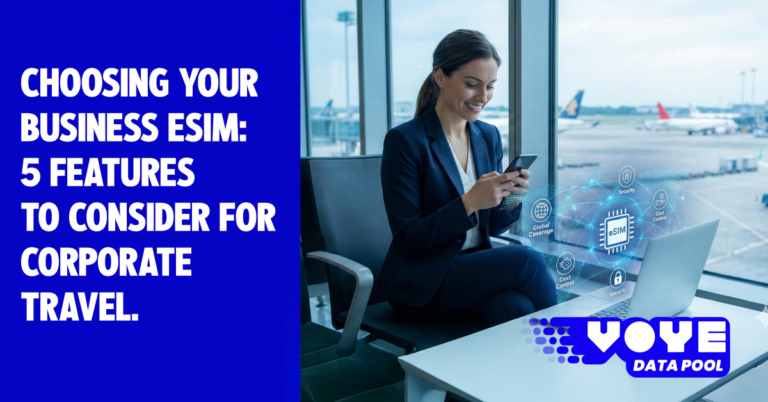
eSIM for Singapore Business Travel
An eSIM removes the need to handle a physical SIM card. The digital SIM profile can be installed on a compatible device before the trip and activated according to the plan requirements.
For business travellers, the main advantage is convenience.
There is no need to search for a local SIM shop immediately after landing. There is also less risk of misplacing a physical SIM removed from the phone.
A business-focused eSIM can help travellers stay connected for:
- Business email
- Microsoft Teams and Zoom calls
- WhatsApp and business messaging
- Google Maps
- Ride-hailing
- Cloud applications
- CRM platforms
- Digital boarding passes
- Travel booking apps
- Two-factor authentication
- Mobile hotspot use
For companies sending several employees to Singapore, a business connectivity solution can also make deployment and expense management easier.
Voye Data Pool provides a business-focused approach to mobile connectivity, helping companies manage travel connectivity without making each employee responsible for arranging a separate connection.
Where Business Travellers Spend Time in Singapore?
Singapore is compact, but choosing the right area can still save valuable time.
1. Marina Bay
Marina Bay is one of Singapore’s best-known business and conference areas. It is close to major hotels, corporate offices, restaurants and event venues.
It can be a convenient choice for travellers attending conferences or meeting clients in the central area.
2. Raffles Place
Raffles Place sits at the heart of Singapore’s financial district. Banks, financial services firms, professional services companies and corporate offices are concentrated around this area.
Travellers with several financial-sector meetings may find accommodation nearby useful.
3. Shenton Way and Tanjong Pagar
These areas combine offices, hotels, restaurants and transport connections. They can work well for travellers who want access to the CBD without staying directly in the busiest part of the financial district.
4. One-North
One-North is associated with technology, research, innovation and knowledge-based businesses. It can be a useful location for technology companies, startups and research-focused meetings.
5. Changi Business Park
Changi Business Park is closer to the airport and hosts offices from several industries. It can be practical for travellers whose meetings are concentrated in the eastern part of Singapore.
Getting Around Singapore for Business Meetings
Singapore is known for efficient urban transport. The MRT is useful for many journeys, while taxis and ride-hailing services provide flexibility when schedules are tight.
For a business traveller, the best transport option depends on the itinerary.
If several meetings are close to MRT stations, public transport can be efficient. For meetings across different districts, a taxi or ride-hailing service may save time.
The key is to build some buffer into the schedule.
A meeting that ends at 4:30 p.m. does not necessarily mean the next meeting should begin at 5:00 p.m. Allow time for walking, traffic, finding the correct building, and unexpected delays.
Reliable mobile data makes this easier because travellers can check directions, monitor traffic and communicate with colleagues while moving.
Simplify Business Travel Connectivity
Keep travelling teams connected with flexible business eSIM solutions.
Business Etiquette in Singapore
Singapore has a multicultural business environment, so professionalism and respect are important.
English is widely used in business settings. Business discussions are generally direct and professional. Business cards remain relevant, although digital alternatives are also becoming more common. The U.S. Department of Commerce notes that business cards are traditionally exchanged at the beginning of business and social meetings.
A few simple practices can help:
- Be punctual for meetings.
- Use professional and respectful language.
- Avoid rushing introductions.
- Listen carefully before making assumptions.
- Dress appropriately for the company and meeting.
- Carry business cards if they are commonly used in your industry.
- Follow up after important meetings.
Singapore’s tropical climate also deserves attention. The U.S. Department of Commerce notes that temperatures are warm throughout the year, with high humidity and frequent rain showers. Indoor offices, restaurants and taxis are generally air-conditioned.
A lightweight business wardrobe and a compact umbrella can be useful additions to a travel bag.
How to Stay Productive Between Meetings?
A business trip does not stop when a meeting ends.
Travellers often need to answer messages, review presentations, update CRM records or prepare for the next appointment while sitting in a café, airport lounge, or taxi.
This is where dependable connectivity becomes a productivity tool rather than simply a travel convenience.
A simple setup can help:
- Before departure: Install and test the eSIM.
- Before landing: Make sure the device can use mobile data and that important apps are accessible.
- During meetings: Keep documents available through cloud storage or offline access.
- Between meetings: Use mobile data for navigation, communication and urgent work.
- At the hotel: Switch to trusted Wi-Fi when appropriate and keep mobile data available as a backup.
This approach gives business travellers more control over where and when they work.
How Companies Can Simplify Business Travel Connectivity?
Managing connectivity becomes harder when several employees travel to different countries.
One employee may buy a local SIM. Another may use expensive roaming. Someone else may rely on hotel Wi-Fi. Finance teams then receive different expenses from the same trip.
A centralised business connectivity model can reduce that complexity.
With a solution such as Voye Data Pool, companies can approach employee connectivity as part of their wider travel programme instead of treating every trip as a separate task.
This can help businesses create a more consistent process for travelling employees.
The benefits can include:
- Easier connectivity deployment
- More predictable travel expenses
- Less dependence on airport SIM purchases
- Consistent connectivity for travelling teams
- Better visibility for business travel management
- A simpler experience for employees
For companies with employees travelling across multiple Asian markets, a consistent connectivity strategy can be even more valuable.
A Practical Singapore Business Travel Checklist
Before travelling to Singapore for work, check these essentials:
1. Confirm travel documents
Check passport validity, entry requirements and any documentation required for your nationality and travel purpose. Requirements can change, so use official Singapore government sources before departure.
2. Prepare mobile connectivity
Install your eSIM before travelling if your device supports eSIM technology. Test the setup before leaving.
3. Save important addresses
Keep hotel, office, conference and client locations available offline or in an easy-to-access format.
4. Plan transport
Check the route between meetings before the day begins. Singapore is efficient, but a packed itinerary still needs time buffers.
5. Prepare for the weather
Singapore is hot and humid throughout the year. Rain can also appear quickly, so pack accordingly.
6. Keep work documents accessible
Make sure presentations, contracts, proposals and other essential files are available from your phone or laptop.
7. Protect business information
Avoid connecting to unknown public networks when handling sensitive business information. Use trusted connections and follow your company’s security policies.
Singapore Business Travel in 2026: What Business Travellers Should Expect
Singapore’s role as an Asian business hub continues to evolve.
Technology and AI are becoming increasingly important to the country’s business ecosystem. Singapore’s EDB describes the country as one of the world’s AI-ready economies and the leading Asian location for ICT infrastructure. Several global companies have also established AI-focused hubs in Singapore.
At the same time, companies continue to use Singapore as a base for regional operations. In 2025, EDB secured S$8.9 billion in Total Business Expenditure commitments and S$14.2 billion in Fixed Asset Investment commitments, showing continued investment across headquarters, services, R&D and manufacturing.
For travellers, this means Singapore is not simply a place to attend a meeting. It is increasingly a place where companies build partnerships, launch products, manage regional operations and develop new technology.
That makes dependable connectivity even more important.
Final Thoughts: Stay Connected While Doing Business in Singapore
Singapore brings together many of the qualities that business travellers need: international access, efficient infrastructure, a strong corporate ecosystem and a central position in Asia.
But a successful business trip depends on more than reaching the right office at the right time.
You need to stay reachable when plans change. You need access to maps when moving between meetings. You may need to join a call from a hotel lobby or send a presentation while travelling across the city.
Keep Your Team Connected in Asia
Activate, manage, and scale eSIMs with ease.
Reliable connectivity gives you the flexibility to do all of that without depending on a single Wi-Fi network.
For businesses managing frequent international travel, Voye Data Pool can provide a simpler way to approach mobile connectivity for travelling employees.
When the destination is one of Asia’s busiest business hubs, staying connected should be part of the travel plan from the beginning.