

Roaming in the UK: Avoiding High Fees
Roaming in UK can create unexpected costs for business travellers, especially when mobile data is used for meetings, navigation, email, and cloud apps. This guide explains how UK roaming works, why charges can increase, and practical ways to control connectivity costs. Learn how travel eSIMs, data management, Wi-Fi, and centralised business connectivity can help employees stay connected while travelling in the UK without relying on expensive or unpredictable roaming charges.


 10 min read
 Share
Share
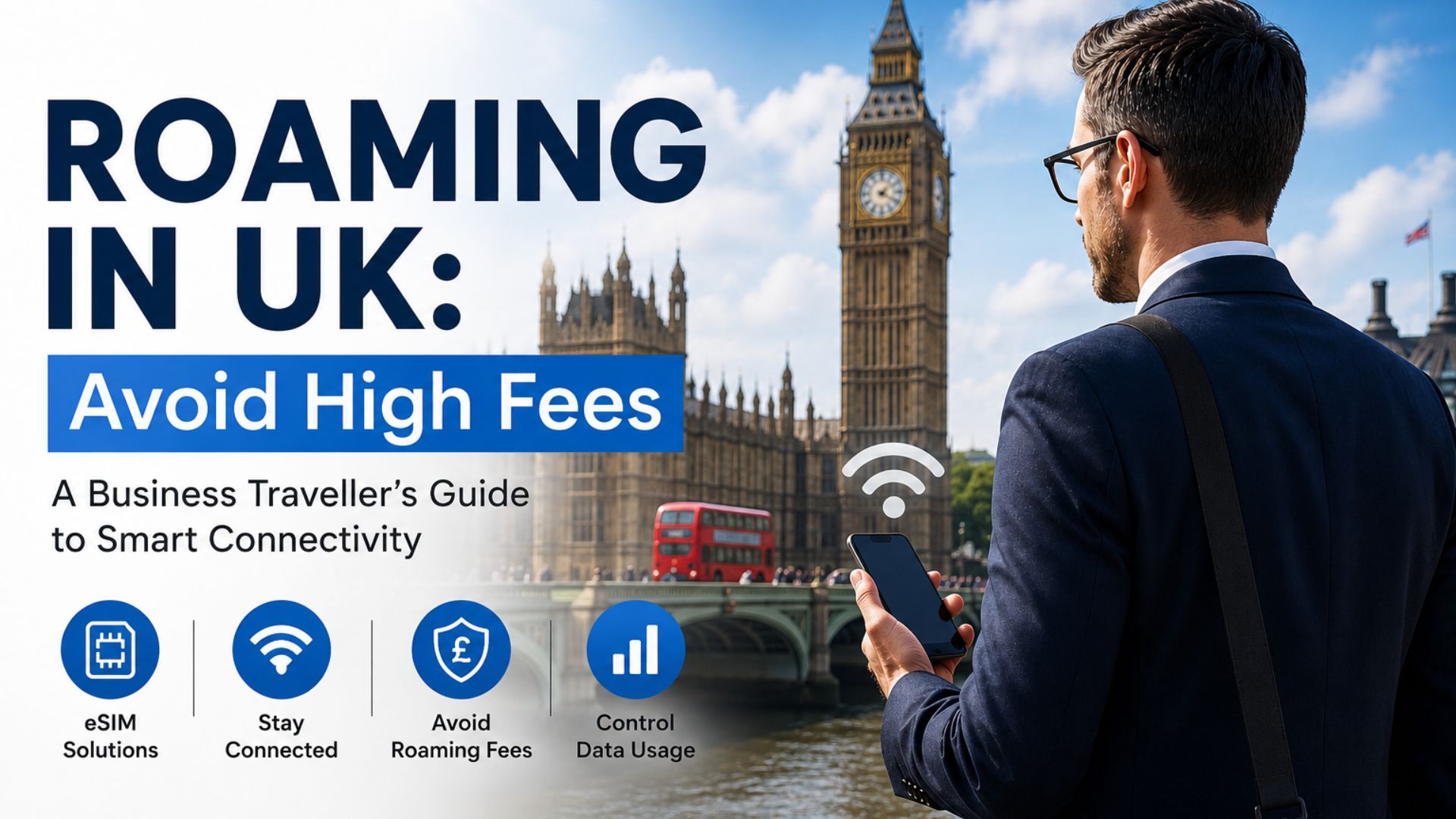
If you are travelling to Britain for meetings, conferences, client visits or short-term projects, roaming in UK can become an unexpected business expense. Your phone may connect to a UK network as soon as you land, and normal activities such as checking email, using Google Maps, joining Teams calls or sending files can consume mobile data quickly. The good news is that you do not have to rely on expensive roaming to stay connected. With the right plan, settings and connectivity strategy, business travellers can stay online while keeping mobile costs predictable.
For companies sending employees to the UK, connectivity should be treated as part of the travel plan-not something to solve after landing.

Avoid UK Roaming Fees
Stay connected without unexpected roaming costs.
What Is Roaming in the UK?
Roaming happens when your mobile phone uses a network outside the country where your mobile plan was issued.
For example, if an employee from the US, India, Australia or another country arrives in London with their home-country SIM, the device may connect to a UK mobile network through a roaming agreement.
The home carrier then charges according to its international roaming policy.
The important point is that the cost is determined mainly by your home mobile provider and plan, not simply by the fact that you are in the UK.
Some plans include UK roaming. Others charge a daily fee, apply a fixed travel pass, or bill data, calls and texts separately.
That makes checking your plan before departure essential.
Why UK Roaming Costs Can Become Expensive?
Business travellers use their phones differently from holiday travellers.
A typical workday may include:
- Checking email and downloading attachments
- Joining Microsoft Teams or Zoom meetings
- Using Google Maps and transport apps
- Accessing cloud documents
- Updating CRM systems
- Sending photographs and presentations
- Using a mobile hotspot for a laptop
- Messaging clients and colleagues
- Uploading files to cloud storage
A few minutes of casual browsing may use very little data. A video meeting, large file upload or hotspot session can consume much more.
This is why a roaming plan that looks sufficient on paper may become expensive during a busy business trip.
The real problem is unpredictability
Roaming becomes a business risk when employees do not know:
- How much data is included
- Whether the UK is covered
- What happens after the allowance is used
- Whether calls and texts are included
- Whether hotspot use is allowed
- Whether the plan has a fair-use policy
- When a daily roaming fee is triggered
Ofcom has previously found significant gaps in consumer understanding of roaming charges. Its research found that 19% of UK mobile customers who had travelled outside the UK or intended to do so did not know whether they would be charged when travelling in the EU/EEA; the figure was 30% for travel elsewhere in the world.
For businesses, that uncertainty can multiply across an entire travelling team.
Is Roaming in the UK Free?
It can be, but you should never assume it is. The cost depends on your home-country carrier, tariff and destination.
The UK’s relationship with EU roaming also changed after Brexit. UK customers travelling into the EU are no longer guaranteed surcharge-free roaming under EU rules, and operators can set their own commercial policies.
For an international visitor travelling to the UK, the important question is different:
Does your mobile provider include the UK in your roaming allowance?
Some international plans include the UK at no additional cost. Others may charge daily roaming fees or apply separate data rates.
Before travelling, check the provider’s current UK roaming terms rather than relying on what was included in an older plan.
7 Ways to Avoid High Roaming Fees in the UK
1. Check Your Roaming Policy Before You Fly
Do this before leaving home-not after your phone connects to a UK network.
Check:
- UK coverage
- Included data
- Call and text charges
- Daily or weekly roaming passes
- Fair-use limits
- Hotspot restrictions
- Out-of-bundle rates
- Data spending limits
Take a screenshot or save the terms on your phone so you can refer to them offline.
For business travellers, this simple step can prevent an avoidable expense.
2. Turn Off Data Roaming on Your Primary SIM
If you plan to use an eSIM or another data connection in the UK, disable data roaming on your home SIM.
This prevents your phone from accidentally using the expensive connection.
On a dual-SIM phone, you can keep your normal SIM active for calls or SMS while selecting the travel eSIM as the mobile-data line.
Apple also recommends checking international roaming options with your network provider before travelling.
3. Use Wi-Fi Strategically
Hotel, office and conference Wi-Fi can reduce mobile data consumption.
However, business travellers should not treat public Wi-Fi as their only connectivity option.
You may need mobile data when:
- Travelling between meetings
- Using maps
- Calling a rideshare
- Checking transport information
- Working from a café
- Joining a meeting outside the office
- Responding to an urgent client request
A good approach is to use trusted Wi-Fi when appropriate while keeping a dedicated mobile connection available for essential work.
4. Consider a UK Travel eSIM
An eSIM can provide a second mobile connection without requiring a physical SIM card.
For a business traveller, this can be useful because the travel data plan can handle internet access while the primary SIM remains available for calls and messages, depending on the device and carrier.
A UK-focused eSIM can offer:
- Prepaid data
- Clear usage limits
- Digital activation
- No physical SIM swapping
- Mobile hotspot capability on supported plans
- Connectivity shortly after arrival
The key benefit is cost predictability.
Instead of allowing your primary carrier to bill every megabyte according to international roaming rates, you can use a dedicated travel data plan with a known allowance.
eSIM vs Traditional Roaming for Business Travel
| Factor | Traditional Roaming | Travel eSIM |
| Setup | Usually automatic | Set up before or during travel |
| Cost control | Depends on carrier | Usually easier to budget |
| Physical SIM | Not required | Not required |
| Data allowance | Depends on home plan | Selected travel plan |
| Multiple countries | Depends on carrier | Depends on eSIM coverage |
| Business management | Often limited | Can be centrally managed with enterprise solutions |
| Risk of unexpected charges | Higher if settings are unmanaged | Lower when configured correctly |
An eSIM is not automatically cheaper in every situation. If your existing mobile plan already includes generous UK roaming, changing plans may not make sense.
The goal is to compare total expected usage and cost, not simply choose the newest technology.
Simplify Business Connectivity
Manage business eSIMs from one platform.
5. Download Maps and Work Files Before Travelling
Reducing unnecessary mobile data use is another easy way to control costs.
Before your flight, download:
- Offline Google Maps
- Important presentations
- Meeting documents
- Travel confirmations
- Hotel information
- Train or transport information
- Frequently used files
You can also disable automatic app updates and cloud photo backups over mobile data.
These small changes can help preserve your travel data allowance for work that actually needs a live connection.
6. Monitor Hotspot and Video Calls
Hotspot use deserves special attention.
Connecting a laptop to your phone can cause background applications to consume data without you noticing. Cloud storage, software updates, email synchronisation and browser activity can all run in the background.
Video meetings can also consume significantly more data than basic messaging.
For important meetings, use reliable office or hotel Wi-Fi when available. When travelling between locations, use your mobile connection as a controlled backup rather than leaving a laptop connected continuously.
7. Give Employees a Clear Connectivity Policy
For companies, preventing roaming fees should not depend on every employee remembering the right phone settings.
A simple travel connectivity policy can specify:
- Which eSIM or roaming plan employees should use.
- When data roaming must be disabled.
- Which apps can use mobile data.
- Whether hotspot use is allowed.
- How much data is available per trip.
- Who employees should contact if connectivity fails.
- How usage is monitored.
This turns mobile connectivity from an employee-by-employee problem into a managed business process.
Why Business Travellers Need More Than Hotel Wi-Fi?
Hotel Wi-Fi is useful, but it cannot cover every part of a business trip. Imagine an executive travelling from London Heathrow to a client meeting in Manchester.
They may need mobile data to:
- Navigate from the airport
- Contact the client
- Book transport
- Join a last-minute call
- Access a presentation
- Check a changing itinerary
Waiting until the traveller reaches the hotel is not practical.
Reliable mobile connectivity provides a layer of independence that Wi-Fi cannot.
It also reduces the temptation to connect to unknown public networks simply because there is no other option.
How Voye Data Pool Helps Businesses Control UK Travel Connectivity?
For companies with employees travelling regularly, buying separate roaming plans for every traveller can become difficult to manage.
Voye Data Pool provides a business-focused eSIM platform designed to simplify global connectivity.
The platform supports connectivity across more than 130 countries and gives businesses centralised control over employee and device connections. Companies can provision eSIMs remotely, monitor usage and manage connectivity from a central dashboard.
Instead of treating every business trip as a separate telecom purchase, organisations can build a more consistent connectivity process.
1. Centralised eSIM management
IT or travel teams can manage employee connectivity from one platform rather than relying on multiple individual carrier accounts.
2. Shared data management
Voye Data Pool uses a shared data model that can better match the way business teams actually travel. Employees do not all consume the same amount of data, so a pooled approach can reduce the waste created by rigid individual allowances.
3. Real-time usage visibility
Businesses can monitor usage and identify unusually high consumption before it becomes a larger cost issue.
4. Remote provisioning
Employees do not need to wait for a physical SIM to arrive before travelling. eSIM connectivity can be provisioned remotely on compatible devices.
5. Support for global teams
A UK trip may be followed by meetings in France, Germany, the UAE or the US. A global connectivity platform can simplify management when employees regularly cross borders.
This matters even more in 2026, when business travel depends heavily on cloud applications, video communication and always-available mobile access.
A Simple UK Roaming Checklist for Business Travellers
Before travelling to the UK:
- Check whether your current plan includes UK roaming.
- Confirm the data allowance and out-of-bundle rates.
- Check whether hotspot use is permitted.
- Download important work files.
- Download offline maps.
- Decide whether a travel eSIM makes financial sense.
- Install and configure the eSIM before departure if possible.
- Disable data roaming on the primary SIM when using the travel connection.
- Confirm which SIM is selected for mobile data.
- Keep your company’s connectivity support details available.
When you arrive:
- Confirm the correct data SIM is active.
- Check that data roaming is disabled on the primary line if required.
- Test mobile data before leaving the airport.
- Monitor usage during the first day.
- Use trusted Wi-Fi for large downloads and long video meetings where practical.
Final Takeaway: Make UK Connectivity Predictable
Roaming in UK does not have to become an expensive surprise on a business trip. The first step is understanding what your current mobile plan covers. The second is controlling which connection your phone uses. The third is choosing a predictable alternative when traditional roaming does not provide good value.
Stay Connected Across the UK
Reliable eSIM connectivity for business travel.
For occasional travellers, a suitable roaming pass may be enough. For employees who travel frequently, a dedicated eSIM can offer better control. For organisations managing multiple travellers across different countries, centralised eSIM management can simplify provisioning, usage monitoring and cost control. With the right strategy, business travellers can land in the UK ready to work-without waiting for Wi-Fi or worrying about an unexpected mobile bill.