

Internet Access in the Schengen Area: One Plan for All
Schengen area internet makes it easier for business travellers to stay connected across multiple European destinations. A regional eSIM can provide mobile data without requiring travellers to purchase or switch physical SIM cards in each country. This guide explains how internet access works across the Schengen Area, the difference between Schengen and EU roaming, data needs for business trips, and what to check before choosing a connectivity plan for multi-country travel in 2026.


 10 min read
 Share
Share
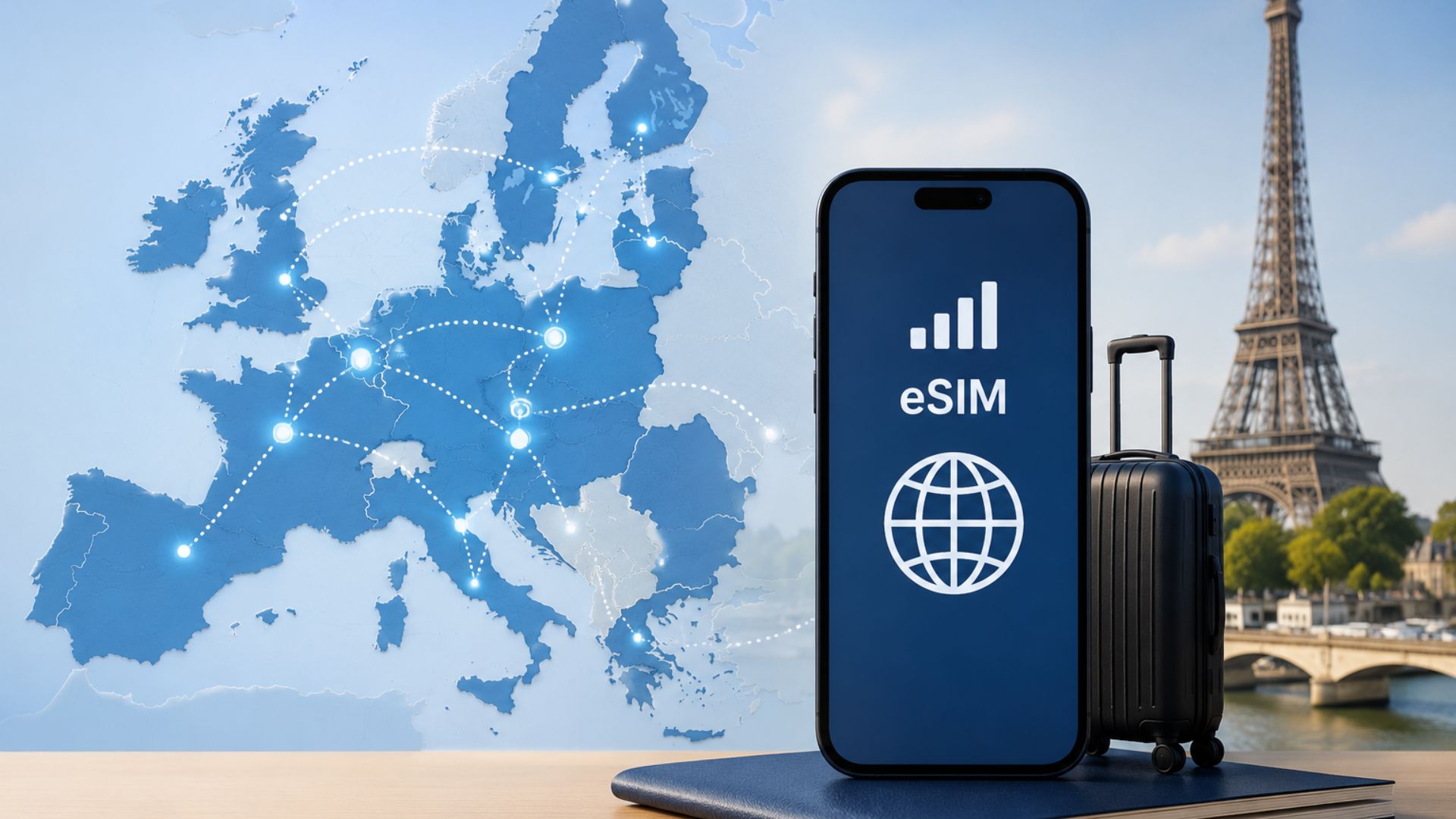
Schengen area internet is easier to manage when business travellers use one regional connectivity plan instead of arranging mobile data for every country on the itinerary. A single eSIM can keep employees online as they move between France, Germany, Italy, Spain, the Netherlands, and other European destinations. For companies managing frequent international travel, this approach reduces setup work and gives travellers a simpler way to stay connected.
What Is Schengen Area Internet?
Schengen area internet refers to mobile data access while travelling across countries within the Schengen Area. The Schengen Area currently includes 29 countries, including all 27 EU member states except Cyprus, plus Iceland, Liechtenstein, Norway and Switzerland. Bulgaria and Romania became full Schengen members on 1 January 2025.
However, there is an important distinction between Schengen borders and mobile connectivity.
Schengen is mainly about movement between participating countries. It does not create one universal mobile network or one mandatory internet plan.
Your ability to use mobile data depends on your mobile operator or eSIM provider and the countries included in your plan.

Stay Connected Across Schengen Europe
Reliable connectivity for multi-country business travel.
For business travellers, this distinction matters. A trip may include several Schengen countries in a few days. Changing SIMs or buying separate data plans for every destination can create unnecessary work.
A regional eSIM can solve that problem by providing one digital connectivity setup for multiple destinations.
Why Business Travellers Need a Better Connectivity Plan?
Business travel rarely follows a simple one-country itinerary.
An employee might fly from New York to Paris, take a train to Brussels, continue to Amsterdam and then travel to Berlin for a client meeting. Another employee may visit Milan, Zurich and Munich during the same week.
Every stop can create another connectivity decision.
Without a regional plan, travellers may need to:
- Purchase local SIM cards
- Compare roaming charges
- Find airport SIM shops
- Activate new data plans
- Swap physical SIM cards
- Track different data allowances
- Troubleshoot connectivity after crossing a border
These small tasks add friction to an already busy trip.
A business-focused eSIM changes the process. The employee can install the eSIM before departure and use the same connectivity setup across supported destinations.
For companies, the benefit goes beyond convenience. A centralised connectivity solution can also make it easier to manage employees, monitor usage and control business travel costs.
One eSIM for Multiple Schengen Countries
The biggest advantage of a regional eSIM is simple: one setup can cover multiple destinations.
Instead of purchasing a France plan for one meeting and a Germany plan for the next, a traveller can use a regional plan that supports both countries.
The same principle can apply to an itinerary such as:
Paris → Brussels → Amsterdam → Berlin → Munich → Milan
The traveller does not need to treat every border as a new connectivity problem.
Voye Data Pool is designed for this type of business travel. Employees install their eSIM before travelling, then connect to available local networks when they arrive at their destination. Companies can manage users, assign eSIMs, set usage policies and monitor connectivity from a central platform.
That makes the setup useful for companies with employees travelling across several countries rather than teams making occasional single-destination trips.
Schengen Area vs EU Roaming: What Is the Difference?
This is one of the most important things to understand before choosing a connectivity plan.
Schengen Area membership does not automatically mean free mobile roaming for every traveller.
The EU’s Roam Like at Home rules allow eligible mobile customers to use calls, texts and mobile data in other EU countries without additional roaming charges, subject to the applicable rules and fair-use limits. The regime also covers Iceland, Liechtenstein and Norway. Since 1 January 2026, Ukraine and Moldova have also been included.
The United Kingdom is not covered by the EU’s Roam Like at Home rules, although some operators voluntarily offer similar benefits.
This matters for international business travellers because an employee’s home mobile plan may not receive the same roaming benefits as an EU or EEA subscriber.
For example, a traveller arriving in Europe from the United States, India or another country outside the EU/EEA should check the roaming terms of their home carrier before relying on their existing SIM.
A business eSIM can provide another option.
Why an eSIM Makes Sense for Business Travel?
An eSIM is a digital SIM profile built into compatible smartphones and other supported devices. It removes the need to insert a physical SIM card when changing connectivity plans.
For business travel, this can offer several practical advantages.
1. No Physical SIM Swapping
- Employees can keep their primary SIM in the phone while using the business eSIM for mobile data.
- That means the employee can avoid carrying several physical SIM cards or searching for a replacement after landing.
2. Connectivity Before the Trip
- The eSIM can be installed before departure.
- Employees can prepare their connectivity while they still have reliable Wi-Fi at home or in the office. This is useful when the first task after landing is a client call rather than finding a mobile shop.
3. Easier Multi-Country Travel
- A regional plan can support several countries under one setup.
- This is particularly useful for consultants, sales teams, executives, project managers and other employees who move between European markets.
4. Better Visibility for Companies
- Business connectivity should not be managed like a personal travel expense.
- Voye Data Pool provides a central dashboard for managing employees, eSIMs, usage and costs. Its business plans are built for organisations that need centralised control over mobile connectivity.
5. Less Travel Administration
- Travel teams do not have to arrange a new SIM every time an employee visits another country.
- A repeatable eSIM process can make connectivity part of the standard travel workflow.
How Voye Data Pool Supports Schengen Business Travel?
Voye Data Pool gives businesses a central way to manage mobile connectivity for travelling employees.
The process is straightforward:
1. Choose a business plan
Select a plan based on the company’s expected connectivity needs.
2. Add travelling employees
Create or upload the users who need connectivity.
3. Assign eSIMs
Allocate eSIMs to compatible employee devices.
4. Set usage policies
Define data allowances and connectivity rules based on business needs.
5. Monitor usage and costs
Track employee usage from one central dashboard.
Voye Data Pool currently supports connectivity across 130+ countries, making it suitable for companies whose travel programmes extend beyond Europe as well.
This wider coverage can be useful for companies with employees travelling from Europe to North America, Asia-Pacific or other global markets.
Simplify European Business Travel
Stay connected across supported European destinations.
How Much Data Does a Business Traveller Need?
There is no single data amount that works for every employee.
The right allowance depends on how the employee uses mobile data.
| Business activity | Typical data requirement |
| Email and messaging | Low |
| Maps and navigation | Low to moderate |
| CRM and cloud apps | Moderate |
| Video calls | Moderate to high |
| File uploads and downloads | High |
| Hotspot for laptop work | High |
| Frequent video meetings | High |
A sales employee who mainly uses email, maps and messaging may need far less data than a consultant who spends hours on video calls.
For companies, it can be more efficient to assign different data policies to different user groups instead of giving every employee the same allowance.
A Practical Schengen Business Trip Example
Consider a sales manager travelling from the United States for a seven-day European business trip.
The itinerary is:
Day 1–2: Paris, France
Day 3: Brussels, Belgium
Day 4: Amsterdam, Netherlands
Day 5–6: Berlin, Germany
Day 7: Munich, Germany
The employee needs mobile data for:
- Client calls
- Microsoft Teams or Zoom
- Google Maps
- CRM access
- Travel bookings
- Messaging
- Laptop hotspot access
With a country-by-country approach, connectivity becomes another item to manage at every destination.
With a supported regional eSIM, the employee can use one connectivity setup across the itinerary.
That is the core value of one plan for all.
Is Schengen Area Internet Always the Same Everywhere?
No.
A regional eSIM does not mean every location will have identical network performance.
Speed and coverage can vary based on:
- Local network availability
- Indoor coverage
- Rural or mountainous terrain
- Network congestion
- Device compatibility
- Local carrier infrastructure
- The eSIM provider’s network agreements
Even EU roaming rules recognise that network quality may vary between locations because of local infrastructure and geography.
For business users, the goal should be reliable access rather than assuming every location will deliver identical speeds.
Major cities and business centres generally have strong mobile infrastructure, but travellers should still check the exact country coverage offered by their connectivity provider.
What to Check Before Choosing a Schengen Connectivity Plan
Before purchasing a plan, business travellers and travel managers should check five key areas.
1. Country Coverage
- Do not rely only on the phrase “Europe coverage.”
- Check the actual list of supported countries.
- A Europe plan may include countries outside Schengen, while some destinations on a wider European itinerary may have different coverage conditions.
2. Data Allowance
- Estimate how much data employees use for work.
- Video conferencing and laptop hotspot use can consume much more data than email and messaging.
3. Validity
- Match the plan duration with the expected trip length.
- Frequent travellers may also benefit from a longer business subscription instead of arranging connectivity separately for every journey.
4. Hotspot Support
- If employees need to connect laptops or tablets, confirm whether hotspot or tethering is supported.
5. Business Management
- For corporate travel, consider more than the price of data.
Look for features such as:
- Centralised eSIM management
- Usage monitoring
- Employee management
- Data controls
- Cost visibility
- Bulk deployment
- Business support
These features can matter more than saving a small amount on an individual travel plan.
Schengen Internet in 2026: What Business Travellers Should Know
In 2026, European business travel is increasingly digital. Employees depend on cloud platforms, video meetings, mobile authentication, navigation and real-time communication throughout their trips.
Connectivity is therefore part of business continuity.
The European Commission also states that the EU’s Roam Like at Home rules have been extended until 2032, while the roaming area was expanded to Ukraine and Moldova from 1 January 2026.
Still, companies should not assume that every employee’s home mobile plan provides the same roaming benefits.
A managed eSIM gives businesses another way to create a consistent connectivity process for international teams.
Common Mistakes When Planning Schengen Internet
- Buying a SIM at Every Airport :
Airport SIMs may solve an immediate problem, but they are not ideal for employees visiting several countries.
- Assuming Schengen Means Free Roaming
Schengen controls border movement. It does not guarantee free mobile roaming for every traveller.
- Ignoring Non-Schengen Stops
European business itineraries can include destinations outside the Schengen Area. Check the complete itinerary rather than focusing on one region.
- Giving Every Employee the Same Data Allowance
Different roles have different connectivity needs. A field sales employee may use more data than an executive who mainly uses email.
- Waiting Until Arrival
Installing and testing connectivity before departure reduces the risk of starting a business trip without working mobile data.
One Plan. Multiple Countries. Less Connectivity Hassle.
Business travel should focus on meetings, customers and results-not finding a SIM card after every border crossing.
A regional eSIM can simplify internet access across supported Schengen destinations by giving travelling employees one connectivity setup for multi-country trips.
For companies, the bigger opportunity is central management.
With Voye Data Pool, businesses can manage employee eSIMs, control usage and monitor connectivity through one platform. That makes it easier to build a repeatable travel connectivity process instead of managing every trip as a separate task.
One Plan for Multiple Countries
Simplify internet access across your European itinerary.
For organisations with teams moving across Europe and other international markets, one managed eSIM platform can turn business travel connectivity into a simple, scalable process.
Ready to simplify connectivity for travelling teams? Explore Voye Data Pool and build a business connectivity setup for your global workforce.