

Germany eSIM Data: Reliable Connectivity for EU Business
Germany eSIM data helps business travellers stay connected across Frankfurt, Berlin, Munich, Hamburg and other major commercial centres. With digital activation, flexible data plans and Europe-wide options, an eSIM can simplify connectivity for meetings, conferences, train journeys and remote work. This guide explains how much data business travellers may need, when an eSIM makes sense compared with roaming, what to check before purchase, and how Voye Data Pool helps businesses manage connectivity for travelling teams.


 11 min read
 Share
Share
Germany is one of Europe’s busiest destinations for business travel, with professionals moving between Frankfurt, Munich, Berlin, Hamburg, and other commercial centres for meetings, conferences, and trade events. Germany eSIM data gives business travellers a flexible way to stay online for email, navigation, messaging, video calls and cloud-based work without relying entirely on airport Wi-Fi or a physical SIM. For travellers crossing several European countries, the right eSIM can also make connectivity easier to manage throughout the trip.
Why Germany eSIM Data Matters for Business Travel?
A business trip rarely means staying in one place.
A typical itinerary may include an airport transfer in Frankfurt, a client meeting in Munich, a conference in Berlin, and a train journey to another city. Each part of the trip can depend on mobile data.
Business travellers may need connectivity to:
- Check email before a meeting
- Join Microsoft Teams or Zoom calls
- Access cloud documents and CRM platforms
- Use Google Maps or local transport apps
- Book taxis and hotels
- Share presentations and files
- Communicate with colleagues through Slack or WhatsApp
- Use mobile payment services
- Check flight and train updates
- Work from hotels, cafés or shared offices
Germany’s mobile infrastructure is also well developed. According to the German Federal Network Agency, around 95% of the country’s land area had 5G coverage by October 2025. Mobile broadband through 4G or 5G covered about 98% of the country.
That makes mobile connectivity a practical part of business travel rather than simply a convenience.
What Is Germany eSIM Data?
Germany eSIM data is mobile internet access delivered through an embedded SIM profile instead of a physical SIM card.
An eSIM can be installed digitally on a compatible smartphone. Once activated, the device can use the eSIM for mobile data while the traveller keeps their regular SIM available for calls, messages or verification codes.
For a business traveller, this setup can be useful because there is no need to remove the primary SIM.
The process is usually simple:
- Select a Germany or Europe eSIM data plan.
- Purchase the plan online.
- Install the eSIM before departure.
- Activate it when required.
- Set the eSIM as the preferred mobile-data line.
This approach can save time at the airport. It also means the traveller can arrive in Germany with a connectivity plan already prepared.

Stay Connected Across Germany
Reliable eSIM data for business travel in Germany.
Do You Need a Germany eSIM If You Are Travelling From Another EU Country?
Not always.
EU “Roam Like at Home” rules allow eligible mobile customers to use calls, texts and mobile data in other EU countries without additional roaming charges, subject to the terms and fair-use rules of their plan. Germany is included in the 27-country EU roaming area.
That changes the decision for EU-based business travellers.
If an employee already has sufficient EU roaming data, their existing mobile plan may be enough for a short Germany trip. A separate Germany eSIM can still be useful when the existing allowance is limited, when the employee needs additional business data or when the company wants a separate connectivity option.
The situation is different for many travellers arriving from outside the EU. Their domestic carrier may offer limited international roaming or charge higher rates for data abroad. In that case, a travel eSIM can provide a more predictable way to access mobile data.
The key question is not simply whether an eSIM is available. It is whether the traveller’s existing plan provides enough data, coverage and flexibility for the entire business trip.
How Much Germany eSIM Data Does a Business Traveller Need?
Data usage depends on how the phone is used during the trip.
A traveller who mainly checks email and messages will use far less data than someone who joins video meetings and shares a laptop connection.
Here is a practical guide:
| Business activity | Typical data requirement |
| Email and messaging | Low |
| Maps and navigation | Low to moderate |
| Web browsing | Moderate |
| Cloud documents | Moderate |
| Video meetings | Moderate to high |
| Frequent file uploads | High |
| Laptop hotspot | High |
| Streaming and large downloads | Very high |
For a short meeting trip, a smaller data allowance may be enough when hotel and office Wi-Fi are available.
A traveller with several video meetings each day should allow more headroom. Laptop tethering can increase consumption quickly, especially when cloud applications, software updates or large files are running in the background.
For that reason, business travellers should avoid choosing a plan based only on the number of travel days. Data usage matters just as much as trip duration.
Germany eSIM Data for Frankfurt Business Trips
Frankfurt is a particularly important example of why reliable mobile connectivity matters.
The city recorded 74,862 events and 7.92 million in-person attendees in 2025. Three-quarters of those events were business-related.
Professionals arriving for conferences and trade fairs may need mobile data from the moment they leave Frankfurt Airport.
Connectivity can support:
- Airport and rail navigation
- Event registration apps
- Digital tickets
- Business messaging
- Client communication
- Presentation access
- Ride-hailing
- Last-minute schedule changes
Large events can also create heavy demand for venue Wi-Fi. Having mobile data as a backup gives employees another way to stay connected when public networks become congested.
Staying Connected Across Berlin, Munich and Hamburg
Germany’s business ecosystem extends well beyond Frankfurt.
Berlin has a strong technology and startup scene. Munich is important for engineering, manufacturing and corporate business. Hamburg has major logistics, maritime and commercial activity. Düsseldorf is another key destination for trade fairs and industrial business.
A Germany eSIM can support employees moving between these cities without requiring a physical SIM change.
That matters when the schedule is tight.
Instead of finding a local mobile shop after landing, the employee can install the eSIM before the trip and manage the connection digitally.
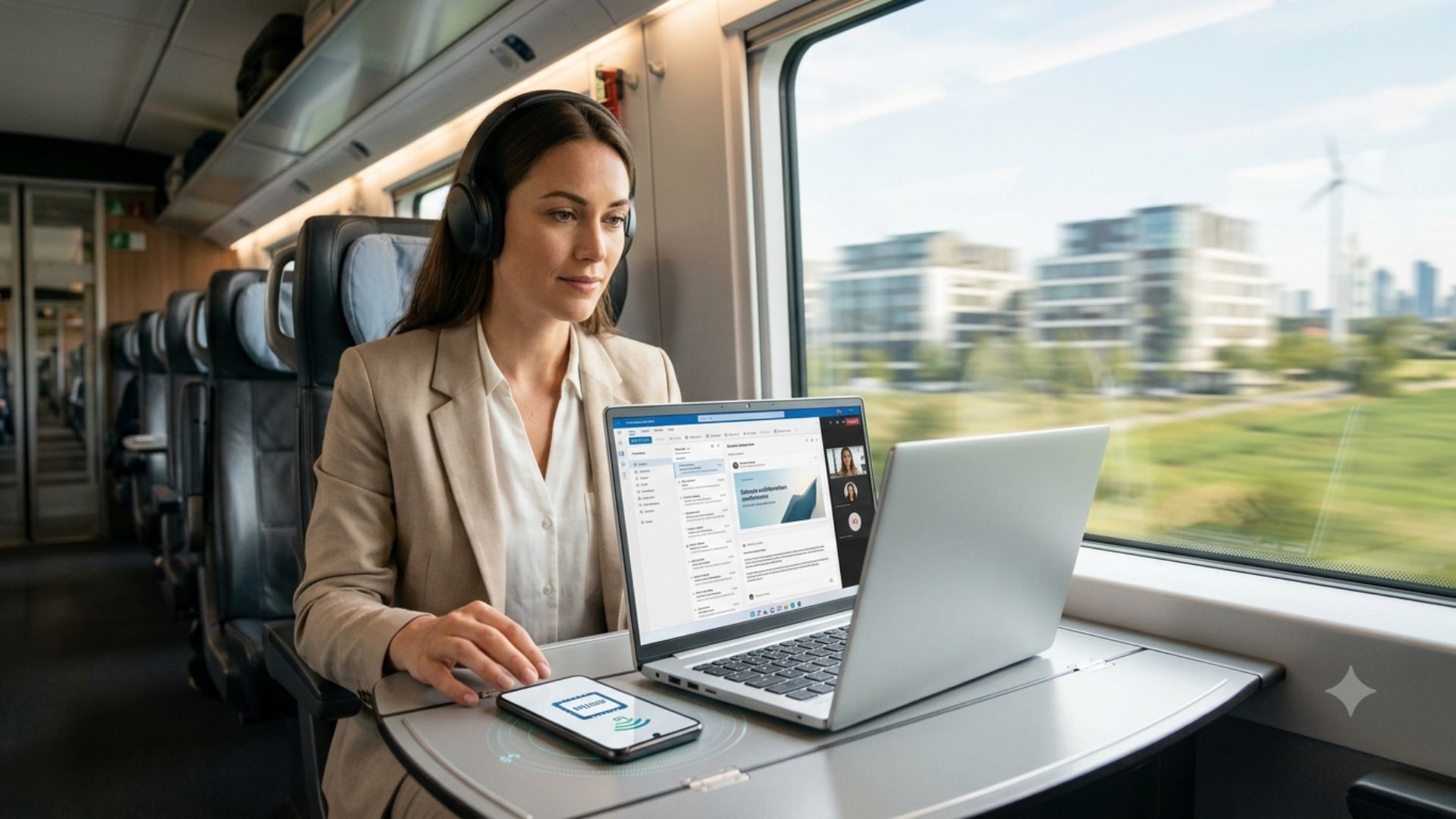
Germany eSIM Data for Train Travel
Business travellers in Germany often move between cities by rail.
That can mean working from a train while travelling between meetings.
Mobile data can help employees:
- Check train schedules
- Download meeting documents
- Respond to urgent emails
- Send messages to colleagues
- Join selected online meetings
- Update calendars
- Access cloud applications
Coverage can still vary by location. Rural areas, tunnels and some transport corridors may have weaker service than major city centres.
The Federal Network Agency also notes that mobile coverage varies between operators and that rural and structurally weaker areas can be more affected by gaps in 5G availability.
For employees travelling outside major cities, checking the network coverage supported by an eSIM provider is therefore important.
Germany eSIM Data for Multi-Country EU Business Trips
Germany is often only one stop on a European business itinerary.
An employee may fly into Frankfurt, travel to Amsterdam, attend a meeting in Paris and then continue to Milan.
Buying a separate SIM for every country creates unnecessary administration.
A regional Europe eSIM can be more convenient when the same trip includes multiple supported destinations. The traveller can use one digital setup instead of changing SIMs as the itinerary changes.
For businesses managing several employees, this becomes even more useful.
A centralised eSIM approach can reduce the need for employees to purchase local SIM cards themselves. It can also make connectivity easier to standardise across frequent business trips.
Germany eSIM Data vs International Roaming
International roaming is still useful for many travellers. It can be simple because the employee’s existing number and plan remain active.
However, roaming terms differ between carriers and plans.
Some travellers may have generous international allowances. Others may have daily limits, fair-use restrictions or additional charges.
An eSIM provides another option.
| Factor | Traditional international roaming | Germany eSIM data |
| Physical SIM required | No | No |
| Keep primary SIM | Yes | Yes |
| Separate data allowance | Usually no | Often yes |
| Prepaid cost control | Depends on carrier | Usually easier to plan |
| Multi-country option | Depends on carrier | Available with regional plans |
| Installation | Already active | Digital setup required |
| Business data separation | Limited | More flexible |
The best choice depends on the employee’s existing mobile contract.
For eligible EU travellers, domestic roaming rights may already provide good value. For international travellers or employees with restrictive roaming allowances, an eSIM can offer a practical alternative.
Simplify Business Travel Connectivity
Flexible eSIM connectivity for travelling teams.
Why Business Travellers Should Consider Voye Data Pool?
Business connectivity becomes more complicated when a company has employees travelling to different countries.
One employee may travel to Germany. Another may visit France. A third may move between several European markets during the same week.
Managing connectivity separately for every traveller can create extra work.
Voye Data Pool is designed to simplify business connectivity with a centralised eSIM approach for travelling teams.
Businesses can use a single system to manage global connectivity while reducing the manual work associated with traditional SIM deployment.
For companies with frequent international travel, this can help create a more consistent employee experience.
Instead of asking every traveller to research local SIM options, the organisation can establish a standard connectivity process before employees leave.
What to Check Before Buying Germany eSIM Data?
Not every Germany eSIM is equally suitable for business use.
Before selecting a plan, check these factors:
1. Network coverage
Look at which German networks the provider supports. Coverage can vary by location, so network access matters more than the brand printed on the eSIM.
2. Data allowance
Estimate how much data the employee will need for meetings, maps, email and work applications.
3. Hotspot support
Laptop tethering can be important when travelling between meetings. Confirm that hotspot use is supported before relying on it.
4. Validity period
A 7-day plan may work for a short conference. Longer projects may require a 15-day or 30-day option.
5. Europe coverage
If Germany is only one stop on the itinerary, compare a Germany-only plan with a regional Europe option.
6. Activation process
An employee should be able to install and activate the eSIM without visiting a physical store.
7. Device compatibility
The smartphone must support eSIM functionality and should be network-unlocked where required.
8. Business management
For company travel, consider whether the provider can support multiple employees and centralised connectivity management.
How to Prepare a Germany eSIM Before Departure?
Setting up connectivity before leaving home reduces pressure after landing.
Start by checking whether the employee’s smartphone supports eSIM. Install the eSIM while connected to reliable Wi-Fi.
Keep the primary SIM active if it is needed for calls, SMS or authentication.
Next, set the travel eSIM as the preferred mobile-data line. Data roaming should normally be enabled for the travel eSIM when the provider requires it, while the primary SIM’s data roaming should be managed carefully to avoid unintended charges.
A quick test before departure can also prevent problems at the airport.
Germany eSIM Data: Best Practices for Business Travellers in 2026
Business travel in 2026 is increasingly dependent on cloud services and mobile applications.
A few simple habits can make mobile data more reliable:
- Download important documents before travelling.
- Save offline maps for longer journeys.
- Turn off automatic app updates over mobile data.
- Disable unnecessary cloud backups while roaming.
- Use hotel or office Wi-Fi for large downloads.
- Keep a backup communication method for critical meetings.
- Monitor data usage during the trip.
- Carry a charging bank for long travel days.
- Test the eSIM before the first important meeting.
These steps can reduce unnecessary data consumption and help employees stay productive.
Is Germany eSIM Data Worth It for Business Travel?
For many business travellers, the answer depends on the existing mobile plan.
An EU traveller with generous roaming may not need a separate Germany eSIM for a short trip. Someone travelling from outside the EU may find an eSIM much more useful, particularly when international roaming is expensive or limited.
The value becomes clearer when an employee needs predictable mobile data, easy digital activation, hotspot access or connectivity across several countries.
Germany also has strong mobile infrastructure, with around 95% of its land area covered by 5G as of October 2025.
For a business trip, reliable connectivity can support much more than browsing. It can keep meetings moving, help employees navigate unfamiliar cities and provide access to the systems they need to work.
Final Takeaway
Germany eSIM data can be a practical connectivity option for professionals travelling for meetings, conferences, trade fairs and client visits.
The right choice starts with the itinerary.
Check the existing roaming allowance, estimate actual data usage, review network coverage and decide whether Germany-only or Europe-wide connectivity makes more sense. For EU travellers, existing Roam Like at Home benefits may already cover many short trips. For international travellers and companies managing mobile teams, a dedicated eSIM solution can provide greater flexibility.
With Voye Data Pool, businesses can take a more organised approach to employee connectivity and reduce the manual effort involved in managing international data access.
For business travellers heading to Germany in 2026, the goal is simple: spend less time worrying about connectivity and more time getting business done.
Stay Connected Across Europe
One eSIM for business travel across Europe.