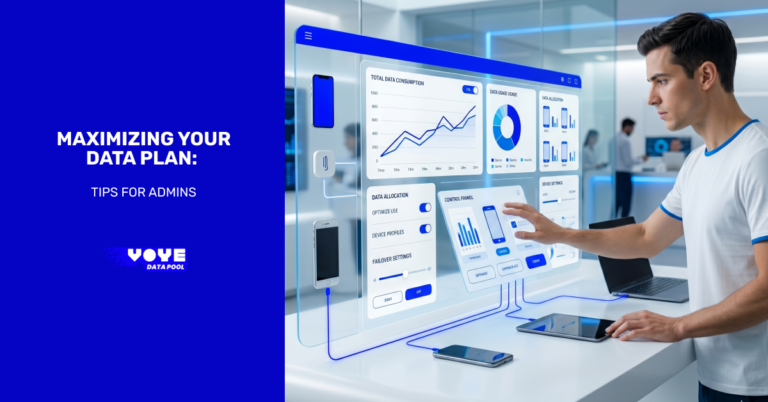


Setting Data Limits Without Stifling Productivity
Setting data limits is essential for organizations looking to balance connectivity costs with employee productivity. This guide explores how IT and administrative teams can create effective data management policies that improve visibility, support hybrid work, encourage responsible usage, and optimize operational efficiency. Learn practical strategies for managing mobile data consumption without disrupting workflows, reducing collaboration, or limiting access to the business-critical tools employees rely on every day.


 8 min read
 Share
Share

Modern organizations depend on connectivity more than ever before. Employees work across offices, homes, customer sites, and international locations while relying on cloud applications, collaboration platforms, and business-critical tools. For IT and administrative teams, managing mobile data usage has become an important responsibility that directly affects operational efficiency, employee experience, and overall business costs.
At the same time, controlling connectivity expenses can be challenging. Organizations often struggle to find the right balance between reducing unnecessary consumption and ensuring employees have uninterrupted access to the resources they need. While limiting usage may appear to be a straightforward solution, overly restrictive policies can negatively impact productivity, collaboration, and employee satisfaction. The most successful organizations focus on smart data governance rather than strict limitations.
Why Mobile Data Management Matters More Than Ever?
As businesses continue to embrace hybrid work models, digital transformation initiatives, and cloud-based workflows, mobile connectivity has evolved from a convenience into a business necessity. Employees increasingly rely on video conferencing, document-sharing platforms, messaging tools, and remote access applications to complete their daily responsibilities.
Without proper oversight, data consumption can quickly become difficult to manage. IT administrators frequently encounter situations where usage patterns vary significantly between departments. Sales teams, field service personnel, executives, and remote employees often require different levels of connectivity to perform their jobs effectively.
Organizations that lack visibility into data usage frequently experience several challenges:
- Unpredictable monthly connectivity expenses
- Limited insight into employee consumption trends
- Difficulty allocating resources efficiently
- Increased administrative workload
- Challenges forecasting future connectivity requirements
Managing these issues effectively requires a strategic approach that aligns business objectives with employee needs.

Control Data Costs Smarter
Manage connectivity efficiently while supporting workforce productivity and growth.
Understanding the Relationship Between Data Policies and Productivity
One of the most common mistakes organizations make is assuming that tighter controls automatically lead to better cost management. In practice, restrictive policies can create new operational challenges.
Employees who rely on mobile connectivity often need immediate access to customer information, project documentation, communication platforms, and business applications. When connectivity restrictions interfere with these activities, productivity losses can quickly outweigh any potential savings.
Consider a sales representative preparing for a client presentation while traveling. Access to cloud-based materials, video conferencing tools, and customer records may be essential for closing a deal. Similarly, field teams often require real-time access to technical documentation and support resources. In these situations, inadequate connectivity can directly affect business outcomes.
Experienced IT leaders understand that effective data management is not about preventing usage. Instead, it is about ensuring that resources are allocated intelligently and used responsibly.
Building a Data-Driven Connectivity Strategy
Successful organizations begin by understanding how data is consumed across their workforce. Rather than applying identical policies to every employee, they evaluate actual business requirements and usage trends.
A data-driven approach typically includes reviewing:
- Department-specific connectivity needs
- Historical usage patterns
- Business-critical applications
- Peak consumption periods
- Employee work environments
- Growth projections and future requirements
This level of analysis helps administrators make informed decisions that support productivity while maintaining financial control.
Organizations managing large workforces often discover that usage patterns vary significantly between teams. Employees who spend most of their day on video calls may require different allocations than employees whose work primarily involves email and messaging. Understanding these distinctions allows businesses to create policies that reflect real operational needs.
The Importance of Visibility and Usage Analytics
Visibility is one of the most valuable tools available to IT and administrative teams. Without accurate reporting and analytics, organizations are often forced to make decisions based on assumptions rather than evidence.
Usage analytics provide insight into how resources are being consumed across departments, locations, and employee groups. These insights help identify trends, detect anomalies, and uncover opportunities for optimization.
For example, recurring spikes in consumption may indicate changing business requirements, inefficient application usage, or opportunities for employee education. Monitoring these patterns enables organizations to respond proactively rather than reactively.
From an administrative perspective, visibility also improves budgeting accuracy. Organizations can forecast future requirements more effectively when they understand historical consumption trends and anticipated business growth.
How to Set Limits Without Creating Friction?
The goal of any connectivity policy should be to support business operations while encouraging responsible usage. Organizations that successfully set data limits focus on flexibility, fairness, and transparency.
Rather than imposing arbitrary restrictions, administrators should establish thresholds based on actual business requirements. Historical usage data provides valuable guidance for determining appropriate allocations.
Organizations should also set data limits according to employee roles and responsibilities. Employees who regularly participate in virtual meetings, manage remote operations, or travel frequently may require higher allocations than those with more limited connectivity needs.
Communication plays an equally important role. Employees are more likely to support organizational policies when they understand the reasons behind them. Clearly explaining how connectivity resources are managed helps build trust and encourages responsible behavior.
Businesses that strategically set data limits often achieve stronger cost control without negatively affecting employee performance.
Encouraging Responsible Data Usage
Technology alone cannot solve every data management challenge. Employee awareness is equally important for long-term success.
Many organizations find that simple education initiatives can significantly reduce unnecessary consumption. Employees who understand the impact of large downloads, background application activity, and non-essential usage are often more mindful of how they consume resources.
Creating a culture of accountability encourages employees to view connectivity as a shared business asset rather than an unlimited resource. This mindset supports both cost optimization and operational efficiency.
Organizations that set data limits while simultaneously investing in employee education frequently achieve better outcomes than those relying solely on restrictive policies.
Enable Productive Mobile Teams
Give employees reliable connectivity wherever business operations take them.
Managing Connectivity in Hybrid and Remote Work Environments
Hybrid work has fundamentally changed how organizations approach connectivity management. Employees now connect from multiple locations, devices, and networks throughout the workday.
This shift requires policies that provide flexibility without sacrificing oversight. Traditional approaches designed for office-based workforces may not adequately support modern operating environments.
Remote employees depend heavily on collaboration platforms, cloud services, and business applications to remain productive. Interruptions in connectivity can delay projects, reduce responsiveness, and negatively affect customer experiences.
For this reason, organizations should set data limits based on practical work requirements rather than assumptions. Policies that reflect real-world usage patterns are more likely to support both productivity and cost management objectives.
As workforce mobility continues to increase, scalable and adaptable connectivity strategies will become even more important.
The Value of Centralized Administration
As organizations grow, managing connectivity resources across multiple users, teams, and locations becomes increasingly complex. Centralized administration helps simplify this process while improving visibility and control.
A centralized approach enables administrators to monitor consumption trends, allocate resources efficiently, identify unusual activity, and maintain consistent policies across the organization.
Benefits often include:
- Improved cost predictability
- Greater operational visibility
- More accurate forecasting
- Reduced administrative burden
- Better resource allocation
- Stronger governance practices
Organizations seeking greater oversight and streamlined operations often turn to solutions by Voye Data Pool to support centralized resource management and improve organizational efficiency.
Creating Sustainable Data Governance Policies
Effective governance goes beyond setting usage thresholds. It involves creating a framework that supports continuous improvement and adapts to changing business needs.
Experienced IT teams regularly review connectivity performance, evaluate emerging usage trends, and adjust policies as necessary. This proactive approach helps ensure that allocations remain aligned with workforce requirements.
Best practices often include regular reporting, periodic policy reviews, stakeholder communication, and ongoing employee education. Together, these efforts create a sustainable approach to connectivity management that balances operational performance with financial responsibility.
Organizations that set data limits within a broader governance framework typically achieve stronger long-term results than those focused solely on short-term cost reduction.
Measuring Success Beyond Cost Savings
While reducing unnecessary expenses remains an important objective, successful connectivity management should be evaluated using multiple performance indicators.
Organizations should consider metrics such as employee productivity, collaboration effectiveness, operational efficiency, user satisfaction, and resource utilization. These indicators provide a more comprehensive understanding of how connectivity policies affect business performance.
The most effective strategies recognize that connectivity is not simply a cost center. It is an operational resource that enables employees to perform their roles efficiently and support organizational growth.
Conclusion
Managing mobile data effectively requires more than restricting usage. Organizations must balance financial accountability with the practical connectivity needs of a modern workforce. When implemented strategically, data policies can improve visibility, support productivity, and create more predictable operational costs.
The most successful organizations rely on data-driven decision-making, transparent communication, and ongoing governance to optimize connectivity resources. By aligning policies with real business requirements, IT and administrative teams can create sustainable frameworks that support both organizational efficiency and employee success. Rather than viewing data limits as restrictions, businesses should see them as part of a broader strategy for smarter, more effective connectivity management.
Simplify Connectivity Management
Centralize data resources and improve visibility across your workforce.