Get 5% Discount using the code VOYE15 Buy eSIM close

Carrier Grade NAT vs. Public IP: What’s Best for Business?

Carrier-grade NAT and public IPs both play important roles in modern business networking, but choosing the right option depends on scalability, security, remote access, and performance needs. This blog explains the differences between shared NAT environments and dedicated public IP deployment, including their impact on VPN stability, VoIP communication, cloud infrastructure, and enterprise connectivity. It also highlights how flexible solutions like a custom data pool and Voye Data Pool can support growing businesses with smarter bandwidth and connectivity management.

Voye Data Pool Team
May 15, 2026 dot Read 10 min read
share Share
Carrier Grade NAT vs. Public IP: What’s Best for Business

Modern businesses rely heavily on stable internet connectivity for cloud operations, remote work, VoIP communication, application hosting, and IoT infrastructure. As IPv4 addresses continue to become limited worldwide, businesses often face an important networking decision between shared NAT environments and dedicated public IP addresses.

For network engineers and IT decision-makers, this choice affects network performance, scalability, accessibility, and security. Businesses handling VPNs, distributed teams, or customer-facing applications must carefully evaluate which approach aligns best with their operational requirements.

Choosing the right IP strategy is not only about internet access. It also influences future scalability, cloud integration, and overall infrastructure reliability.

Understanding IP Addressing in Enterprise Networks

Every device connected to the internet requires an IP address for communication. In business environments, organizations typically use either shared NAT-based connectivity or dedicated public IP allocation.

The selected model determines how devices communicate externally, how traffic is routed, and how easily systems can be accessed remotely.

Businesses with expanding digital operations often need a networking strategy that balances cost efficiency with performance and security.

What Is Network Address Translation?

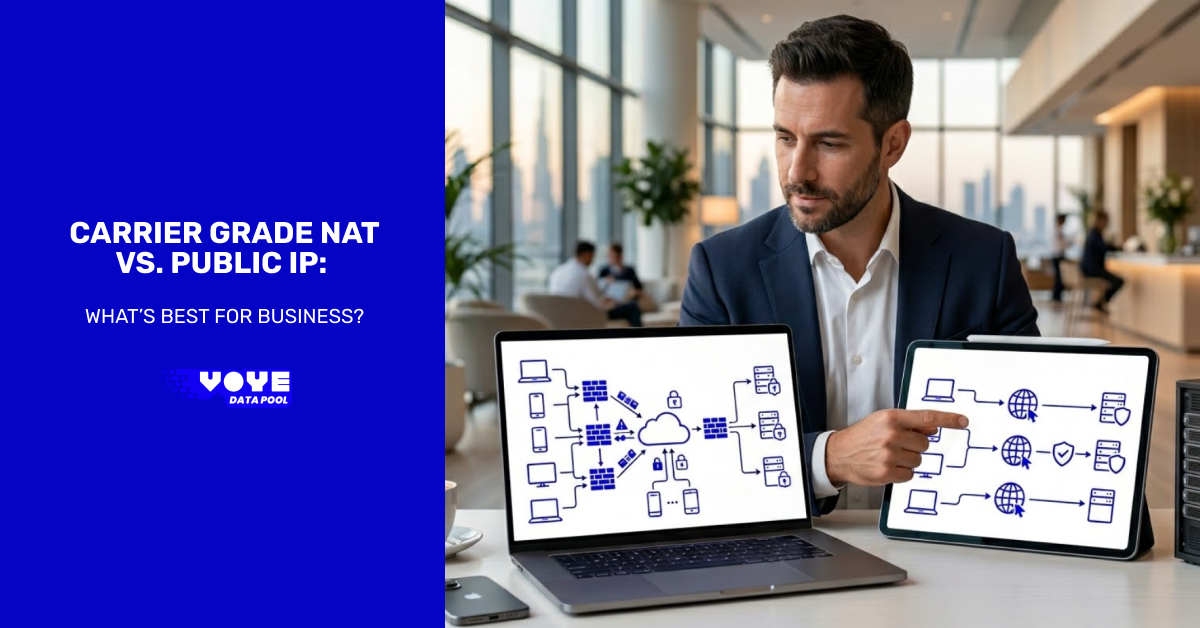
Network Address Translation, commonly known as NAT, allows multiple private devices to share a smaller number of public-facing IP addresses. Traffic generated inside the network is translated before reaching the public internet.

This method helps conserve IPv4 addresses and simplifies address management for Internet service providers.

What Is a Public IP Address?

A public IP address is globally reachable over the Internet. Devices or systems assigned a public IP can communicate directly with external networks without relying on additional translation layers.

Public IP addresses are commonly used for:

  • VPN gateways
  • Web hosting
  • Remote desktop services
  • VoIP platforms
  • CCTV systems
  • IoT deployments
  • Enterprise firewalls

Why Businesses Compare NAT and Public IP Models?

As organizations increasingly depend on cloud platforms, hybrid work environments, and connected devices, networking requirements become more complex.

Businesses compare NAT-based environments and public IP deployment to determine which option better supports:

  • Remote accessibility
  • Security requirements
  • Hosting capabilities
  • Application performance
  • Scalability
  • Cost management
  • Network visibility

The right approach depends on both operational goals and future infrastructure planning.

How Shared NAT Environments Work?

In shared NAT environments, multiple users share a common pool of public IP addresses. Internet service providers dynamically translate internal traffic to public-facing addresses before internet communication occurs.

This model helps providers maximize IPv4 address utilization while supporting large customer bases.

One common implementation is carrier-grade NAT, where translation takes place at the provider level rather than only within the customer’s router or firewall.

Businesses using cloud-based applications and standard internet access often function efficiently within shared NAT environments.

Benefits of Shared NAT Environments

Shared NAT deployment offers several advantages for businesses with simple connectivity requirements.

Efficient IPv4 Address Usage

IPv4 exhaustion remains a major challenge globally. Shared NAT allows providers to conserve public IP resources more effectively.

Lower Connectivity Costs

Organizations without advanced inbound connectivity requirements can reduce operational expenses by using shared IP environments.

Simple Internet Access

Common business activities, such as those below, usually operate without complex configuration:

  • Web browsing
  • SaaS application access
  • Cloud platform usage
  • Email communication

Easier ISP Scalability

Service providers can support more users while minimizing public IP allocation demands.

Limitations of Shared NAT Environments

Although shared NAT environments are suitable for many businesses, they can create limitations for organizations requiring advanced networking capabilities.

Restricted Inbound Connectivity

Carrier-grade NAT introduces a “Double NAT” scenario – one translation at the ISP level and another at the business’s local router. This creates significant hurdles for Peer-to-Peer (P2P) applications, complicates port forwarding, and often breaks the “handshake” required for certain site-to-site VPN tunnels and industrial remote-access tools.

VPN Compatibility Issues

Some VPN protocols may experience connectivity or performance problems when multiple users share the same public IP address.

Reduced Network Visibility

Troubleshooting and monitoring become more complex because multiple users appear under one external IP address.

Shared IP Reputation Risks

If another user associated with the same shared IP performs suspicious activity, blacklist or reputation issues may affect all users connected through that address.

Potential Performance Inconsistencies

Latency-sensitive applications may occasionally experience instability due to translation overhead and session management.

Benefits of Public IP Addresses for Businesses

Public IP deployment provides businesses with greater flexibility, accessibility, and control over their network infrastructure.

Organizations operating remote services or customer-facing applications often benefit significantly from dedicated public addressing.

Direct Remote Accessibility

Public IPs allow systems to be reached directly from external networks without the ISP-level processing required by CGNAT. This eliminates the “middleman” server at the ISP core, reducing latency for time-sensitive operations like high-frequency trading, real-time industrial control systems, and specialized VoIP deployments.

This supports:

  • Remote workforce access
  • Branch office connectivity
  • Device management
  • Secure administration
  • Application availability

Better VPN Stability

Dedicated public IP addresses improve VPN compatibility and help establish stable site-to-site and remote-access tunnels.

Protocols such as IPSec and SSL VPN generally perform more consistently with public IP deployment.

Improved VoIP and SIP Performance

Voice communication platforms depend heavily on low latency and stable sessions. Public IP environments help reduce NAT traversal complications that may impact call quality.

Easier Hosting and Port Configuration

Businesses hosting:

  • Websites
  • Application servers
  • Email servers
  • IoT gateways

can manage inbound traffic more effectively using public IP addresses.

Enhanced Traffic Monitoring

Dedicated public IP infrastructure improves logging accuracy, traffic analysis, and security monitoring capabilities.

Security Comparison Between NAT and Public IP

Security is one of the most important considerations when evaluating networking infrastructure. However, NAT should not be treated as a standalone cybersecurity solution.

Network security depends more on architecture and policy management than on the IP model itself.

Security Advantages of Shared NAT

Shared NAT environments naturally block unsolicited inbound traffic because devices are not directly exposed to the Internet.

This may reduce exposure to automated scanning and unauthorized connection attempts.

Security Considerations for Public IP Deployment

Public IP infrastructure requires stronger perimeter protection and monitoring controls, including:

  • Firewall configuration
  • Intrusion prevention systems
  • Endpoint protection
  • Traffic inspection
  • Multi-factor authentication

When implemented correctly, public IP environments can provide both strong security and operational flexibility.

Why Security Depends on Proper Network Design?

The effectiveness of any networking environment depends primarily on:

  • Access control policies
  • Network segmentation
  • Monitoring systems
  • Authentication standards
  • Threat detection mechanisms

Businesses requiring secure remote connectivity often benefit more from properly managed public IP infrastructure than restrictive NAT-based workarounds.

Performance and Scalability Considerations

Enterprise applications increasingly demand stable and predictable connectivity. As organizations expand, network scalability becomes a critical factor.

Businesses operating cloud infrastructure, IoT systems, or distributed offices require networking solutions capable of supporting increasing workloads.

Shared NAT Scalability

Large-scale NAT systems can support thousands of users effectively. However, heavy session loads may occasionally create bottlenecks during peak traffic periods.

Applications sensitive to latency and session persistence may experience inconsistent behavior.

Public IP Scalability

Public IP deployment provides greater flexibility for:

  • Hybrid cloud networking
  • SD-WAN environments
  • Multi-site operations
  • IoT expansion
  • Edge computing infrastructure

Dedicated addressing also simplifies routing and advanced traffic management.

In some enterprise deployments, carrier-grade NAT may still be used for general internet access while public IPs support business-critical infrastructure and services.

Business Environments That Benefit From Public IPs

Certain industries and workloads strongly benefit from dedicated public IP deployment.

Financial Services

Secure transaction processing and compliance monitoring often require detailed logging and stable connectivity.

Healthcare Organizations

Telemedicine platforms, imaging systems, and remote healthcare applications typically depend on secure direct access.

Manufacturing and Industrial IoT

Connected industrial devices often require centralized monitoring and remote administration capabilities.

Managed Service Providers

MSPs need reliable access to customer infrastructure for troubleshooting and network management.

Hybrid Cloud Enterprises

Businesses integrating on-premise systems with public cloud environments benefit from stable routing and VPN performance.

When Shared NAT Is the Better Option?

Not every business requires a dedicated public IP infrastructure. Organizations with basic internet usage requirements may operate efficiently within shared NAT environments.

This model is often suitable for:

  • Small offices
  • SaaS-focused businesses
  • Temporary deployments
  • Standard cloud usage
  • General web access

Companies without inbound access requirements can often reduce operational costs while maintaining acceptable performance.

The Growing Importance of IPv6

As IPv4 availability continues to decline, IPv6 adoption is becoming increasingly important across enterprise networks.

IPv6 offers significantly larger address capacity and supports long-term scalability.

Benefits of IPv6

IPv6 provides:

  • Expanded address availability
  • Simplified routing
  • Better IoT scalability
  • End-to-end communication
  • Improved future readiness

Why IPv4 Still Matters?

Despite increasing IPv6 deployment, many enterprise systems and applications still rely heavily on IPv4 compatibility.

Businesses, therefore, need networking strategies that support both current operations and future migration plans.

Smarter Connectivity Management for Expanding Businesses

As businesses scale across multiple locations, managing bandwidth and connectivity becomes more challenging. Organizations handling remote teams, IoT deployments, field operations, or distributed branches often need more flexibility than traditional fixed data allocation models can provide.

This is where solutions like Voye Data Pool become valuable within modern enterprise networking environments.

Instead of assigning isolated data limits to individual connections, businesses can optimize usage through centralized allocation strategies that distribute resources where they are needed most. This approach helps reduce unused capacity while improving overall network efficiency.

For network engineers managing dynamic traffic environments, flexible pooling models can support:

  • Better bandwidth utilization across teams and devices
  • Simplified connectivity management
  • Improved scalability for growing operations
  • Centralized monitoring and control
  • More efficient handling of distributed workloads

When combined with the right IP strategy, whether shared NAT environments or dedicated public IP infrastructure, intelligent data management frameworks can improve operational performance while supporting long-term scalability goals.

The Role of a Custom Data Pool in Enterprise Networking

Modern organizations require flexible connectivity models that can adapt to changing workloads and distributed operations.

A custom data pool supports centralized connectivity management, allowing businesses to allocate bandwidth and connectivity resources dynamically across users, devices, and locations while improving operational visibility and scalability.

This approach helps enterprises:

  • Optimize network resource usage
  • Improve bandwidth efficiency
  • Simplify centralized management
  • Support scalable deployments
  • Reduce operational waste

Businesses managing mobile teams, IoT infrastructure, or branch connectivity often benefit from flexible data allocation frameworks that support evolving networking demands.

Conclusion

Choosing between shared NAT environments and dedicated public IP addresses depends on business goals, operational complexity, and long-term scalability requirements.

Shared NAT deployment can provide cost-effective internet access for organizations with basic connectivity needs and limited inbound communication requirements. However, businesses requiring remote access, VPN stability, application hosting, or advanced traffic visibility often gain greater flexibility and performance from public IP deployment.

As enterprise networking continues evolving toward cloud integration, IoT expansion, and distributed operations, businesses must prioritize scalability, security, and operational efficiency. Combining a dedicated Public IP strategy for critical infrastructure with intelligent connectivity management – such as a custom data pool – allows organizations to maintain full control over their traffic while ensuring reliable, future-ready network performance.

Modern businesses rely heavily on stable internet connectivity for cloud operations, remote work, VoIP communication, application hosting, and IoT infrastructure. As IPv4 addresses continue to become limited worldwide, businesses often face an important networking decision between shared NAT environments and dedicated public IP addresses.

For network engineers and IT decision-makers, this choice affects network performance, scalability, accessibility, and security. Businesses handling VPNs, distributed teams, or customer-facing applications must carefully evaluate which approach aligns best with their operational requirements.

Choosing the right IP strategy is not only about internet access. It also influences future scalability, cloud integration, and overall infrastructure reliability.

Understanding IP Addressing in Enterprise Networks

Every device connected to the internet requires an IP address for communication. In business environments, organizations typically use either shared NAT-based connectivity or dedicated public IP allocation.

The selected model determines how devices communicate externally, how traffic is routed, and how easily systems can be accessed remotely.

Businesses with expanding digital operations often need a networking strategy that balances cost efficiency with performance and security.

What Is Network Address Translation?

Network Address Translation, commonly known as NAT, allows multiple private devices to share a smaller number of public-facing IP addresses. Traffic generated inside the network is translated before reaching the public internet.

This method helps conserve IPv4 addresses and simplifies address management for Internet service providers.

What Is a Public IP Address?

A public IP address is globally reachable over the Internet. Devices or systems assigned a public IP can communicate directly with external networks without relying on additional translation layers.

Public IP addresses are commonly used for:

  • VPN gateways
  • Web hosting
  • Remote desktop services
  • VoIP platforms
  • CCTV systems
  • IoT deployments
  • Enterprise firewalls

Why Businesses Compare NAT and Public IP Models?

As organizations increasingly depend on cloud platforms, hybrid work environments, and connected devices, networking requirements become more complex.

Businesses compare NAT-based environments and public IP deployment to determine which option better supports:

  • Remote accessibility
  • Security requirements
  • Hosting capabilities
  • Application performance
  • Scalability
  • Cost management
  • Network visibility

The right approach depends on both operational goals and future infrastructure planning.

How Shared NAT Environments Work?

In shared NAT environments, multiple users share a common pool of public IP addresses. Internet service providers dynamically translate internal traffic to public-facing addresses before internet communication occurs.

This model helps providers maximize IPv4 address utilization while supporting large customer bases.

One common implementation is carrier-grade NAT, where translation takes place at the provider level rather than only within the customer’s router or firewall.

Businesses using cloud-based applications and standard internet access often function efficiently within shared NAT environments.

Benefits of Shared NAT Environments

Shared NAT deployment offers several advantages for businesses with simple connectivity requirements.

Efficient IPv4 Address Usage

IPv4 exhaustion remains a major challenge globally. Shared NAT allows providers to conserve public IP resources more effectively.

Lower Connectivity Costs

Organizations without advanced inbound connectivity requirements can reduce operational expenses by using shared IP environments.

Simple Internet Access

Common business activities, such as those below, usually operate without complex configuration:

  • Web browsing
  • SaaS application access
  • Cloud platform usage
  • Email communication

Easier ISP Scalability

Service providers can support more users while minimizing public IP allocation demands.

Limitations of Shared NAT Environments

Although shared NAT environments are suitable for many businesses, they can create limitations for organizations requiring advanced networking capabilities.

Restricted Inbound Connectivity

Carrier-grade NAT introduces a “Double NAT” scenario – one translation at the ISP level and another at the business’s local router. This creates significant hurdles for Peer-to-Peer (P2P) applications, complicates port forwarding, and often breaks the “handshake” required for certain site-to-site VPN tunnels and industrial remote-access tools.

VPN Compatibility Issues

Some VPN protocols may experience connectivity or performance problems when multiple users share the same public IP address.

Reduced Network Visibility

Troubleshooting and monitoring become more complex because multiple users appear under one external IP address.

Shared IP Reputation Risks

If another user associated with the same shared IP performs suspicious activity, blacklist or reputation issues may affect all users connected through that address.

Potential Performance Inconsistencies

Latency-sensitive applications may occasionally experience instability due to translation overhead and session management.

Benefits of Public IP Addresses for Businesses

Public IP deployment provides businesses with greater flexibility, accessibility, and control over their network infrastructure.

Organizations operating remote services or customer-facing applications often benefit significantly from dedicated public addressing.

Direct Remote Accessibility

Public IPs allow systems to be reached directly from external networks without the ISP-level processing required by CGNAT. This eliminates the “middleman” server at the ISP core, reducing latency for time-sensitive operations like high-frequency trading, real-time industrial control systems, and specialized VoIP deployments.

This supports:

  • Remote workforce access
  • Branch office connectivity
  • Device management
  • Secure administration
  • Application availability

Better VPN Stability

Dedicated public IP addresses improve VPN compatibility and help establish stable site-to-site and remote-access tunnels.

Protocols such as IPSec and SSL VPN generally perform more consistently with public IP deployment.

Improved VoIP and SIP Performance

Voice communication platforms depend heavily on low latency and stable sessions. Public IP environments help reduce NAT traversal complications that may impact call quality.

Easier Hosting and Port Configuration

Businesses hosting:

  • Websites
  • Application servers
  • Email servers
  • IoT gateways

can manage inbound traffic more effectively using public IP addresses.

Enhanced Traffic Monitoring

Dedicated public IP infrastructure improves logging accuracy, traffic analysis, and security monitoring capabilities.

Security Comparison Between NAT and Public IP

Security is one of the most important considerations when evaluating networking infrastructure. However, NAT should not be treated as a standalone cybersecurity solution.

Network security depends more on architecture and policy management than on the IP model itself.

Security Advantages of Shared NAT

Shared NAT environments naturally block unsolicited inbound traffic because devices are not directly exposed to the Internet.

This may reduce exposure to automated scanning and unauthorized connection attempts.

Security Considerations for Public IP Deployment

Public IP infrastructure requires stronger perimeter protection and monitoring controls, including:

  • Firewall configuration
  • Intrusion prevention systems
  • Endpoint protection
  • Traffic inspection
  • Multi-factor authentication

When implemented correctly, public IP environments can provide both strong security and operational flexibility.

Why Security Depends on Proper Network Design?

The effectiveness of any networking environment depends primarily on:

  • Access control policies
  • Network segmentation
  • Monitoring systems
  • Authentication standards
  • Threat detection mechanisms

Businesses requiring secure remote connectivity often benefit more from properly managed public IP infrastructure than restrictive NAT-based workarounds.

Performance and Scalability Considerations

Enterprise applications increasingly demand stable and predictable connectivity. As organizations expand, network scalability becomes a critical factor.

Businesses operating cloud infrastructure, IoT systems, or distributed offices require networking solutions capable of supporting increasing workloads.

Shared NAT Scalability

Large-scale NAT systems can support thousands of users effectively. However, heavy session loads may occasionally create bottlenecks during peak traffic periods.

Applications sensitive to latency and session persistence may experience inconsistent behavior.

Public IP Scalability

Public IP deployment provides greater flexibility for:

  • Hybrid cloud networking
  • SD-WAN environments
  • Multi-site operations
  • IoT expansion
  • Edge computing infrastructure

Dedicated addressing also simplifies routing and advanced traffic management.

In some enterprise deployments, carrier-grade NAT may still be used for general internet access while public IPs support business-critical infrastructure and services.

Business Environments That Benefit From Public IPs

Certain industries and workloads strongly benefit from dedicated public IP deployment.

Financial Services

Secure transaction processing and compliance monitoring often require detailed logging and stable connectivity.

Healthcare Organizations

Telemedicine platforms, imaging systems, and remote healthcare applications typically depend on secure direct access.

Manufacturing and Industrial IoT

Connected industrial devices often require centralized monitoring and remote administration capabilities.

Managed Service Providers

MSPs need reliable access to customer infrastructure for troubleshooting and network management.

Hybrid Cloud Enterprises

Businesses integrating on-premise systems with public cloud environments benefit from stable routing and VPN performance.

When Shared NAT Is the Better Option?

Not every business requires a dedicated public IP infrastructure. Organizations with basic internet usage requirements may operate efficiently within shared NAT environments.

This model is often suitable for:

  • Small offices
  • SaaS-focused businesses
  • Temporary deployments
  • Standard cloud usage
  • General web access

Companies without inbound access requirements can often reduce operational costs while maintaining acceptable performance.

The Growing Importance of IPv6

As IPv4 availability continues to decline, IPv6 adoption is becoming increasingly important across enterprise networks.

IPv6 offers significantly larger address capacity and supports long-term scalability.

Benefits of IPv6

IPv6 provides:

  • Expanded address availability
  • Simplified routing
  • Better IoT scalability
  • End-to-end communication
  • Improved future readiness

Why IPv4 Still Matters?

Despite increasing IPv6 deployment, many enterprise systems and applications still rely heavily on IPv4 compatibility.

Businesses, therefore, need networking strategies that support both current operations and future migration plans.

Smarter Connectivity Management for Expanding Businesses

As businesses scale across multiple locations, managing bandwidth and connectivity becomes more challenging. Organizations handling remote teams, IoT deployments, field operations, or distributed branches often need more flexibility than traditional fixed data allocation models can provide.

This is where solutions like Voye Data Pool become valuable within modern enterprise networking environments.

Instead of assigning isolated data limits to individual connections, businesses can optimize usage through centralized allocation strategies that distribute resources where they are needed most. This approach helps reduce unused capacity while improving overall network efficiency.

For network engineers managing dynamic traffic environments, flexible pooling models can support:

  • Better bandwidth utilization across teams and devices
  • Simplified connectivity management
  • Improved scalability for growing operations
  • Centralized monitoring and control
  • More efficient handling of distributed workloads

When combined with the right IP strategy, whether shared NAT environments or dedicated public IP infrastructure, intelligent data management frameworks can improve operational performance while supporting long-term scalability goals.

The Role of a Custom Data Pool in Enterprise Networking

Modern organizations require flexible connectivity models that can adapt to changing workloads and distributed operations.

A custom data pool supports centralized connectivity management, allowing businesses to allocate bandwidth and connectivity resources dynamically across users, devices, and locations while improving operational visibility and scalability.

This approach helps enterprises:

  • Optimize network resource usage
  • Improve bandwidth efficiency
  • Simplify centralized management
  • Support scalable deployments
  • Reduce operational waste

Businesses managing mobile teams, IoT infrastructure, or branch connectivity often benefit from flexible data allocation frameworks that support evolving networking demands.

Conclusion

Choosing between shared NAT environments and dedicated public IP addresses depends on business goals, operational complexity, and long-term scalability requirements.

Shared NAT deployment can provide cost-effective internet access for organizations with basic connectivity needs and limited inbound communication requirements. However, businesses requiring remote access, VPN stability, application hosting, or advanced traffic visibility often gain greater flexibility and performance from public IP deployment.

As enterprise networking continues evolving toward cloud integration, IoT expansion, and distributed operations, businesses must prioritize scalability, security, and operational efficiency. Combining a dedicated Public IP strategy for critical infrastructure with intelligent connectivity management – such as a custom data pool – allows organizations to maintain full control over their traffic while ensuring reliable, future-ready network performance.

Related Articles

  • Roaming in Europe: Navigating Data Post-Brexit

    Roaming in Europe after Brexit requires a more strategic approach to mobile connectivity, especially for business travelers. With changing regulations, inconsistent pricing, and varying network performance, managing data efficiently has become essential. This blog outlines key challenges, cost considerations, and modern solutions such as eSIM and custom data pool systems. It also highlights how Voye Data Pool simplifies cross-border connectivity, ensuring reliable, secure, and cost-effective internet access for professionals traveling across multiple European destinations.

  • 5G vs 4G LTE: What Business Travelers Need to Know?

    Connectivity for modern enterprises is no longer a mere convenience; it is a critical, board-level concern. As the foundational infrastructure that sustains global teams, facilitates real-time decision-making, and drives seamless cross-border operations, the network you deploy in the field directly dictates your bottom line. In an era of rapid digital transformation, choosing between 5G and 4G LTE is not just a technical preference – it is a strategic choice that fundamentally impacts your revenue, corporate security, and long-term operational continuity.

  • VPN on Mobile: Why You Need Encrypted Data Streams?

    Mobile VPNs have become essential for securing enterprise data in an increasingly connected world. By encrypting data streams, they protect sensitive business information from cyber threats, especially across public and unstable networks. Combined with strategies like custom data pool management and solutions such as Voye Data Pool, organizations can enhance both security and operational efficiency. This approach enables safe remote work, ensures compliance, and strengthens overall IT infrastructure, making mobile VPNs a critical component of modern enterprise security frameworks.

  • Hidden Compliance Benefits of Centralized Data Pool Management

    Centralized data pool management is emerging as a core compliance enabler for modern enterprises. By unifying critical data into a governed, monitored environment, organizations gain stronger audit readiness, improved privacy controls, and demonstrable regulatory accountability. This approach reduces data sprawl, minimizes security risks, and streamlines GDPR and CCPA obligations. With clearer lineage, consistent enforcement, and automated retention, centralized pools transform compliance from reactive to strategic. For IT, security, and compliance leaders, it delivers long-term resilience against evolving regulations.

  • Converting Your Fleet from Plastic SIMs to eSIMs

    Fleet connectivity is evolving rapidly as businesses shift to smarter, scalable solutions. The move to convert SIM to eSIM helps fleet managers improve operational efficiency, reduce downtime, and gain better control over data usage. With features like remote provisioning, multi-network access, and integration with a custom data pool and Voye Data Pool, fleets can streamline connectivity management. This transition supports cost optimization, enhances security, and prepares fleet operations for future technologies and expansion across regions with seamless network performance.