


How to Get Internet in China With VPN Support?
Staying connected in China requires a strategic approach that combines reliable internet access with secure VPN support. This guide explains how business travelers can navigate restrictions using modern solutions like eSIM and shared connectivity models. With the integration of China VPN eSIM, professionals can ensure uninterrupted access to global tools while maintaining data security. It also highlights the role of custom data pool systems and Voye Data Pool in simplifying connectivity management for teams operating in China.


 8 min read
 Share
Share
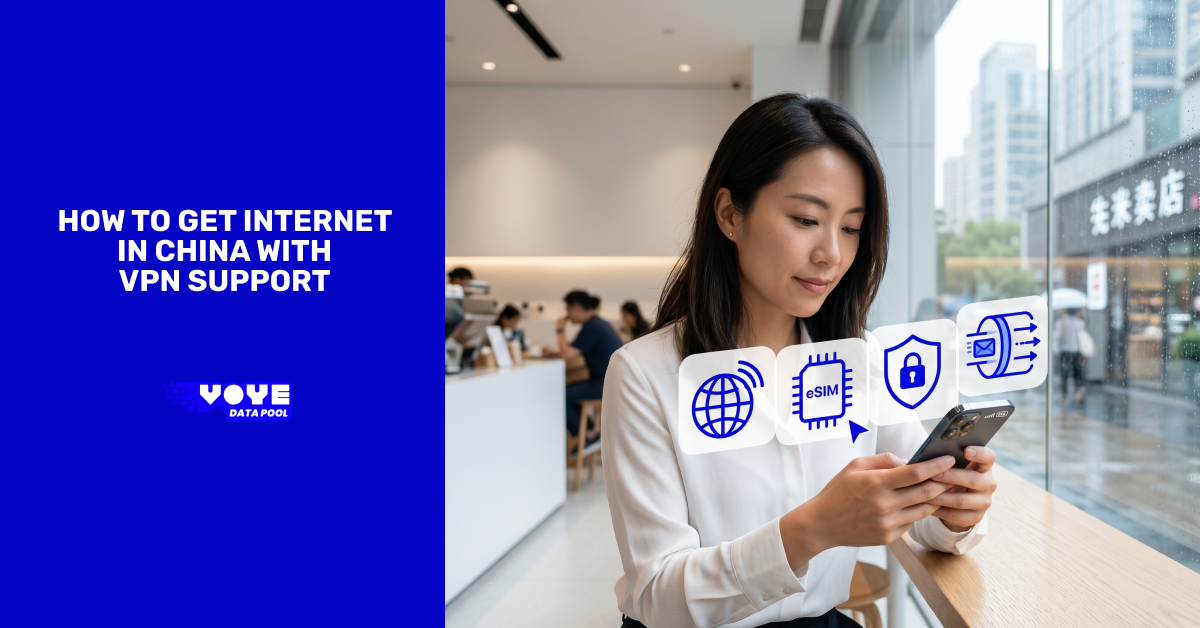
Staying connected in China requires more than simply turning on mobile data. For business travelers, internet access is directly tied to productivity, communication, and security. The country’s tightly controlled digital ecosystem means that many everyday tools used elsewhere do not function in the same way, or at all. Entering this environment unprepared can disrupt workflows, delay decisions, and create unnecessary friction in professional engagements.
Understanding how to combine reliable connectivity with VPN support is the key to maintaining seamless operations while in China.
The Reality of Internet Access in China
China’s internet infrastructure is fast and advanced, but access is filtered through a regulatory system that restricts many global services. This creates a split experience where domestic platforms function flawlessly while international tools may be inaccessible or unstable.
For a business traveler, this difference becomes immediately noticeable. Sending emails through corporate systems, joining virtual meetings, or accessing shared cloud drives can suddenly become difficult. The issue is not the lack of internet, but rather how that internet is structured and controlled.
This makes it essential to think of connectivity in China as a combination of two layers: access to a network and access to the global internet. The first is easy to obtain. The second requires deliberate setup.
Why VPN Support Is Non-Negotiable?
A Virtual Private Network acts as a secure bridge between your device and the open internet. Without it, many of the tools used in international business environments simply will not work.
For example, platforms like Gmail, Google Drive, Slack, and even some corporate dashboards may fail to load or function inconsistently. A VPN routes your connection through servers outside China, restoring access while also encrypting your data.
Beyond accessibility, security becomes another major factor. Business travelers often handle sensitive information such as contracts, financial data, and internal communications. Using a VPN ensures that this information remains protected from potential interception, especially when working across unfamiliar networks.
The effectiveness of a VPN in China depends heavily on preparation. Installing and testing it before arrival is critical, as many VPN provider websites are not accessible within the country.

Explore Smart Data Plans
Discover flexible China VPN eSIM options for seamless connectivity abroad.
Choosing the Right Way to Connect
When it comes to getting online, there is no single solution that fits every traveler. The right choice depends on the length of stay, the number of devices, and the level of connectivity required.
International roaming offers simplicity but often comes at a high cost. It allows immediate access without setup, which can be useful upon arrival. However, relying on it long term is rarely practical due to pricing and inconsistent speeds.
Local SIM cards provide a more affordable option and strong domestic coverage. They integrate well with China’s network infrastructure, making them reliable for basic browsing and local apps. However, they do not solve the problem of restricted access. Without a VPN, the experience remains limited.
Portable WiFi devices introduce flexibility, especially for teams. They allow multiple users to connect through a single device, which can be convenient during meetings or travel between cities. Still, they require charging, carrying additional hardware, and pairing with a VPN for full functionality.
This is where eSIM technology has started to redefine the experience.
The Rise of eSIM for Business Travelers
eSIM solutions eliminate many of the traditional barriers associated with connectivity, allowing for digital activation within minutes. However, travelers must verify device compatibility before departure. Notably, many smartphones purchased in Mainland China, Hong Kong, and Macao (including specific iPhone models) do not possess eSIM hardware and rely solely on physical slots. Ensuring your device is both carrier-unlocked and eSIM-compatible is a critical first step.
What makes eSIM particularly appealing in China is the ability to secure a high-speed local data connection without the logistical hurdle of physical SIM cards. However, because this data is often subject to local network regulations, it does not automatically bypass content restrictions. This makes the pairing of an eSIM with a robust VPN essential for accessing the global internet.
For business travelers juggling tight schedules, this means less time dealing with connectivity issues and more time focusing on work.
Many professionals now turn to a China VPN eSIM approach that integrates both connectivity and access into a single streamlined setup. This combination simplifies the process while maintaining performance and security.
Integrating VPN with eSIM for Seamless Access
Using an eSIM alone does not replace the need for a VPN, but together they create a powerful solution. The eSIM ensures consistent access to mobile data, while the VPN ensures that this connection remains unrestricted and secure.
This pairing is particularly valuable during high-stakes scenarios such as virtual meetings, file transfers, or real-time collaboration. A stable connection backed by secure routing reduces the risk of interruptions and maintains professional continuity.
The experience becomes even smoother when both are configured before departure. Once in China, the system works in the background, allowing the traveler to operate as if they were in a less restricted environment.
Managing Connectivity at Scale with Custom Data Pool
For organizations sending multiple employees to China, individual connectivity setups can quickly become inefficient. Managing separate plans, tracking usage, and handling reimbursements creates unnecessary complexity.
A custom data pool addresses this challenge by consolidating data usage across multiple users into a single shared plan. Instead of allocating fixed limits to each individual, data can be distributed dynamically based on actual needs.
This approach reflects how business travel operates in reality. Some team members may require constant connectivity for meetings and coordination, while others may only need occasional access. A shared pool ensures that resources are used efficiently without overpaying for unused data.
Upgrade Travel Connectivity
Choose China VPN eSIM for secure and uninterrupted business internet access
How Voye Data Pool Enhances Business Travel Connectivity?
Voye Data Pool builds on the concept of shared data by integrating it with modern connectivity solutions like eSIM. It allows businesses to manage internet access for their teams in a centralized and scalable way.
For travel in China, this becomes particularly valuable. Instead of relying on multiple local SIM cards or fragmented solutions, companies can deploy a unified system that works across devices and users.
The flexibility of Voye Data Pool means that teams can stay connected without worrying about individual limits or inconsistent access. It supports international routing, which complements VPN usage and ensures that employees can access the tools they need without disruption.
From a management perspective, it also simplifies oversight. Usage can be monitored in real time, costs can be controlled more effectively, and adjustments can be made as travel needs evolve.
Practical Considerations for Business Travelers
Even with the right tools, a smooth internet experience in China depends on preparation and awareness. Connectivity should be treated as part of travel planning, not an afterthought.
Before departure, install at least two different VPN services to provide a safety net. It is vital to ensure these services support “Obfuscated” or “Stealth” protocols, which are designed to bypass deep packet inspection. Standard VPN protocols are often identified and throttled instantly by local filters; using specialized stealth settings ensures your connection remains undetected and stable. Additionally, download all necessary apps, offline maps, and setup guides while still outside the country, as provider websites are often inaccessible once you land.
Once in China, network conditions may vary depending on location. Major cities typically offer strong coverage, while more remote areas may present occasional challenges. Being adaptable and having backup options helps maintain continuity.
Security should remain a constant priority. Using encrypted connections, enabling multi-factor authentication, and avoiding unsecured public networks are all simple but effective measures.
Balancing Cost, Convenience, and Performance
Each connectivity option comes with trade-offs. International roaming offers convenience but at a premium cost. Local SIM cards provide affordability but require additional setup for unrestricted access. Portable WiFi adds flexibility but introduces hardware dependency.
eSIM solutions, especially when paired with VPN support, tend to offer the most balanced approach. They combine ease of use with reliable performance, making them well-suited for business travelers who need consistent connectivity without unnecessary complications.
When combined with Voye Data Pool, the experience becomes even more streamlined. Businesses gain control over costs while ensuring that their teams remain connected wherever they operate.
Conclusion
Accessing the internet in China is not about finding a single solution, but about combining the right tools to create a seamless experience. For business travelers, this means pairing secure connectivity with effective VPN support.
eSIM technology has emerged as a practical and efficient option, reducing setup time and improving flexibility. When integrated with a VPN, it enables access to essential global services while maintaining security. For organizations, adopting a custom data pool and leveraging the solution by Voye Data Pool further enhances efficiency and control.
With the right preparation and approach, staying connected in China becomes far less complicated, allowing business travelers to focus on what truly matters: getting work done without interruption.
Stay Connected in China
Access a secure internet easily with reliable China VPN eSIM plans