

How to Set Up a Corporate Data Pool in 5 Minutes?
Managing mobile connectivity across employees, remote teams, and connected devices can quickly become complex and expensive. A corporate data pool simplifies operations by centralizing data usage, enabling instant eSIM activation, and giving IT administrators full visibility and control from a single platform. With Voye Data Pool, businesses can deploy secure global connectivity in minutes, reduce roaming costs, and support teams without handling physical SIM cards.


 8 min read
 Share
Share

Modern organizations depend on uninterrupted internet access. Employees work remotely, teams travel internationally, and connected devices transmit operational data continuously. Traditional SIM cards and roaming plans cannot efficiently support this growing demand. Companies face high roaming costs, complicated provisioning, security concerns, and administrative overload.
A corporate data pool solves these issues by centralizing mobile connectivity under one managed platform. Instead of managing dozens or hundreds of individual plans, businesses control everything from a single dashboard. Activation, allocation, monitoring, and security enforcement happen instantly.
What Is a Corporate Data Pool?
A corporate data pool is a centralized mobile data allocation system shared across multiple employees, teams, or connected devices. Instead of individual mobile plans assigned separately, all data usage comes from a unified enterprise allocation.
Key Characteristics:
- Centralized connectivity management.
- Shared data usage across users and devices.
- Real-time monitoring.
- Policy-based usage control.
- Secure provisioning.
- Instant activation.
In traditional setups, every SIM card has its own billing and configuration. In a corporate pool, administrators allocate usage dynamically. If one team consumes less data, another team can utilize the remaining capacity.
This eliminates wastage and dramatically reduces operational complexity.
Why Businesses Need a Corporate Data Pool?
A corporate data pool gives organizations centralized control over mobile connectivity, allowing multiple employees and devices to share data efficiently under one managed system. It reduces roaming costs, simplifies administration, improves security, and ensures reliable connectivity for remote teams, travelers, and IoT deployments without managing individual SIM plans.
1. Rising Remote Workforce
Hybrid and remote work has expanded significantly. Employees often operate from different cities or countries. Managing individual roaming plans becomes expensive and difficult.
2. International Travel
Sales teams, consultants, and executives frequently travel. Roaming charges can increase operational costs unpredictably.
3. Device Connectivity
IoT sensors, payment terminals, field equipment, and monitoring devices all require consistent connectivity. Each device cannot be manually managed with physical SIMs.
4. Administrative Burden
IT teams spend valuable time:
- Ordering SIM cards.
- Activating lines.
- Troubleshooting connectivity.
- Tracking usage.
A centralized pool removes repetitive tasks and improves efficiency.
5. Security Concerns
Uncontrolled mobile connections expose organizations to data leaks and unauthorized network access. Centralized policy enforcement solves this risk.
How to Set Up a Corporate Data Pool in 5 Minutes?
Businesses can quickly deploy centralized connectivity by creating an admin account, activating eSIM profiles, assigning data policies, and monitoring usage from a single dashboard. The process removes SIM logistics and manual configuration. IT teams gain instant control over users and devices.
Step 1: Create an Enterprise Account
First, register your organization on the Voye Data Pool platform.
You will:
- Add company details.
- Verify admin credentials.
- Assign a primary administrator.
After verification, you gain access to the management dashboard.
Step 2: Configure Organization Settings
Inside the dashboard, configure your organization structure.
Add:
- Departments.
- Teams.
- User roles.
- Access permissions.
This helps you apply data policies later without manual configuration for each employee.
Step 3: Activate eSIM Profiles
Instead of distributing physical SIM cards, the platform generates digital eSIM profiles.
You simply:
- Select the country or region.
- Generate a QR code.
- Send it to employees or device owners.
Users scan the code, and connectivity activates instantly.
At this stage of deployment, connectivity is activated instantly through digital provisioning, allowing organizations to seamlessly start your data pool without waiting for SIM deliveries or coordinating with telecom vendors, so users and devices can go online immediately.
Step 4: Allocate Data Policies
Administrators can assign usage rules to maintain control and optimize costs.
Examples:
- The sales team gets a higher allocation.
- IoT sensors get minimal continuous data.
- Temporary contractors receive limited access.
- International travelers receive roaming-enabled plans.
Policies can include:
- Speed limits.
- Data caps.
- Geographic restrictions.
- Automatic suspension.
All rules apply instantly.
Step 5: Monitor and Optimize
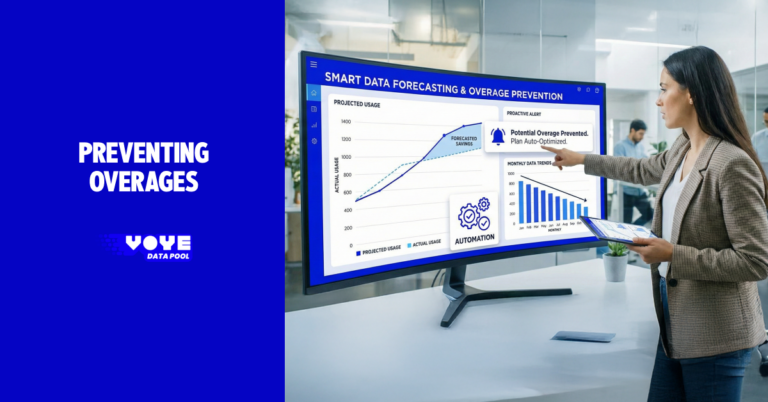
After activation, the dashboard displays real-time analytics.
You can view:
- Active users.
- Device status.
- Data consumption.
- Regional usage.
- Alerts and anomalies.
If a device exceeds normal behavior, IT teams can suspend or restrict access immediately.

Seamless eSIM Connectivity for Enterprises
Activate, manage, and scale eSIMs with ease.
Security and Compliance
Enterprise connectivity must meet strict security standards. Voye Data Pool integrates multiple layers of protection.
Built-in Security Features:
- Encrypted network communication.
- Access-based permissions.
- Device-level authentication.
- Usage monitoring alerts.
- Remote suspension capability.
Compliance Benefits:
Centralized management helps companies maintain regulatory compliance across regions. Administrators can audit connectivity logs and maintain documentation for internal and external audits.
Use Cases Across Industries
Consulting firms and international teams stay connected while traveling without relying on local SIM cards.
- Logistics and Transportation
Fleet trackers and logistics devices maintain constant connectivity for route monitoring.
- FinTech and Payment Terminals
Payment devices require secure and stable network connections for transaction processing.
- Retail Chains
Stores across multiple cities connect POS systems and inventory platforms.
- IoT Deployments
Smart meters, environmental sensors, and industrial monitoring devices transmit real-time operational data.
Best Practices for Managing a Corporate Data Pool
Effective management requires clear usage policies, regular monitoring, and proper user segmentation. IT teams should assign data limits, enable alerts, and review analytics to prevent misuse and control costs. Consistent oversight ensures secure connectivity and efficient performance across all employees and devices.
- Define Clear Usage Policies
Set reasonable limits per department to prevent unnecessary consumption.
- Monitor Regularly
Weekly monitoring helps detect abnormal usage patterns.
Segment Devices and Users
Separate employee devices and machine devices for easier control.
Use Alerts:
Enable automated notifications for:
- High usage.
- Unauthorized locations.
- Inactive devices.
Review Monthly Reports:
Data analytics helps optimize costs and future capacity planning.
Cost Optimization Benefits
A corporate data pool reduces telecom expenses by sharing data across users and devices instead of paying for separate plans. Businesses avoid roaming charges, unused subscriptions, and SIM management overhead. Centralized monitoring also helps IT teams identify waste and control usage efficiently.
Savings Come From:
Cost reductions come from shared data usage, eliminating roaming charges and unused plans. Businesses also save operational time by avoiding SIM handling and manual provisioning.
- Eliminating roaming charges.
- Avoiding unused plans.
- Shared allocation.
- Reduced operational labor.
- No SIM logistics.
IT departments also save time, allowing focus on infrastructure and cybersecurity projects instead of telecom management.
Common Deployment Mistakes to Avoid
Organizations often misconfigure policies when implementing centralized connectivity, leading to unnecessary costs and security risks. Failing to set data limits, not removing inactive users, and allowing unrestricted roaming can waste resources. Regular monitoring and proper access control help maintain efficiency and protection.
- Assigning unlimited access to all users.
- Ignoring usage analytics.
- Not setting geographic restrictions.
- Forgetting to remove inactive users.
- Mixing personal and company devices.
Proper configuration ensures security and financial efficiency.
Troubleshooting Quick Tips
If connectivity issues occur, first verify the eSIM profile is properly installed and the correct network is selected. Check assigned data policies and restart the device to refresh the connection. Reissuing the activation QR or reviewing dashboard alerts usually resolves most problems quickly.
If a user cannot connect:
- Confirm eSIM installation.
- Check network coverage selection.
- Verify assigned data policy.
- Restart the device.
- Reissue QR profile if required.
The centralized platform makes diagnosing issues significantly easier compared to traditional telecom setups.
Future Ready Connectivity
eSIM technology is rapidly becoming the global connectivity standard. Many modern smartphones, tablets, laptops, and IoT hardware already support it.
Adopting a corporate data pool today prepares organizations for:
- Borderless workforce.
- Connected equipment.
- Remote operations.
- Real-time analytics environments.
Companies no longer need telecom providers in every country. A single platform handles connectivity everywhere.
Seamless eSIM Connectivity for Enterprises
Activate, manage, and scale eSIMs with ease.
Why Choose Voye Data Pool?
Voye Data Pool provides enterprise-grade eSIM connectivity designed specifically for global organizations. The platform connects users and devices through a single management interface.
Platform Advantages:
The platform provides centralized control over connectivity, allowing IT teams to activate, manage, and monitor users and devices from one dashboard. Instant eSIM provisioning removes physical SIM handling and speeds up deployment. Built-in security, global coverage, and scalable management ensure reliable connectivity for growing business operations.
1. Global Coverage
Operate across 130+ countries without changing SIM cards.
2. Instant eSIM Provisioning
No shipping delays. Activate connectivity digitally within minutes.
3. Centralized Dashboard
Monitor all users, devices, and data usage in one place.
4. Scalable Infrastructure
Suitable for startups, mid-sized businesses, and multinational corporations.
5. Security First Architecture
Encrypted connectivity, policy enforcement, and access controls protect company data.
6. Simple Deployment
No telecom engineering knowledge required.
Ready to Simplify Business Connectivity?
Enterprise connectivity should be fast, secure, and manageable. Traditional SIM-based management cannot keep up with global operations and remote work environments.
A centralized corporate data pool gives organizations control over costs, security, and operations. Voye Data Pool simplifies this process by enabling instant eSIM activation, centralized monitoring, and scalable deployment across 130+ countries.
With only a few configuration steps, IT and admin teams can deploy connectivity for employees and devices within minutes while maintaining full visibility and control.
Businesses that modernize connectivity infrastructure improve operational efficiency, protect sensitive data, and support global expansion without telecom complexity.
Frequently Asked Questions:
1. What devices support eSIM?
Most modern smartphones, tablets, laptops, and many IoT devices support eSIM functionality.
2. Can multiple countries be covered under one plan?
Yes. The platform supports international connectivity across more than 130+ countries.
3. Is physical SIM shipping required?
No. All provisioning happens digitally using QR-based activation.
4. Can IT admins suspend a device remotely?
Yes. Devices can be restricted, paused, or deactivated instantly from the dashboard.
5. Is it suitable for small businesses?
Yes. The system scales from small teams to large multinational organizations.
6. Does it improve security?
Yes. Centralized monitoring and policy controls significantly reduce unauthorized network access.