

The CFO’s Guide to Telecom Expense Management
Telecom costs are complex and often hidden. This CFO focused guide explains how to gain visibility, control spend, and optimize enterprise connectivity using modern TEM and eSIM management.


 11 min read
 Share
Share
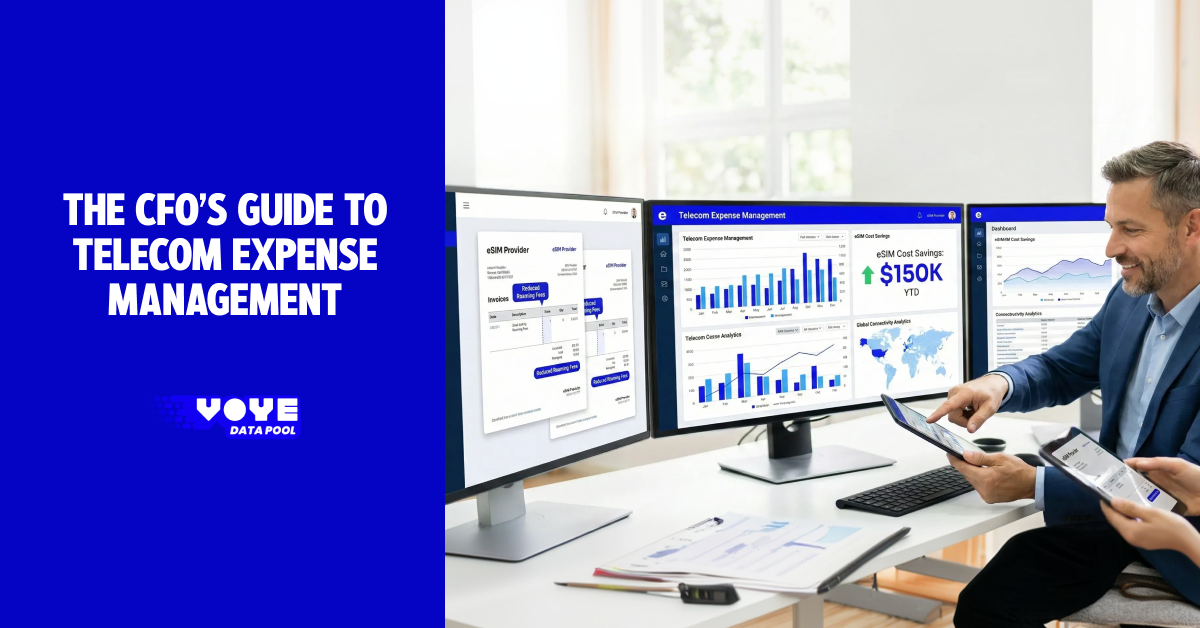
In an era where digital connectivity underpins every business function, telecom expenses have quietly become one of the most complex and least transparent cost categories on the balance sheet. For Chief Financial Officers, telecom spend is no longer just a utility cost. It is a strategic lever that can influence profitability, operational efficiency, compliance, and global scalability.
Telecom Expense Management, commonly referred to as TEM, provides the structure, data, and governance CFOs need to gain control over this critical spend area. This guide offers a comprehensive and practical view of telecom expense management through a CFO lens. It explains why TEM matters, how to build a strong framework, and how modern technologies such as enterprise eSIM management can redefine telecom cost control for global organizations.
This blog is designed to serve as a complete reference for finance leaders who want to reduce waste, improve visibility, and align connectivity investments with business outcomes.
Understanding Telecom Expense Management
Telecom Expense Management is the discipline of tracking, managing, and optimizing all costs related to telecommunications services. These services typically include mobile voice and data plans, international roaming, IoT connectivity, fixed lines, cloud communications, collaboration tools, and increasingly, eSIM based connectivity.
At its core, TEM involves four fundamental pillars:
- Inventory management of all telecom assets and services
- Invoice processing and validation
- Usage analysis and optimization
- Governance, compliance, and reporting
For CFOs, TEM transforms telecom from a fragmented operational cost into a transparent, controllable, and auditable financial category.
Why Telecom Expense Management Is a CFO Priority?
Telecom expenses often escape scrutiny because they are distributed across departments, geographies, and vendors. Unlike capital expenditures, telecom costs are recurring, variable, and difficult to forecast without the right data. This makes them a prime area for inefficiency.
From a CFO perspective, the importance of telecom expense management stems from several critical factors.
Hidden Cost Leakage
Industry studies consistently show that enterprises overspend on telecom services by 10 to 30 percent due to unused lines, billing errors, outdated plans, and poor contract oversight. Without a centralized TEM approach, these inefficiencies compound month after month.
Increasing Global Complexity
Remote work, global hiring, and cross border operations have expanded telecom usage across countries and carriers. Managing multiple vendors, currencies, tax regimes, and roaming policies without automation increases financial risk.
Compliance and Audit Readiness
Telecom invoices often involve complex taxes, surcharges, and regulatory fees. Inaccurate accounting can expose the organization to audit findings and compliance issues. CFOs need verifiable, traceable telecom data that aligns with financial reporting standards.
Strategic Decision Making
Connectivity decisions now impact employee productivity, customer experience, and IoT driven innovation. Telecom expense management provides the data CFOs need to evaluate return on investment and support strategic initiatives.
The True Scope of Telecom Expenses
One of the biggest misconceptions about telecom spend is that it only includes mobile phone bills. In reality, the scope is much broader and continues to expand.
Telecom expenses typically include:
- Mobile voice, SMS, and data plans
- International roaming and travel connectivity
- Fixed line and broadband services
- Unified communications and collaboration platforms
- Cloud telephony and contact center services
- IoT and machine to machine connectivity
- eSIM subscriptions and data pools
- Device costs and lifecycle management
For organizations with distributed teams or connected devices, telecom expenses can represent one of the fastest growing operational cost categories.

Simplify Global Telecom Spend
Manage, monitor, and optimize enterprise connectivity from one platform
Common Challenges CFOs Face in Telecom Expense Management
Even financially mature organizations struggle with telecom expense management due to structural and operational challenges.
Lack of Visibility
Telecom data is often scattered across invoices, spreadsheets, HR systems, and IT tools. Without a single source of truth, CFOs lack real time visibility into total spend, usage patterns, and cost drivers.
Vendor Proliferation
Enterprises frequently work with multiple telecom carriers across regions. Each vendor has different billing formats, contract terms, and service definitions. This fragmentation complicates consolidation and analysis.
Inaccurate Billing
Telecom billing errors are common. They may include duplicate charges, incorrect rates, unauthorized services, or charges for inactive users. Without systematic validation, these errors go unnoticed.
Poor Governance
Without clear policies for provisioning, usage, and deactivation, organizations accumulate unused SIMs, inactive lines, and unnecessary services. This governance gap directly impacts the bottom line.
Limited Forecasting Capability
Variable usage, roaming charges, and currency fluctuations make telecom expenses difficult to forecast. CFOs need predictive insights to manage budgets effectively.
Building a CFO Led Telecom Expense Management Framework
Effective TEM starts with leadership from the finance function. While IT and procurement play critical roles, CFO ownership ensures that telecom management aligns with financial strategy and accountability.
Step 1: Establish Centralized Ownership
Telecom expenses should have a clearly defined owner at the enterprise level. This does not mean finance manages day to day operations, but it does mean finance defines governance, reporting standards, and performance metrics.
Step 2: Create a Complete Telecom Inventory
You cannot manage what you cannot see. A comprehensive inventory should include every active service, SIM, eSIM, device, user, and contract. This inventory should be continuously updated and reconciled with invoices.
Step 3: Implement Invoice Validation Processes
Every telecom invoice should be validated against contracts, rate plans, and actual usage. Automated validation tools can flag discrepancies and recover overcharges.
Step 4: Analyze Usage and Optimize Plans
Usage data reveals opportunities to right size plans, eliminate waste, and negotiate better rates. CFOs should insist on regular usage reviews and optimization cycles.
Step 5: Enforce Governance Policies
Clear policies for provisioning, roaming, upgrades, and deactivation reduce unnecessary costs. Governance should be embedded into workflows, not enforced manually.
Step 6: Enable Executive Reporting
CFOs need dashboards that translate telecom data into financial insights. Reports should show spend by department, region, vendor, and business unit, along with trends and savings achieved.
Take Control of Connectivity
Eliminate hidden telecom costs with centralized eSIM management
The Role of Technology in Modern TEM
Traditional telecom expense management relied heavily on spreadsheets and manual audits. This approach is no longer viable for global, digital organizations.
Modern TEM platforms leverage automation, analytics, and integration to deliver continuous control.
Key capabilities CFOs should look for include:
- Automated invoice ingestion and validation
- Real time usage monitoring
- Centralized asset and inventory management
- Integration with ERP, HR, and IT systems
- Advanced analytics and forecasting
- Support for mobile, IoT, and eSIM connectivity
Technology transforms TEM from a reactive cost control exercise into a proactive financial discipline.
eSIM and the Evolution of Telecom Expense Management
The rise of eSIM technology is reshaping how enterprises think about connectivity and telecom expenses. Unlike traditional SIM cards, eSIMs are embedded, remotely provisioned, and centrally managed.
For CFOs, eSIM introduces both new opportunities and new considerations.
Cost Transparency
eSIM platforms provide real time visibility into data usage, activation status, and cost allocation. This level of transparency supports more accurate budgeting and chargebacks.
Reduced Operational Overhead
Remote provisioning eliminates shipping, inventory handling, and manual activation costs. This reduces both direct expenses and administrative burden.
Global Scalability
eSIM enables seamless connectivity across borders without reliance on local SIM procurement. CFOs gain more predictable global connectivity costs and reduced roaming exposure.
Faster Optimization
Data pools and dynamic plans allow organizations to align usage with actual demand, minimizing overage charges and unused capacity.
Enterprise eSIM Management as a Strategic Financial Tool
Enterprise eSIM management platforms elevate TEM by unifying connectivity management under a single control layer. This is particularly valuable for CFOs overseeing global teams and distributed devices.
Voye Data Pool is an example of how modern eSIM management supports financial control and scalability.
Voye Data Pool delivers reliable, scalable, and global eSIM management designed for enterprise needs. Its platform enables CFOs and finance teams to:
- Centrally activate, manage, and monitor eSIMs across regions
- Gain real time visibility into usage and spend
- Simplify vendor management through unified data pools
- Improve cost allocation and accountability
- Support global teams and IoT deployments with borderless connectivity
By integrating eSIM management into the broader TEM framework, finance leaders can align connectivity costs with business growth rather than treating them as an uncontrollable overhead.
Key Metrics CFOs Should Track in Telecom Expense Management
To manage telecom expenses effectively, CFOs need clear and actionable metrics.
Some of the most important TEM metrics include:
- Total telecom spend as a percentage of revenue
- Spend by department, region, and cost center
- Active versus inactive lines or eSIMs
- Average cost per user or device
- Roaming and international data costs
- Billing error rates and recovered amounts
- Savings achieved through optimization initiatives
These metrics provide a factual basis for decision making and performance evaluation.
Telecom Expense Management and Budget Forecasting
Accurate forecasting is one of the greatest challenges in telecom expense management. Variability in usage, new hires, travel, and device deployments can quickly derail budgets.
Modern TEM solutions improve forecasting through:
- Historical usage trend analysis
- Scenario modeling for growth or contraction
- Real time alerts for abnormal usage
- Integration with workforce and device planning data
For CFOs, this means fewer surprises and greater confidence in financial projections.
Aligning TEM with Procurement and Vendor Strategy
Telecom expense management is closely tied to procurement. CFOs should ensure that TEM insights inform vendor negotiations and contract renewals.
Data driven negotiation enables:
- Benchmarking rates across vendors and regions
- Identifying underperforming contracts
- Consolidating vendors to gain scale discounts
- Structuring flexible plans that align with usage patterns
TEM transforms vendor management from a reactive process into a strategic advantage.
Risk Management and Compliance in Telecom Spend
Telecom expenses carry financial, operational, and regulatory risks. CFOs must ensure that TEM frameworks address these risks proactively.
Key risk areas include:
- Unauthorized usage or fraud
- Non compliant tax and surcharge accounting
- Data privacy and security concerns
- Contractual penalties and overcommitments
A strong TEM program, supported by secure platforms and clear governance, reduces exposure and strengthens audit readiness.
Future of Telecom Expense Management
Telecom expense management is evolving rapidly as connectivity becomes more embedded in every business process. Several trends are shaping the future of TEM.
Convergence of Finance and IT Data
TEM platforms are increasingly integrating with ERP, HR, and IT systems to provide a holistic view of costs, assets, and users.
Real Time Cost Control
Static monthly reports are giving way to real time monitoring and alerts that enable immediate corrective action.
Expansion of IoT and eSIM Use Cases
As IoT deployments scale, TEM will extend beyond employees to thousands or millions of connected devices.
Focus on Strategic Value
CFOs are moving beyond cost reduction to evaluate how connectivity investments support growth, resilience, and innovation.
Best Practices for CFOs Implementing TEM
To maximize the impact of telecom expense management, CFOs should follow several best practices.
- Treat telecom as a strategic spend category, not just an operational cost
- Ensure finance leadership and accountability
- Invest in technology that supports automation and scalability
- Collaborate closely with IT, HR, and procurement
- Review metrics and optimization opportunities regularly
- Align connectivity strategy with business objectives
These practices help embed TEM into the financial DNA of the organization.
Why Telecom Expense Management Matters More Than Ever
In a world of remote work, global teams, and digital transformation, connectivity is mission critical. Yet without disciplined management, telecom expenses can erode margins and create financial blind spots.
For CFOs, telecom expense management offers a rare opportunity to achieve quick wins while building long term financial resilience. By combining governance, data, and modern platforms such as enterprise eSIM management, finance leaders can turn telecom from a cost center into a strategic asset.
Final Thoughts: A CFO’s Competitive Advantage
Telecom expense management is no longer optional. It is a core component of financial stewardship in the digital age. CFOs who invest in visibility, control, and optimization gain a competitive advantage that extends beyond cost savings.
With platforms like Voye Data Pool enabling reliable, scalable, and global eSIM management, enterprises can simplify connectivity while strengthening financial oversight. The result is a future ready approach to telecom expense management that supports growth, agility, and profitability.
By adopting the principles outlined in this guide, CFOs can take control of telecom spend, reduce risk, and ensure that every connection delivers measurable business value.
Power Financial Visibility Worldwide
Scale global teams with secure and predictable connectivity