How to Wipe Data from a Lost Employee Device Remotely?
Losing an employee’s device can expose critical business data if not handled quickly and effectively. This guide outlines how organizations can remotely wipe lost devices, reduce security risks, and maintain control over sensitive information. It emphasizes the importance of strong endpoint management, encryption, and centralized data strategies like custom data pools. With the right preparation and tools in place, security leaders can ensure that even when devices are lost, business data remains protected, compliant, and inaccessible to unauthorized users.


 8 min read
 Share
Share
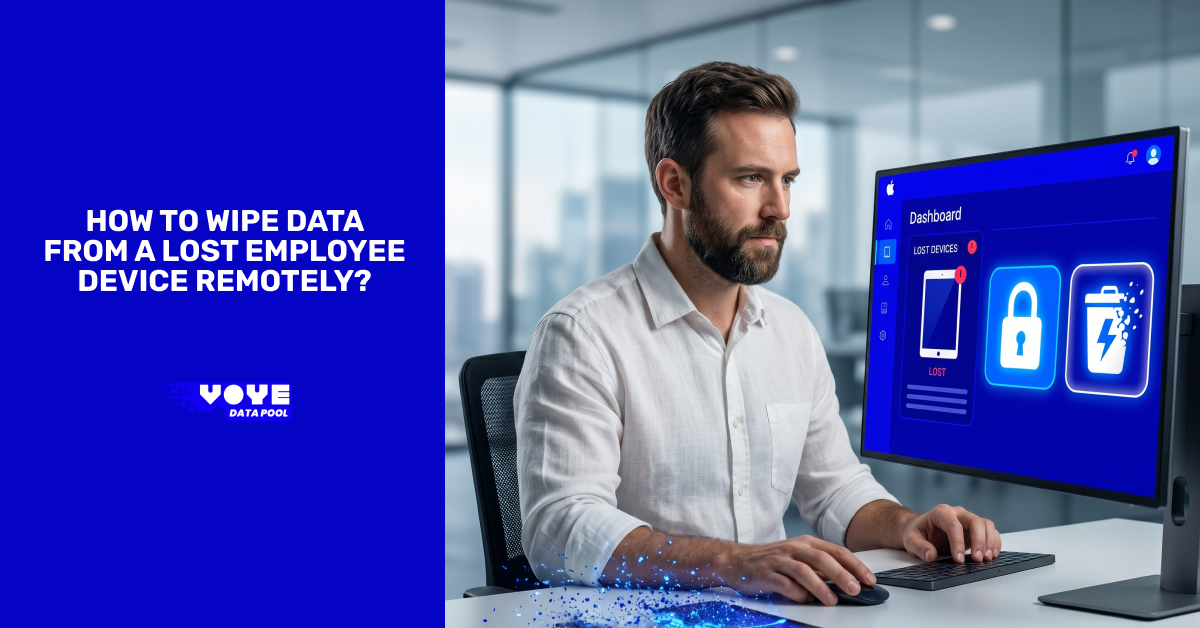
A lost employee device creates a moment where time, control, and visibility all collapse at once. For a Security Lead, the challenge is not just technical execution but maintaining authority over data that is no longer physically within reach. Remote data wiping is not merely a feature in a toolkit. It is a decisive action that defines whether an incident remains contained or escalates into a breach.
The ability to erase data remotely sits at the intersection of endpoint security, identity management, and data governance. When executed correctly, it ensures that even in the absence of the device, control over sensitive information never leaves the organization.
The Real Risk Behind a Lost Device
A missing device is rarely just about hardware. It represents an active gateway into enterprise systems. Modern work environments blur the lines between local storage and cloud access, meaning a single unlocked session or cached credential can expose far more than expected.
What makes this risk particularly dangerous is its unpredictability. Devices can be lost in transit, stolen, or simply misplaced, but in each scenario, the data remains vulnerable until decisive action is taken. The longer the delay, the greater the exposure.
From a leadership standpoint, the focus shifts from recovery to containment. The device may or may not return. The data must be secured regardless.
Remote Wiping as a Strategic Security Control
Remote wiping is a decisive security mechanism within a broader defense strategy, though it is rarely instantaneous. Its true power lies in its ability to permanently neutralize the threat once a connection is made, ensuring that even if physical recovery is impossible, the window of exposure is eventually slammed shut through automated policy enforcement.
This capability becomes even more powerful when integrated with centralized systems. A well-designed environment ensures that data is not deeply embedded within the device itself but accessed through controlled layers. This is where approaches like a custom data pool begin to change the equation, reducing dependency on endpoints and making remote wipe actions faster and more effective.

Secure Data On The Go
Protect business data instantly with reliable remote connectivity solutions.
Building the Foundation Before an Incident Happens
The effectiveness of a remote wipe depends entirely on the groundwork laid beforehand. Without proper infrastructure, even the most urgent response can fail.
A strong endpoint management system acts as the command center. It provides visibility into device status, enables remote commands, and ensures that every device remains within administrative reach. Encryption adds another layer of assurance, ensuring that even if a wipe is delayed, the data cannot be easily accessed.
Equally important is how data is structured across devices. Organizations that rely heavily on local storage face greater risks. Those who implement a custom data pool approach gain the advantage of centralized control, where access can be revoked instantly, and data exposure is minimized.
At the network level, maintaining a secure mobile connection ensures that commands such as remote wipe, lock, or access revocation can be executed without friction, regardless of where the device is located.
What Actually Happens During a Remote Wipe?
When a device is reported lost, the response must be immediate but controlled. The first step is not wiping, but understanding the situation. Knowing what data resides on the device and how it is accessed determines the level of response required.
Locking the device often comes first. It buys time and prevents immediate misuse. However, locking alone is not sufficient in high-risk scenarios. The decision to wipe must follow quickly when sensitive data is involved.
The wipe process itself varies depending on the system in place. In some cases, it triggers a full reset, removing all data and configurations. In others, it selectively removes corporate data while leaving personal content intact. This distinction becomes critical in environments where employees use their own devices for work.
Behind the scenes, the system issues a command that executes once the device connects to a network. However, because a wipe is asynchronous, it remains pending until connectivity is established. This makes hardware-level encryption the primary line of defense, as it secures data during the “gap” before the wipe command can be received and processed by the device.
The Role of Data Architecture in Wipe Effectiveness
Remote wiping is most effective when there is less to wipe in the first place. This might sound counterintuitive, but it reflects a deeper principle of modern security design.
When data is centrally managed through the platform provided by Voye Data Pool, devices act more as access points than storage units. Sensitive information remains within controlled environments, and endpoints only retrieve what is necessary, often temporarily.
This architecture reduces the risk associated with device loss. Even before a wipe is executed, the actual exposure is limited. Once the wipe command is triggered, the process becomes faster, cleaner, and more reliable.
Voye Data Pool strengthens this model by decoupling the data from the hardware. By ensuring that access is dynamic and revocable at the source, it provides a “network-level wipe” that works even if the physical device is offline. This reinforces the remote wipe action by ensuring that once a session is revoked, the device effectively holds a key to a door that has already been locked.
Navigating the Complexity of Different Device Types
Not all devices respond to remote wiping with the same reliability. Smartphones, with “always-on” cellular data, typically receive commands instantly. Laptops, however, often require a user to log in or connect to a known Wi-Fi network before they can communicate with a management server. In these cases, the ability to wipe depends heavily on the device reaching a network gate before an unauthorized user can bypass the OS.
Specialized devices and IoT endpoints introduce another layer of complexity. These often require alternative approaches, such as revoking access credentials or disabling integrations rather than performing a traditional wipe.
The key is not uniformity but adaptability. A strong security framework accounts for these differences and ensures that each device category is handled appropriately without delaying the response.
Stay Connected Anywhere Securely
Enable seamless access and fast remote actions on lost devices.
Compliance, Privacy, and Control
Remote wiping operates within a sensitive space where security requirements intersect with legal and privacy considerations. This is particularly relevant in BYOD environments, where personal and corporate data coexist.
Selective wiping becomes essential in such cases, provided the device was enrolled in a containerized management profile (MAM) beforehand. This allows organizations to surgically remove business applications and encrypted data caches without interfering with personal information, maintaining employee privacy while still enforcing rigorous corporate security.
Auditability also plays a critical role. Every wipe action must be recorded, including when it was initiated, how it was executed, and whether it was successful. These records are not just for internal tracking but also for regulatory compliance.
Clear communication with employees further strengthens the process. Transparency ensures that actions are understood and reduces the likelihood of disputes or confusion.
After the Wipe: What Comes Next?
Executing a remote wipe is not the end of the process. It marks the transition into analysis and improvement.
Understanding how the device was lost provides insights into potential gaps in policy or training. Was it negligence, lack of awareness, or a systemic issue? Each answer leads to a different corrective action.
Reissuing devices also presents an opportunity to strengthen configurations. Updated policies, improved controls, and tighter integrations can be implemented before the new device is deployed.
Over time, these refinements contribute to a more resilient system, where each incident strengthens the overall security posture rather than exposing weaknesses.
Challenges That Test Remote Wipe Strategies
Even with the best systems in place, challenges can arise. Devices may remain offline for extended periods, delaying wipe execution. Employees may report losses late, increasing the window of exposure.
These challenges highlight the importance of layered security. Remote wiping should not be the only line of defense. Encryption, access controls, and centralized data management all play supporting roles.
A system built around redundancy ensures that even if one control is delayed, others continue to protect the data.
Strengthening Your Approach as a Security Leader
Leadership in security is defined by anticipation rather than reaction. Remote wiping is most effective when it is part of a broader, well-integrated strategy.
Automation reduces response time, ensuring that actions can be triggered instantly. Regular testing validates that systems work as expected under real conditions. Integration between endpoint management and data platforms ensures that control remains centralized, even as devices become more distributed.
Combining these elements creates an environment where losing a device does not equate to losing control.
Conclusion
Devices will always be lost. That is an operational reality. What defines a strong organization is not the absence of incidents but the ability to handle them without disruption.
Remote data wiping, when backed by intelligent systems like a custom data pool and Voye Data Pool, transforms a potential crisis into a controlled event. It ensures that data remains protected, access remains governed, and the organization stays one step ahead.
In the end, it is not about the device that went missing. It is about the data that never did.
Control Devices From Anywhere
Maintain security visibility and execute wipes without network limitations.