

Business Travel Guide to the USA: Roaming Solutions
Business travel in the United States requires reliable and efficient connectivity to maintain productivity and communication. This guide highlights essential USA business roaming solutions, helping professionals choose the right option for seamless data access, cost control, and secure usage. It also explains how modern approaches like eSIM and custom data pool models improve flexibility for organizations. With Voye Data Pool, businesses can optimize roaming strategies and ensure uninterrupted connectivity throughout their travel experience.


 8 min read
 Share
Share
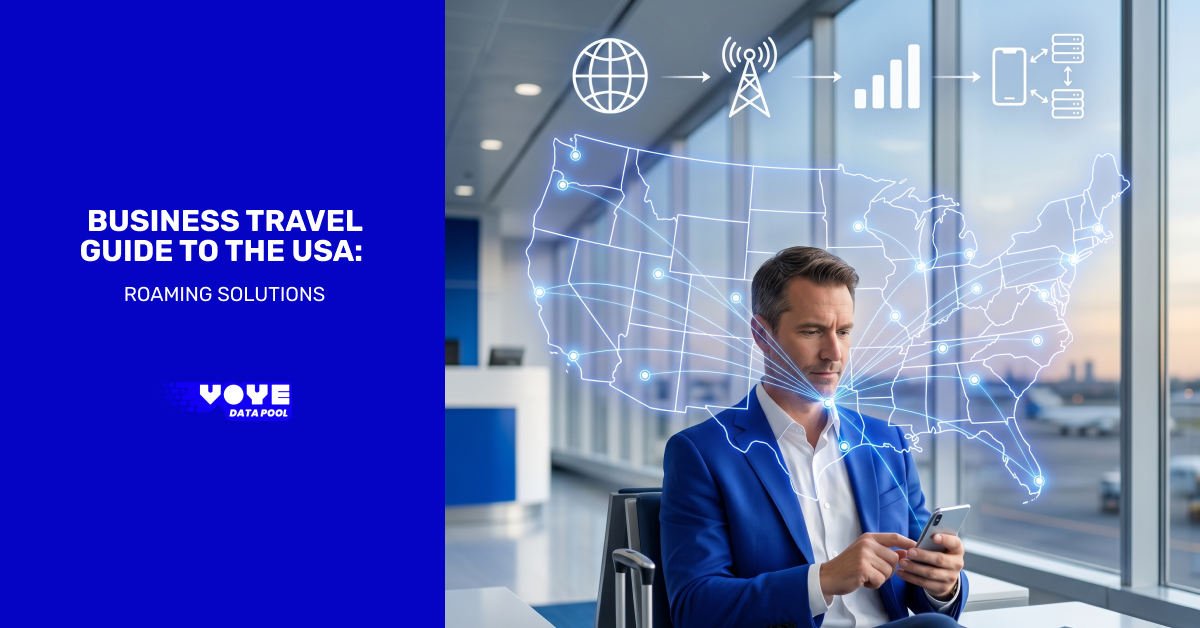
Business travel in the United States moves at a fast pace, and connectivity sits at the center of everything. From coordinating airport pickups to closing deals over video calls, every interaction depends on stable and secure mobile data. For business travelers, roaming is not just about staying online. It is about staying productive, responsive, and competitive in a dynamic environment.
Unlike leisure trips, business travel involves tight schedules, real-time collaboration, and constant communication. A weak signal or unexpected data outage can disrupt meetings, delay decisions, and affect outcomes. That is why choosing the right roaming solution is a strategic decision rather than a convenience.
The Role of Connectivity in Modern Business Travel
The United States has one of the most advanced telecom infrastructures in the world, yet connectivity experiences can vary depending on location, network provider, and device compatibility. A traveler moving between cities like New York, San Francisco, and Chicago may experience excellent speeds, while connectivity in transit zones or smaller towns may fluctuate.
Business travelers depend on uninterrupted access to cloud platforms, emails, CRM tools, and virtual meeting applications. These tools are data-intensive and require consistent bandwidth. Even a short interruption during a client presentation or negotiation can create friction.
Connectivity also plays a critical role in navigation, ride-hailing, digital payments, and real-time scheduling. The expectation is simple: everything should work instantly upon arrival without complex setup.

Stay Connected Anywhere USA
Reliable USA business roaming for uninterrupted work travel connectivity.
Navigating Roaming Options in the USA
Roaming in the United States is not a one-size-fits-all experience. The choice depends on the frequency of travel, duration of stay, and the intensity of data usage.
International roaming plans from home carriers now typically average $12 to $15 per day for a “Day Pass.” While convenient, these often include hidden “Fair Usage” policies that throttle speeds to 2G levels after just 2GB of daily usage. For a business traveler in 2026, this makes high-definition video conferencing impossible. Furthermore, pay-as-you-go rates have remained static at roughly $2.05 per MB, meaning a single background app update could lead to “bill shock” exceeding $1,000 in a single afternoon.
Local SIM cards offer better pricing and access to domestic networks. However, the process of purchasing, activating, and managing a new number can be inconvenient. Business travelers who rely on their primary number for communication often find this option disruptive. eSIM technology has introduced a more flexible alternative. With instant activation and the ability to switch between profiles, eSIMs reduce the need for physical SIM changes. However, not all devices support eSIM, and some plans may prioritize cost over performance.
For organizations managing multiple travelers, these individual solutions often fall short. The lack of centralized control, unpredictable costs, and inconsistent user experiences creates operational challenges.
The Shift Toward Smarter Roaming Models
As business travel becomes more global and frequent, companies are moving toward smarter connectivity models. Instead of assigning individual plans to each traveler, organizations are adopting shared data ecosystems that optimize usage across teams.
A custom data pool represents this shift. It allows businesses to allocate a shared volume of data across multiple users, ensuring that resources are used efficiently. Heavy users can consume more data without exceeding individual limits, while lighter users do not leave unused data behind.
This approach aligns with how modern teams operate. Employees travel across different regions, often at overlapping times, and require flexibility rather than rigid plans. A shared model adapts to these changing needs.
Addressing Common Connectivity Challenges
Even with advanced solutions, business travelers often encounter challenges that require proactive management.
While 95% of the US population is now covered by 5G, coverage quality varies wildly by carrier. In 2026, T-Mobile leads in raw availability, while Verizon often provides the superior 5G video experience in urban cores. Business travelers still face “dead zones” in rural corridors or within dense glass-and-steel conference centers where high-frequency 5G signals struggle to penetrate. A modern solution must provide multi-network switching, allowing the device to hop between AT&T, T-Mobile, and Verizon to maintain a stable 500Mbps connection regardless of the specific local infrastructure.
Cost unpredictability is another concern. Data-heavy activities such as video conferencing, file transfers, and cloud synchronization can quickly consume allocated limits. Without proper monitoring, expenses can escalate. Security is equally critical. Public Wi-Fi networks, commonly used in airports and hotels, expose users to potential cyber threats. Mobile data, when managed securely, provides a safer alternative for accessing sensitive information.
Device compatibility also plays a role. Not all devices are optimized for US network bands, which can affect speed and reliability. Pre-travel checks can prevent these issues.
Real-World Use Case: A Consulting Team in Transit
Consider a consulting firm with a team traveling from India to the United States for a two-week client engagement. The team consists of project managers, analysts, and technical experts, each with different data needs.
During the first few days, the team relies heavily on video conferencing, cloud dashboards, and document sharing. Midway through the trip, they begin traveling between cities, increasing their reliance on navigation apps and real-time communication tools.
Instead of managing separate roaming plans, the firm uses a centralized data solution. This allows the entire team to draw from a shared pool, ensuring that high-demand users are supported without exceeding limits. At the same time, administrators monitor usage in real time, making adjustments as needed.
This model not only reduces costs but also eliminates the stress of managing connectivity on an individual level.
Smart Data For Teams
Manage travel connectivity easily with flexible custom data pool solutions.
Enhancing Efficiency with Voye Data Pool
For organizations seeking a streamlined approach, Voye Data Pool offers a practical solution tailored to business travel. It combines flexibility, scalability, and centralized control, making it suitable for companies with frequent international operations.
The Voye Data Pool platform provides an enterprise-grade dashboard where administrators can instantly reallocate data in real-time. In 2026, this includes the ability to set custom usage quotas for different teams – for example, giving technical leads higher priority bandwidth while capping data for short-term contractors. Because the system connects to local US networks rather than routing traffic back through a home country, it reduces latency and can lower organizational roaming costs by up to 90% compared to traditional carrier plans.
One of the key advantages lies in visibility. Real-time analytics provide insights into how data is being consumed, enabling businesses to make informed decisions. This level of control is particularly useful during high-intensity travel periods when data demand fluctuates. Voye Data Pool also supports multi-device usage, which is essential for professionals who rely on smartphones, tablets, and laptops simultaneously. The ability to maintain consistent connectivity across devices enhances productivity and reduces downtime.
Managing Connectivity During the Trip
As business travel progresses, data usage patterns often change. Initial days may involve heavy communication, while later stages focus on execution and reporting. Monitoring usage throughout the trip helps maintain balance and avoid disruptions.
At this stage, reliance on USA business roaming becomes more evident, as travelers engage in frequent meetings, presentations, and collaborative sessions. Adjusting data consumption based on these activities ensures that connectivity remains stable.
Simple practices such as reducing video quality during calls, limiting background app activity, and prioritizing essential tools can significantly extend data availability. Secure Wi-Fi can be used selectively, but mobile data remains the backbone of reliable connectivity.
Industry Perspectives on Connectivity Needs
Different industries approach roaming with unique priorities. Consulting firms prioritize collaboration tools and file sharing, while sales teams focus on CRM access and communication. Technology professionals require secure connections for system monitoring and deployment.
Healthcare and pharmaceutical professionals place a strong emphasis on data security and compliance. Their connectivity solutions must meet strict standards while maintaining reliability.
A flexible roaming strategy must accommodate these diverse requirements without adding complexity. Solutions that adapt to varying usage patterns provide a clear advantage.
The Future of Business Roaming in the USA
The evolution of mobile connectivity continues to reshape business travel. The expansion of 5G networks across major US cities is enhancing speed and reducing latency, enabling smoother video calls and faster data transfers.
In 2026, eSIM has become the primary standard, with most flagship business smartphones now shipping without physical SIM slots. This shift has turned connectivity into a software-defined service. Advancements in AI-driven analytics now allow Voye to predict high-usage periods and alert managers before a data pool is exhausted, ensuring that a critical negotiation is never cut short by a connectivity cutoff.
Businesses are increasingly looking for solutions that integrate seamlessly with their operations. Connectivity is no longer a standalone service. It is part of a larger ecosystem that supports productivity, security, and cost efficiency.
Conclusion
Business travel in the United States demands more than basic connectivity. It requires a reliable, secure, and adaptable roaming strategy that supports the fast-paced nature of professional engagements.
While traditional options such as international roaming and local SIM cards serve specific needs, they often fall short for frequent travelers and organizations. Modern approaches like a custom data pool offer greater flexibility and efficiency, aligning with the evolving demands of global business.
Voye Data Pool brings structure and control to roaming, enabling businesses to manage connectivity with precision. With the right strategy in place, business travelers can stay focused on their goals, confident that their connection will keep up with their ambitions.
Upgrade Travel Connectivity Today
Seamless USA business roaming with secure high-speed data access.