

Remote Learning Internet: Reliable Connectivity for Education & Research
Remote learning internet plays a vital role in modern education, helping students and teachers access online classes, digital resources, research databases, virtual collaboration tools and learning platforms. This guide covers the internet requirements for remote learning, the importance of reliable connectivity, mobile internet options, eSIM technology and common connectivity challenges. It also explains how schools, universities and research teams can improve internet access to create more flexible, reliable and effective digital learning environments.


 10 min read
 Share
Share
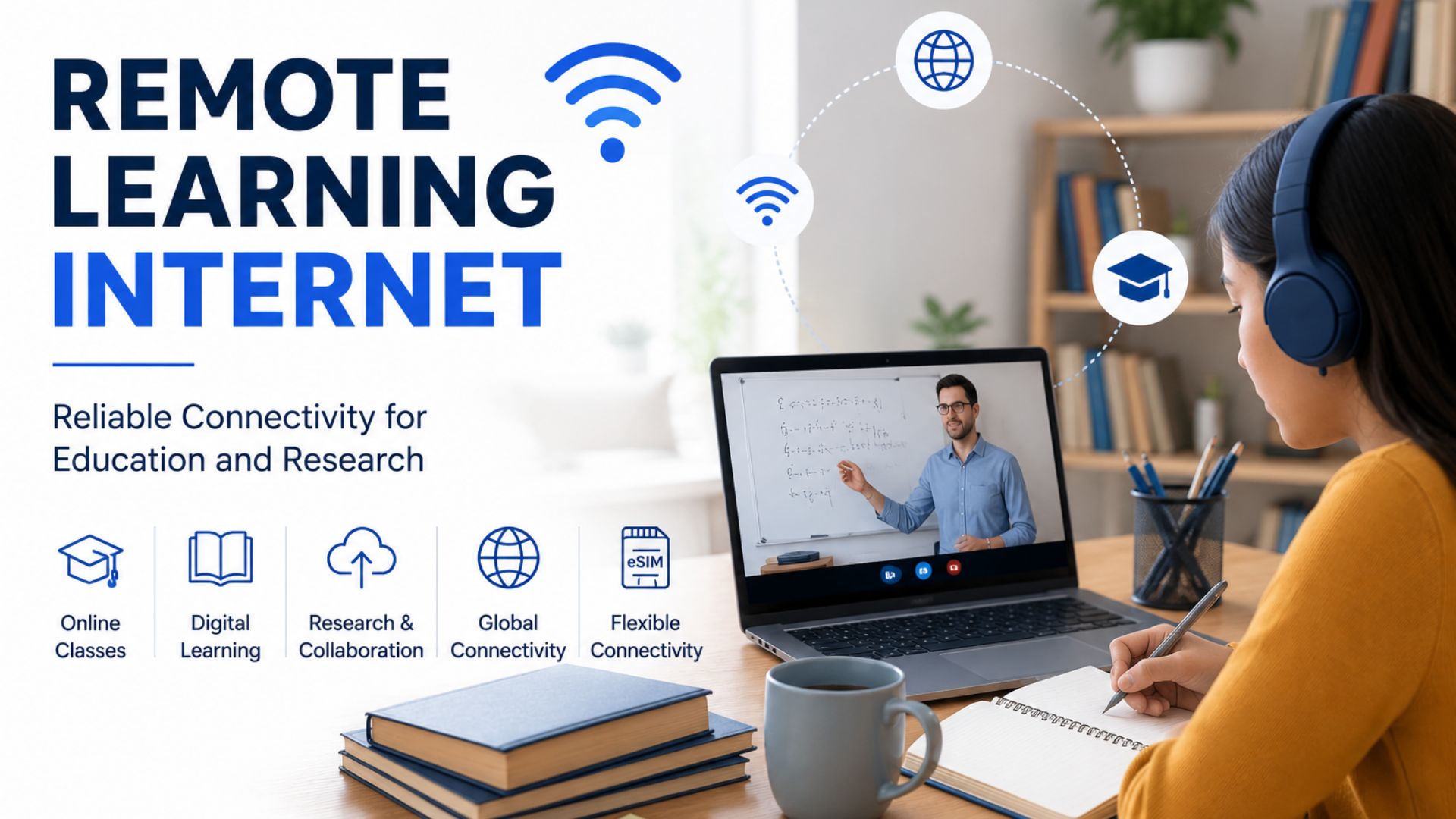
Remote learning internet has become an important part of modern education. Students attend virtual classes, download course materials, submit assignments, access digital libraries, and collaborate with teachers and classmates online. Researchers also depend on reliable connectivity to access academic databases, cloud platforms, research papers, and collaboration tools.
A weak connection can interrupt a live lecture, delay an assignment upload, or make it difficult to access large research files. For schools, colleges, universities, and education organisations, reliable internet is no longer just a convenience. It is part of the learning infrastructure.
In 2026, education is increasingly connected to cloud-based platforms, video learning, digital resources, and mobile devices. That makes reliable connectivity essential for students and educators who need to learn or teach beyond the traditional classroom.

Keep Learning Connected Anywhere
Stay connected with reliable eSIM solutions for education teams.
What Is Remote Learning Internet?
Remote learning internet refers to an internet connection that allows students, teachers, and researchers to access educational resources without being physically present at a school, college, or university.
It supports activities such as:
- Live online classes and video lectures
- Learning management systems (LMS)
- Digital libraries and research databases
- Online assignments and examinations
- Educational videos and recorded lessons
- Cloud-based documents and applications
- Student-teacher communication
- Virtual group projects
- Academic research and collaboration
- Access to online courses and training
The connection can come from fixed broadband, fibre, Wi-Fi, mobile broadband, 4G, 5G, or other wireless technologies.
The important factor is not simply having internet access. The connection needs to be stable, reliable, and suitable for the learning activity.
Why Reliable Internet Matters for Remote Learning
Remote learning depends on continuous access to digital platforms. A student may have a laptop and the right software, but those resources become difficult to use when the connection keeps dropping.
The OECD notes that stable, high-speed connectivity with low latency is important for both real-time and self-paced digital learning.
Reliable connectivity helps students:
Attend live classes
Video-based classes require a consistent connection. Interruptions can cause students to miss explanations, discussions, and important instructions.
Access learning materials
Modern courses often include videos, presentations, PDFs, interactive lessons, and cloud-based resources. A stable connection makes these resources easier to access.
Submit assignments
Large presentations, videos, design files, and research documents can take time to upload. A dependable connection reduces the risk of failed submissions.
Communicate with teachers
Email, messaging platforms, video calls, and virtual office hours all depend on internet access.
Collaborate with classmates
Group projects increasingly use cloud documents, online meeting tools, and shared learning platforms. Students need reliable access to work together.
How Much Internet Speed Is Needed for Remote Learning?
There is no single internet speed that works for every student or institution. The right level depends on the number of connected users and what they are doing online.
A student watching a recorded lecture has different needs from a classroom where 30 students are simultaneously joining a live video session.
As a practical guide:
| Learning activity | Suggested connection |
| Web browsing and reading | Basic broadband |
| Downloading documents | Stable broadband |
| HD educational videos | Moderate to high-speed connection |
| Live video classes | Stable broadband with sufficient upload and download capacity |
| Video conferencing | Reliable connection with low interruptions |
| Large research files | Higher download capacity |
| Multiple users at once | Higher overall bandwidth |
For example, the University of San Diego identifies 25 Mbps download and 3 Mbps upload as an absolute minimum recommendation for remote learning, while noting that higher speeds provide a better experience.
However, speed alone does not determine connection quality. Latency, network stability, congestion, and upload performance can also affect the learning experience.
Download Speed vs Upload Speed
Students often focus only on download speed, but upload speed matters too.
Download speed affects activities such as:
- Watching lectures
- Downloading research papers
- Opening websites
- Accessing digital libraries
- Downloading course files
Upload speed becomes important when:
- Joining interactive video sessions
- Uploading assignments
- Sending large files
- Presenting during an online class
- Uploading recorded presentations
- Collaborating through cloud applications
For institutions, both sides of the connection should be considered when selecting connectivity solutions.
Mobile Internet for Remote Learning
Fixed broadband is not available everywhere. Students may study from temporary accommodation, rural areas, campus housing, libraries, travelling locations, or places where broadband service is unreliable.
This is where mobile connectivity can provide an additional option.
A mobile data connection can allow students and educators to connect laptops, tablets or compatible smartphones without depending entirely on a fixed broadband network.
Mobile connectivity can be especially useful for:
- Travelling students
- Field researchers
- Visiting academics
- Remote learners
- Students living in areas with inconsistent broadband
- Education teams working across multiple locations
- International study programmes
- Temporary learning environments
Research has repeatedly shown that internet availability and connection quality can influence online learning. An India-based study found that 50% of surveyed students reported excellent internet connectivity, while the remaining participants reported good or poor connectivity. The study also found differences in connectivity across locations.
The Role of eSIM in Education Connectivity
An eSIM can provide mobile connectivity without requiring a physical SIM card. This can be useful when learners, researchers or education teams move between locations.
For example, an international research team may travel between several countries for fieldwork. Instead of purchasing and managing a physical SIM at every destination, compatible devices can use eSIM technology for mobile data connectivity.
For education organisations, eSIM technology can support:
- International student programmes
- Field research teams
- Visiting faculty
- Study-abroad programmes
- Educational conferences
- Remote education initiatives
- Mobile learning devices
- Temporary connectivity requirements
The main benefit is flexibility. Connectivity can be provisioned digitally rather than relying on physical SIM distribution.
Remote Learning Internet for Research
Remote learning is only one part of modern digital education. Research also depends heavily on internet access.
Students and researchers may need to access:
- Academic journals
- Digital libraries
- Online archives
- Research databases
- University portals
- Cloud storage
- Statistical tools
- Research software
- Online conferences
- Collaboration platforms
Large datasets and multimedia research can also require substantial bandwidth.
For researchers working outside a university campus, mobile connectivity can provide a useful backup when local Wi-Fi is unavailable.
This becomes particularly important for field researchers. They may work in locations where traditional campus infrastructure is not available but still need to upload observations, communicate with supervisors or access cloud-based research tools.
Simplify Connectivity for Education Teams
Manage connectivity for students, faculty, and researchers.
Internet Challenges Facing Remote Learners
Access to the internet does not automatically create equal learning opportunities.
The digital divide includes differences in connectivity, devices, affordability, infrastructure and digital skills. The OECD identifies these factors as important barriers to equal participation in digital education.
Common challenges include:
- Unstable connections
Frequent disconnections can interrupt classes and make online assessments difficult.
- Limited bandwidth
Multiple people using the same connection can reduce available bandwidth.
- High data consumption
Video classes and large downloads can quickly consume mobile data allowances.
- Rural connectivity gaps
Students in remote areas may have fewer reliable internet options.
- Device limitations
A smartphone may provide basic access but may not offer the same functionality as a laptop or desktop.
- Power interruptions
Internet connectivity is not useful if students cannot consistently power their devices or network equipment.
A study of online learning in India found that 52% of surveyed teachers reported stable and reliable internet, while 32% described their connection as satisfactory. Others reported poor connectivity.
How Schools and Universities Can Improve Connectivity?
Educational institutions can take several practical steps to make remote learning more resilient.
1. Assess student connectivity
Institutions should understand how students connect to the internet, what devices they use and where connectivity gaps exist.
2. Provide backup connectivity
Hotspots, mobile data and eSIM-based solutions can provide alternatives when fixed broadband is unavailable.
3. Support asynchronous learning
Recorded lectures and downloadable resources can help students who cannot always attend live sessions.
4. Reduce unnecessary data consumption
Compressing videos and providing downloadable materials can help learners with limited data.
5. Improve campus connectivity
Strong Wi-Fi remains important for students who use libraries, classrooms, and other campus spaces for digital learning.
6. Create flexible learning policies
Connectivity problems should not automatically prevent students from completing coursework. Institutions can provide reasonable alternatives for learners facing technical barriers.
7. Monitor connectivity needs
Connectivity requirements change as courses, technologies, and student populations change. Regular reviews can help institutions identify new gaps.
How Voye Data Pool Can Support Education Connectivity
Voye Data Pool provides a centralised eSIM connectivity platform designed for organisations managing mobile connectivity across multiple users and locations. While the platform is built for business connectivity, its capabilities can also be relevant to education organisations with travelling teams, researchers, international programmes, or distributed devices. Voye Data Pool provides connectivity across 130+ countries, with eSIM management, remote activation, and centralised usage visibility.
Education organisations can use this type of connectivity model for scenarios such as:
- Research teams travelling internationally
- Faculty members attending overseas conferences
- Students participating in international programmes
- Field researchers working away from campus
- Education teams managing mobile devices
- Temporary connectivity for off-campus projects
A centralised platform can also make it easier for administrators to manage multiple eSIMs rather than handling each connection separately.
Benefits of Centralised Connectivity for Education Teams
- Easier deployment
eSIMs can be provisioned digitally, reducing the need to distribute physical SIM cards.
- Centralised management
Administrators can manage multiple connections from a single platform.
- Better visibility
Usage monitoring can help organisations understand how connectivity is being consumed.
- International flexibility
Education teams working across borders can maintain mobile connectivity without relying on a separate physical SIM for every destination.
- Scalable connectivity
A centralised approach can support organisations as their number of connected users and devices grows.
Voye Data Pool’s business platform currently offers plans with multiple eSIMs and coverage across more than 141 countries, depending on the selected plan.
Remote Learning Internet: A Practical Checklist
Before choosing an internet solution for remote learning, schools, universities and education teams should consider:
- Is the connection stable during live classes?
- Is upload speed sufficient for video calls and assignments?
- Can multiple users connect at the same time?
- Is there a backup connection?
- How much data do students or staff need?
- Does the solution work outside the main campus?
- Can connectivity be used internationally?
- Can administrators monitor usage?
- Can additional users or devices be added easily?
- Are compatible devices available to learners?
The best solution is usually not the one with the highest advertised speed. It is the one that matches the actual learning environment.
The Future of Internet Connectivity in Education
Education is moving towards a more flexible digital model. Online courses, hybrid classrooms, cloud-based research, digital assessments, and virtual collaboration are likely to remain important parts of education.
Connectivity will therefore need to support more than video calls. Students may use several cloud applications at the same time, researchers may transfer large datasets, and institutions may manage thousands of connected devices.
In 2026, the focus should shift from simply asking whether a student has internet access to asking whether that connection is reliable, sufficient, secure and available when learning requires it.
Mobile connectivity and eSIM technology can play a supporting role alongside fixed broadband and campus networks. Together, these technologies can create more resilient learning environments.
Final Thoughts
Reliable remote learning internet is a foundation for modern digital education. Students need it to attend classes, research information, submit assignments, and communicate with teachers. Researchers need it to access academic resources, transfer data and collaborate across locations. The digital divide shows that internet access is still uneven, making flexible connectivity options important for educational institutions.
Power Learning Beyond the Classroom
Enable flexible connectivity for remote learning and research.
For organisations managing students, researchers, faculty, or mobile learning devices across different locations, eSIM connectivity can provide another layer of flexibility. Voye Data Pool helps organisations manage eSIM connectivity centrally, with global coverage, remote provisioning, and usage visibility. The goal is simple: make connectivity less of a barrier to learning and more of an enabler of education.