Get 5% Discount using the code VOYE15 Buy eSIM close

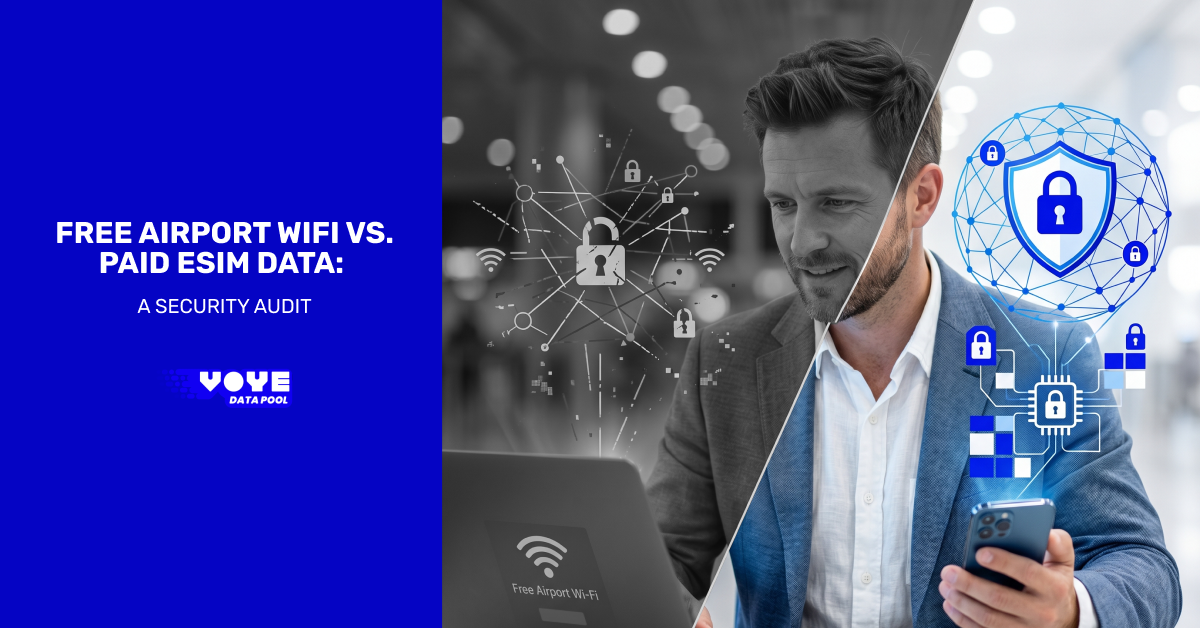
Free Airport WiFi vs. Paid eSIM Data: A Security Audit

Free airport WiFi may offer convenience, but it can expose business travelers and organizations to significant cybersecurity risks. This blog explores the security differences between public airport networks and enterprise eSIM solutions, examining threat exposure, compliance considerations, reliability, and risk management. Designed for CISOs and security leaders, it provides a practical security audit of both connectivity options and explains why secure mobile connectivity has become an essential component of modern enterprise travel strategies.

Voye Data Pool Team
May 29, 2026 dot Read 8 min read
share Share
Free Airport WiFi vs. Paid eSIM Data A Security Audit

Modern business travel depends on uninterrupted connectivity. Whether executives are reviewing sensitive reports, security teams are monitoring incidents remotely, or employees are collaborating across continents, internet access has become a critical requirement rather than a convenience. Airports have responded by offering free WiFi networks that allow travelers to connect quickly and avoid roaming expenses. At the same time, paid eSIM data solutions have emerged as an alternative that promises greater privacy, reliability, and control.

For CISOs and cybersecurity leaders, the choice between free airport WiFi and paid eSIM connectivity extends beyond cost considerations. It directly impacts organizational risk exposure, data protection strategies, regulatory compliance, and business continuity. Understanding the security implications of each option is essential in an era where threat actors continuously target mobile users and remote workers. This security audit examines both connectivity methods, highlights key risks, and provides practical insights for enterprise decision-makers.

Why Connectivity Security Matters During Travel?

Business travelers frequently access corporate email, cloud applications, collaboration platforms, customer databases, and internal systems while on the move. Airports are particularly attractive environments for cybercriminals because they bring together thousands of users, devices, and networks in a single location.

When travelers connect to unsecured or poorly managed networks, attackers may attempt to intercept communications, deploy malicious software, steal credentials, or conduct surveillance activities. A single compromised connection can create a pathway into broader enterprise systems, making travel connectivity a strategic security concern rather than a personal one.

As organizations continue to embrace remote and hybrid work models, the security of mobile internet access has become an increasingly important component of enterprise risk management.

Understanding Free Airport WiFi

Free airport WiFi provides convenient internet access to travelers without requiring direct payment. Users typically connect through a captive portal, accept terms and conditions, and gain immediate access to the network.

While this convenience is appealing, airport WiFi environments often present several security challenges. Large public networks serve thousands of users simultaneously, creating opportunities for attackers to exploit weak security controls or user behavior.

Common risks associated with airport WiFi include:

  • Rogue access points designed to mimic legitimate airport networks.
  • Session hijacking attacks target unsecured connections.
  • Credential theft through phishing pages and fake login portals.
  • Network monitoring by malicious actors sharing the same infrastructure.

Although many airports have improved wireless security standards, users frequently struggle to verify whether they are connecting to the official network or an impersonated version created by attackers.

The Hidden Risks Behind Public Networks

One of the primary concerns with airport WiFi is visibility. Users rarely know who manages the network, how traffic is monitored, or what security controls are in place. This lack of transparency creates uncertainty for organizations responsible for protecting sensitive information.

Threat actors commonly exploit crowded travel environments because travelers are often distracted, rushed, and focused on logistics rather than cybersecurity. In these conditions, even experienced professionals may inadvertently connect to fraudulent networks or overlook warning signs.

The issue becomes more concerning when employees access confidential corporate resources. Sensitive communications, financial information, intellectual property, and customer records may all become attractive targets if security measures are inadequate.

Security researchers have repeatedly highlighted the dangers associated with public WiFi hacking in transportation hubs, hospitality venues, and other high-traffic locations. While not every public network is inherently dangerous, the expanded attack surface significantly increases organizational exposure.

How Paid eSIM Data Changes the Security Equation?

Paid eSIM data offers a fundamentally different connectivity model. Instead of relying on shared public infrastructure, users connect directly through mobile carrier networks using a digitally provisioned SIM profile.

This approach reduces many of the risks commonly associated with public wireless environments. Since connectivity occurs through a cellular network rather than a shared hotspot, opportunities for local network-based attacks are significantly reduced.

From a security perspective, eSIM technology provides several advantages:

  • Reduced exposure to rogue wireless access points.
  • Greater control over network authentication.
  • Lower risk of local interception attacks.
  • Consistent connectivity across multiple destinations.

For security teams, these advantages can translate into a smaller attack surface and improved confidence when employees access corporate resources while traveling.

Evaluating Threat Models for Enterprise Travelers

A meaningful security audit requires examining realistic threat scenarios rather than focusing solely on theoretical risks.

Consider a senior executive waiting for an international flight while reviewing confidential acquisition documents. If that executive connects to a compromised airport network, attackers may attempt credential harvesting, traffic analysis, or malware delivery.

Now consider the same executive using a paid eSIM connection. The attacker no longer shares the same local wireless environment and loses access to many attack techniques that depend on public network proximity.

The difference is not merely technical. It directly affects the likelihood of successful compromise.

For CISOs responsible for protecting high-value personnel, reducing attack opportunities is often more important than responding after an incident occurs. Proactive risk reduction remains one of the most effective cybersecurity strategies.

Compliance and Regulatory Considerations

Many organizations operate within strict regulatory frameworks that govern data protection and information security. Industries such as finance, healthcare, legal services, and government contracting face particularly demanding compliance requirements.

When employees access regulated information through public networks, organizations may encounter additional challenges related to:

  • Data confidentiality.
  • Auditability.
  • Secure transmission requirements.
  • Third-party network dependencies.

Paid eSIM connectivity can support compliance objectives by providing a more controlled and predictable network environment. While eSIM usage alone does not guarantee compliance, it can complement broader security controls such as VPNs, endpoint protection, zero-trust architectures, and multifactor authentication.

For enterprise security leaders, the objective is not simply enabling connectivity but ensuring that connectivity aligns with governance and risk management standards. This is one reason why many organizations are increasingly evaluating enterprise eSIM solutions as part of their broader cybersecurity and mobility strategies.

Reliability as a Security Factor

Security discussions often focus exclusively on threats and vulnerabilities, but reliability also plays a significant role.

Overloaded airport WiFi networks may experience congestion, slow performance, or unexpected interruptions. These disruptions can encourage risky behavior as users seek alternative connectivity options or bypass security controls to complete urgent tasks.

A reliable connection helps maintain secure workflows. Employees are less likely to connect to suspicious networks, disable protective technologies, or postpone critical updates when dependable internet access is available.

Paid eSIM solutions frequently provide more consistent performance across different locations, supporting both productivity and security objectives. Reliability becomes particularly important during incident response situations where communication delays can have operational consequences.

Cost Versus Risk: The Executive Perspective

At first glance, free airport WiFi appears to offer obvious financial advantages. However, security leaders understand that direct costs represent only one component of the equation.

The true cost of a connectivity decision should also include potential exposure to:

  • Data breaches.
  • Incident response expenses.
  • Regulatory penalties.
  • Reputational damage.
  • Operational disruptions.

A single cybersecurity incident can far exceed the cumulative cost of secure connectivity solutions for an entire workforce.

This is why many organizations evaluate internet access through a risk-adjusted lens rather than a purely budgetary one. The conversation shifts from saving a few dollars on connectivity to preventing potentially significant business losses.

The ongoing concerns surrounding public WiFi hacking reinforce the importance of assessing total risk rather than focusing solely on immediate expenses.

Building a Secure Travel Connectivity Strategy

Effective travel security requires a layered approach. Neither airport WiFi nor eSIM technology should be viewed as a standalone solution.

Organizations can strengthen travel security by implementing several complementary measures:

  • Enforce VPN usage for all remote connections.
  • Require multifactor authentication across critical systems.
  • Deploy mobile threat defense solutions.
  • Provide security awareness training for travelers.
  • Establish clear connectivity policies before international travel.

When combined with secure mobile connectivity, these controls create multiple barriers against cyber threats.

Organizations seeking scalable global connectivity often evaluate solutions such as Voye Data Pool because secure access has become an integral part of modern travel risk management. Selecting the right connectivity strategy should align with broader cybersecurity objectives rather than short-term convenience.

Final Security Audit Findings

The comparison between free airport WiFi and paid eSIM data reveals a clear distinction in risk exposure. Airport WiFi delivers convenience and accessibility, but it also introduces uncertainties related to network trust, user verification, and potential attack vectors. These concerns become more significant when employees handle sensitive business information.

Paid eSIM connectivity offers a more controlled environment that reduces reliance on shared public infrastructure. While no technology eliminates risk, eSIM-based access can substantially decrease opportunities for network-based attacks and support stronger enterprise security practices. For organizations focused on reducing exposure, improving compliance alignment, and protecting mobile workforces, this approach presents a compelling security advantage.

As cyber threats continue to evolve, CISOs must evaluate connectivity choices through the lens of risk management rather than convenience alone. The most effective travel security strategies prioritize secure access, operational resilience, and long-term protection of corporate assets. In that context, paid eSIM data represents more than an alternative to free airport WiFi. It serves as a practical component of a modern cybersecurity framework designed for an increasingly mobile world.

Modern business travel depends on uninterrupted connectivity. Whether executives are reviewing sensitive reports, security teams are monitoring incidents remotely, or employees are collaborating across continents, internet access has become a critical requirement rather than a convenience. Airports have responded by offering free WiFi networks that allow travelers to connect quickly and avoid roaming expenses. At the same time, paid eSIM data solutions have emerged as an alternative that promises greater privacy, reliability, and control.

For CISOs and cybersecurity leaders, the choice between free airport WiFi and paid eSIM connectivity extends beyond cost considerations. It directly impacts organizational risk exposure, data protection strategies, regulatory compliance, and business continuity. Understanding the security implications of each option is essential in an era where threat actors continuously target mobile users and remote workers. This security audit examines both connectivity methods, highlights key risks, and provides practical insights for enterprise decision-makers.

Why Connectivity Security Matters During Travel?

Business travelers frequently access corporate email, cloud applications, collaboration platforms, customer databases, and internal systems while on the move. Airports are particularly attractive environments for cybercriminals because they bring together thousands of users, devices, and networks in a single location.

When travelers connect to unsecured or poorly managed networks, attackers may attempt to intercept communications, deploy malicious software, steal credentials, or conduct surveillance activities. A single compromised connection can create a pathway into broader enterprise systems, making travel connectivity a strategic security concern rather than a personal one.

As organizations continue to embrace remote and hybrid work models, the security of mobile internet access has become an increasingly important component of enterprise risk management.

Understanding Free Airport WiFi

Free airport WiFi provides convenient internet access to travelers without requiring direct payment. Users typically connect through a captive portal, accept terms and conditions, and gain immediate access to the network.

While this convenience is appealing, airport WiFi environments often present several security challenges. Large public networks serve thousands of users simultaneously, creating opportunities for attackers to exploit weak security controls or user behavior.

Common risks associated with airport WiFi include:

  • Rogue access points designed to mimic legitimate airport networks.
  • Session hijacking attacks target unsecured connections.
  • Credential theft through phishing pages and fake login portals.
  • Network monitoring by malicious actors sharing the same infrastructure.

Although many airports have improved wireless security standards, users frequently struggle to verify whether they are connecting to the official network or an impersonated version created by attackers.

The Hidden Risks Behind Public Networks

One of the primary concerns with airport WiFi is visibility. Users rarely know who manages the network, how traffic is monitored, or what security controls are in place. This lack of transparency creates uncertainty for organizations responsible for protecting sensitive information.

Threat actors commonly exploit crowded travel environments because travelers are often distracted, rushed, and focused on logistics rather than cybersecurity. In these conditions, even experienced professionals may inadvertently connect to fraudulent networks or overlook warning signs.

The issue becomes more concerning when employees access confidential corporate resources. Sensitive communications, financial information, intellectual property, and customer records may all become attractive targets if security measures are inadequate.

Security researchers have repeatedly highlighted the dangers associated with public WiFi hacking in transportation hubs, hospitality venues, and other high-traffic locations. While not every public network is inherently dangerous, the expanded attack surface significantly increases organizational exposure.

How Paid eSIM Data Changes the Security Equation?

Paid eSIM data offers a fundamentally different connectivity model. Instead of relying on shared public infrastructure, users connect directly through mobile carrier networks using a digitally provisioned SIM profile.

This approach reduces many of the risks commonly associated with public wireless environments. Since connectivity occurs through a cellular network rather than a shared hotspot, opportunities for local network-based attacks are significantly reduced.

From a security perspective, eSIM technology provides several advantages:

  • Reduced exposure to rogue wireless access points.
  • Greater control over network authentication.
  • Lower risk of local interception attacks.
  • Consistent connectivity across multiple destinations.

For security teams, these advantages can translate into a smaller attack surface and improved confidence when employees access corporate resources while traveling.

Evaluating Threat Models for Enterprise Travelers

A meaningful security audit requires examining realistic threat scenarios rather than focusing solely on theoretical risks.

Consider a senior executive waiting for an international flight while reviewing confidential acquisition documents. If that executive connects to a compromised airport network, attackers may attempt credential harvesting, traffic analysis, or malware delivery.

Now consider the same executive using a paid eSIM connection. The attacker no longer shares the same local wireless environment and loses access to many attack techniques that depend on public network proximity.

The difference is not merely technical. It directly affects the likelihood of successful compromise.

For CISOs responsible for protecting high-value personnel, reducing attack opportunities is often more important than responding after an incident occurs. Proactive risk reduction remains one of the most effective cybersecurity strategies.

Compliance and Regulatory Considerations

Many organizations operate within strict regulatory frameworks that govern data protection and information security. Industries such as finance, healthcare, legal services, and government contracting face particularly demanding compliance requirements.

When employees access regulated information through public networks, organizations may encounter additional challenges related to:

  • Data confidentiality.
  • Auditability.
  • Secure transmission requirements.
  • Third-party network dependencies.

Paid eSIM connectivity can support compliance objectives by providing a more controlled and predictable network environment. While eSIM usage alone does not guarantee compliance, it can complement broader security controls such as VPNs, endpoint protection, zero-trust architectures, and multifactor authentication.

For enterprise security leaders, the objective is not simply enabling connectivity but ensuring that connectivity aligns with governance and risk management standards. This is one reason why many organizations are increasingly evaluating enterprise eSIM solutions as part of their broader cybersecurity and mobility strategies.

Reliability as a Security Factor

Security discussions often focus exclusively on threats and vulnerabilities, but reliability also plays a significant role.

Overloaded airport WiFi networks may experience congestion, slow performance, or unexpected interruptions. These disruptions can encourage risky behavior as users seek alternative connectivity options or bypass security controls to complete urgent tasks.

A reliable connection helps maintain secure workflows. Employees are less likely to connect to suspicious networks, disable protective technologies, or postpone critical updates when dependable internet access is available.

Paid eSIM solutions frequently provide more consistent performance across different locations, supporting both productivity and security objectives. Reliability becomes particularly important during incident response situations where communication delays can have operational consequences.

Cost Versus Risk: The Executive Perspective

At first glance, free airport WiFi appears to offer obvious financial advantages. However, security leaders understand that direct costs represent only one component of the equation.

The true cost of a connectivity decision should also include potential exposure to:

  • Data breaches.
  • Incident response expenses.
  • Regulatory penalties.
  • Reputational damage.
  • Operational disruptions.

A single cybersecurity incident can far exceed the cumulative cost of secure connectivity solutions for an entire workforce.

This is why many organizations evaluate internet access through a risk-adjusted lens rather than a purely budgetary one. The conversation shifts from saving a few dollars on connectivity to preventing potentially significant business losses.

The ongoing concerns surrounding public WiFi hacking reinforce the importance of assessing total risk rather than focusing solely on immediate expenses.

Building a Secure Travel Connectivity Strategy

Effective travel security requires a layered approach. Neither airport WiFi nor eSIM technology should be viewed as a standalone solution.

Organizations can strengthen travel security by implementing several complementary measures:

  • Enforce VPN usage for all remote connections.
  • Require multifactor authentication across critical systems.
  • Deploy mobile threat defense solutions.
  • Provide security awareness training for travelers.
  • Establish clear connectivity policies before international travel.

When combined with secure mobile connectivity, these controls create multiple barriers against cyber threats.

Organizations seeking scalable global connectivity often evaluate solutions such as Voye Data Pool because secure access has become an integral part of modern travel risk management. Selecting the right connectivity strategy should align with broader cybersecurity objectives rather than short-term convenience.

Final Security Audit Findings

The comparison between free airport WiFi and paid eSIM data reveals a clear distinction in risk exposure. Airport WiFi delivers convenience and accessibility, but it also introduces uncertainties related to network trust, user verification, and potential attack vectors. These concerns become more significant when employees handle sensitive business information.

Paid eSIM connectivity offers a more controlled environment that reduces reliance on shared public infrastructure. While no technology eliminates risk, eSIM-based access can substantially decrease opportunities for network-based attacks and support stronger enterprise security practices. For organizations focused on reducing exposure, improving compliance alignment, and protecting mobile workforces, this approach presents a compelling security advantage.

As cyber threats continue to evolve, CISOs must evaluate connectivity choices through the lens of risk management rather than convenience alone. The most effective travel security strategies prioritize secure access, operational resilience, and long-term protection of corporate assets. In that context, paid eSIM data represents more than an alternative to free airport WiFi. It serves as a practical component of a modern cybersecurity framework designed for an increasingly mobile world.

Related Articles

  • Embedded SIM Tech: The Future of Laptop Connectivity

    Embedded SIM technology is transforming how enterprises manage laptop connectivity by eliminating physical SIM dependency and enabling remote provisioning. It offers IT procurement teams greater flexibility, cost control, and scalability across global operations. When combined with solutions like a custom data pool and Voye Data Pool, organizations can optimize data usage and streamline connectivity management. This approach supports hybrid work environments, enhances security, and ensures uninterrupted access, making it a future-ready solution for modern, distributed enterprises.

  • Static IP on eSIM: When and Why You Need It?

    Static IP on eSIM is transforming how modern networks are designed and managed. By combining flexible connectivity with consistent network identity, it enables better security, seamless remote access, and scalable infrastructure. This approach is especially valuable for IoT deployments, edge computing, and distributed systems. With the addition of custom data pool strategies and solutions like Voye Data Pool, network engineers gain greater control, improved visibility, and more efficient data management, making connectivity not just reliable but also highly predictable.

  • Converting Your Fleet from Plastic SIMs to eSIMs

    Fleet connectivity is evolving rapidly as businesses shift to smarter, scalable solutions. The move to convert SIM to eSIM helps fleet managers improve operational efficiency, reduce downtime, and gain better control over data usage. With features like remote provisioning, multi-network access, and integration with a custom data pool and Voye Data Pool, fleets can streamline connectivity management. This transition supports cost optimization, enhances security, and prepares fleet operations for future technologies and expansion across regions with seamless network performance.

  • Work From Anywhere: Enabling the Modern Workforce

    Work from anywhere strategies are transforming how modern businesses manage productivity, communication, and workforce operations. Organizations are adopting flexible work models to improve employee engagement, expand talent access, and strengthen operational efficiency across regions. This blog highlights the importance of workforce intelligence, secure collaboration systems, scalable infrastructure, and employee experience in distributed work environments. It also explains how HR and operations teams can use structured data solutions, custom data pool strategies, and digital tools to support long-term workforce growth and business continuity successfully.

  • Roaming in Europe: Navigating Data Post-Brexit

    Roaming in Europe after Brexit requires a more strategic approach to mobile connectivity, especially for business travelers. With changing regulations, inconsistent pricing, and varying network performance, managing data efficiently has become essential. This blog outlines key challenges, cost considerations, and modern solutions such as eSIM and custom data pool systems. It also highlights how Voye Data Pool simplifies cross-border connectivity, ensuring reliable, secure, and cost-effective internet access for professionals traveling across multiple European destinations.