

How to Secure Remote Access to Company Servers from Abroad?
Securing remote access to company servers from abroad is essential for modern global businesses. This guide outlines proven strategies, including Zero Trust architecture, strong authentication, encrypted networks, and endpoint protection. It also highlights how a custom data pool and Voye Data Pool improve visibility, control, and compliance for distributed teams. By implementing these measures, organizations can secure remote access while minimizing risks, ensuring safe connectivity, and maintaining operational efficiency across international locations.


 8 min read
 Share
Share
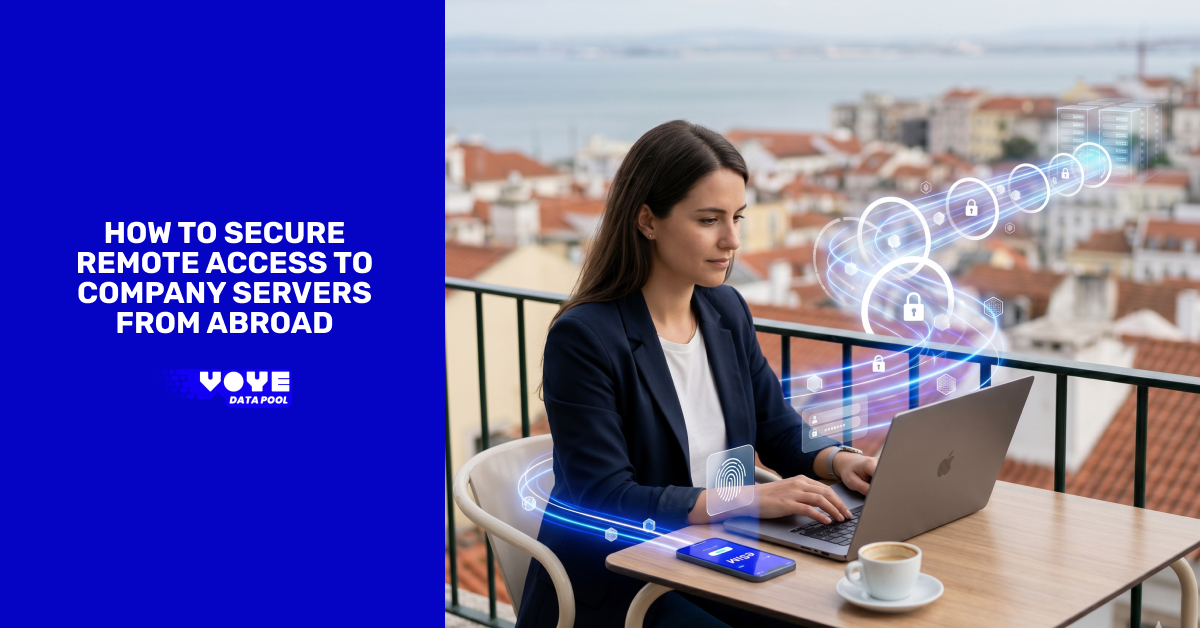
Global business expansion, distributed teams, and hybrid work models have made remote server access a standard operational requirement. Employees, vendors, and partners often need to connect to company systems from different countries, time zones, and network environments. While this flexibility drives productivity, it also introduces complex cybersecurity challenges.
Securing remote access to company servers from abroad requires a well-structured approach that combines technology, policies, and continuous monitoring. Organizations must balance accessibility with strict control to prevent unauthorized access, data breaches, and compliance violations.
Understanding the Risks of Remote Access from Abroad
When users access corporate servers internationally, the attack surface increases significantly. Unlike controlled office environments, remote connections are often made over unknown and potentially insecure networks.
Key Threats to Consider
- Public Wi-Fi vulnerabilities that allow attackers to intercept traffic
- Credential compromise through phishing or brute force attacks
- Malware-infected endpoints connecting to internal systems
- Session hijacking and man-in-the-middle attacks
- Unauthorized access through stolen or reused credentials
Why International Access is Riskier
- Users connect from regions with varying cybersecurity maturity
- Networks may lack proper encryption or monitoring
- Increased exposure to targeted attacks on foreign connections
- Legal complexities around cross-border data access
Organizations must treat every remote connection as potentially risky and implement safeguards accordingly.

Simplify Remote Device Connectivity
Manage employee device connectivity globally through centralized eSIM management tools.
Establishing a Strong Security Framework
A solid security foundation ensures consistency and resilience across all access points.
Zero Trust Architecture
Zero Trust eliminates implicit trust and enforces strict verification.
Core Principles
- Verify every user and device before granting access
- Apply least privilege access controls
- Continuously monitor sessions and behavior
Defense in Depth Strategy
Instead of relying on a single layer, multiple layers of security provide better protection.
Security Layers Include
- Identity and access management
- Network-level protection
- Endpoint security controls
- Application-level safeguards
This layered approach ensures that even if one control fails, others remain active.
Advanced Authentication Mechanisms
Authentication is the first barrier against unauthorized access.
Multi-Factor Authentication
Requiring multiple authentication factors significantly reduces risk.
Common Methods
- Passwords combined with one-time passcodes
- Hardware tokens or authentication apps
- Biometric verification, such as fingerprint or facial recognition
Risk-Based Authentication
Adaptive authentication evaluates risk dynamically.
Factors Considered
- Login location and IP address
- Device type and security posture
- Time of access and user behavior patterns
If a login attempt appears suspicious, additional verification steps are triggered.
Securing Network Connectivity
Network security plays a crucial role in protecting remote access sessions.
Virtual Private Networks
VPNs create encrypted communication channels between users and servers.
Best Practices
- Enforce strong encryption standards such as AES
- Regularly audit VPN access logs
- Use enterprise-grade VPN solutions with Global Points of Presence (PoPs) to minimize latency for international users.
- Use Split-Exclusion or Dynamic Tunneling to ensure corporate data remains encrypted while high-bandwidth apps (like video conferencing) maintain performance.
Software Defined Perimeter
A more modern approach that restricts access based on identity rather than network location.
Advantages
- Hides internal systems from public visibility
- Allows granular access control
- Reduces the attack surface
Endpoint Security and Device Management
Remote access security is only as strong as the devices used to connect.
Device Compliance Enforcement
Before granting access, ensure that devices meet security requirements.
Compliance Checklist
- Updated operating systems and patches
- Active antivirus and endpoint protection tools
- Encrypted storage and secure configurations
Mobile Device Management
MDM solutions allow organizations to control and secure mobile devices.
Key Features
- Remote lock and wipe capabilities
- Application control and restrictions
- Continuous device monitoring
Seamless eSIM Connectivity for Enterprises
Activate, manage, and scale eSIMs with ease.
Data Protection Strategies
Protecting data is central to any remote access security plan.
Encryption in Transit
All communication between remote users and servers must be encrypted using modern secure protocols, specifically TLS 1.3, to ensure the highest level of cryptographic protection.
Encryption at Rest
Sensitive data stored on servers should remain encrypted to prevent unauthorized access.
Data Loss Prevention Systems
DLP tools help detect and block unauthorized data transfers.
Capabilities
- Monitor file transfers and downloads
- Prevent the sharing of sensitive data
- Alert administrators of suspicious activity
Role-Based Access Control and Privilege Management
Limiting access reduces both internal and external risks.
Implementing Role-Based Access
- Assign permissions based on job roles
- Restrict access to only required resources
- Avoid granting excessive privileges
Privileged Access Management
Special controls should be applied to administrative accounts.
Best Practices
- Use temporary privilege elevation
- Monitor all privileged activities
- Enforce stricter authentication for admin users
Continuous Monitoring and Threat Detection
Visibility into system activity is essential for identifying threats early.
Real Time Monitoring
Track and analyze:
- Login attempts and failures
- Geographic access patterns
- Unusual user behavior
Centralized Logging
Store logs in a centralized system for easier analysis and auditing.
Automated Alerts
Set up alerts for:
- Suspicious login attempts
- Access from unexpected locations
- Repeated authentication failures
Incident Response and Recovery Planning
Even with strong security measures, incidents can still occur. A well-prepared response plan minimizes damage.
Key Components of Incident Response
- Clear roles and responsibilities
- Defined escalation procedures
- Communication protocols
Recovery Strategies
- Maintain secure and frequent backups
- Test recovery processes regularly
- Ensure minimal downtime during restoration
Compliance and Cross-Border Regulations
Accessing data from abroad introduces regulatory challenges that must be addressed carefully.
Important Considerations
- Industry-specific compliance requirements
- Privacy regulations across different jurisdictions
- Data sovereignty and “Access-as-Transfer” laws, where simply viewing data across borders may be regulated as a legal data transfer
Maintaining Compliance
- Document all access policies and controls
- Conduct regular security audits
- Maintain detailed access logs for reporting
Leveraging a Custom Data Pool for Better Control
Efficient connectivity management is the “missing link” in securing remote access. When employees travel abroad, they often resort to unsecured public Wi-Fi or individual roaming plans to stay online. This creates Shadow IT risks and fragmented oversight.
Voye Data Pool addresses this by centralizing global connectivity into a single, company-managed ecosystem. Instead of managing hundreds of individual SIM cards or reimbursements, IT teams can distribute data from a shared “pool” to their entire workforce via eSIM technology.
Benefits of the Data Pool Model:
- Elimination of Public Wi-Fi Risks: By providing a reliable, enterprise-managed cellular connection, employees are less likely to connect to risky “Free Wi-Fi” at airports or cafes.
- Real-Time Usage Visibility: The platform provides instant insights into data consumption, allowing administrators to spot unusual activity before it becomes a security liability.
- Granular Data Allocation: IT managers can instantly assign, reallocate, or suspend data access for specific employees through a centralized dashboard.
- Simplified Compliance: Centralized logging of global connectivity helps organizations maintain a clear audit trail of who is connecting and from where.
Secure Your Enterprise Connectivity
Protect business devices with secure and scalable global eSIM connectivity.
Building a Scalable and Secure Access Ecosystem
As organizations grow, their remote access requirements become more complex. Midway through scaling operations, businesses must adopt solutions that can secure remote access efficiently while maintaining flexibility.
Integrating Advanced Platforms
Modern platforms provide a unified approach to managing access, security, and performance.
The Role of Voye Data Pool
Voye Data Pool is designed to support international organizations with a secure and scalable mobile data infrastructure. By utilizing a unified data pool, companies ensure that their distributed workforce remains connected through a private, encrypted cellular “pipe” rather than relying on fragmented local connections.
Key Capabilities:
- Centralized Dashboard: A single-pane-of-glass view to manage eSIMs, monitor performance, and control costs across 130+ countries.
- Zero-Touch Provisioning: Push eSIM profiles directly to compatible devices remotely, ensuring secure onboarding without physical logistics.
- Corporate Policy Enforcement: Set data limits and access rules at the group level, ensuring connectivity aligns with internal security and budget policies.
- Network Redundancy: The platform leverages top-tier local carriers in each region to provide a private, managed cellular “on-ramp” to the internet, ensuring the very first step of a connection is secured.
Best Practices for IT and Security Teams
Employee Training and Awareness
- Educate users about phishing and social engineering
- Promote safe browsing and network practices
- Encourage the use of secure connections
Regular System Updates
- Patch vulnerabilities promptly
- Update security tools and software
- Monitor for outdated systems
Access Reviews and Audits
- Periodically review user access rights
- Remove inactive or unnecessary accounts
- Validate role-based permissions
Backup and Disaster Recovery
- Maintain encrypted backups
- Test recovery processes regularly
- Ensure business continuity plans are in place
Why Voye Data Pool
Managing remote access security often fails at the very first step: the connection. Voye Data Pool simplifies this complexity by bringing the carrier network into the corporate security stack.
It combines performance, control, and scalability in a way that supports modern global operations without overwhelming IT teams. Instead of juggling multiple tools and unsecured networks, organizations get a streamlined environment where the data connection itself is both secure and efficient.
Conclusion
Remote access from abroad is no longer an exception. It is a standard part of how businesses operate today. The challenge is not enabling access, but doing so securely and responsibly.
Organizations that invest in strong authentication, secure networks, endpoint protection, and intelligent data management will not only reduce risk but also improve operational agility. Security becomes an enabler rather than a barrier.
With the right strategies and platforms in place, businesses can confidently connect their global workforce while keeping critical systems protected.