Get 5% Discount using the code VOYE15 Buy eSIM close

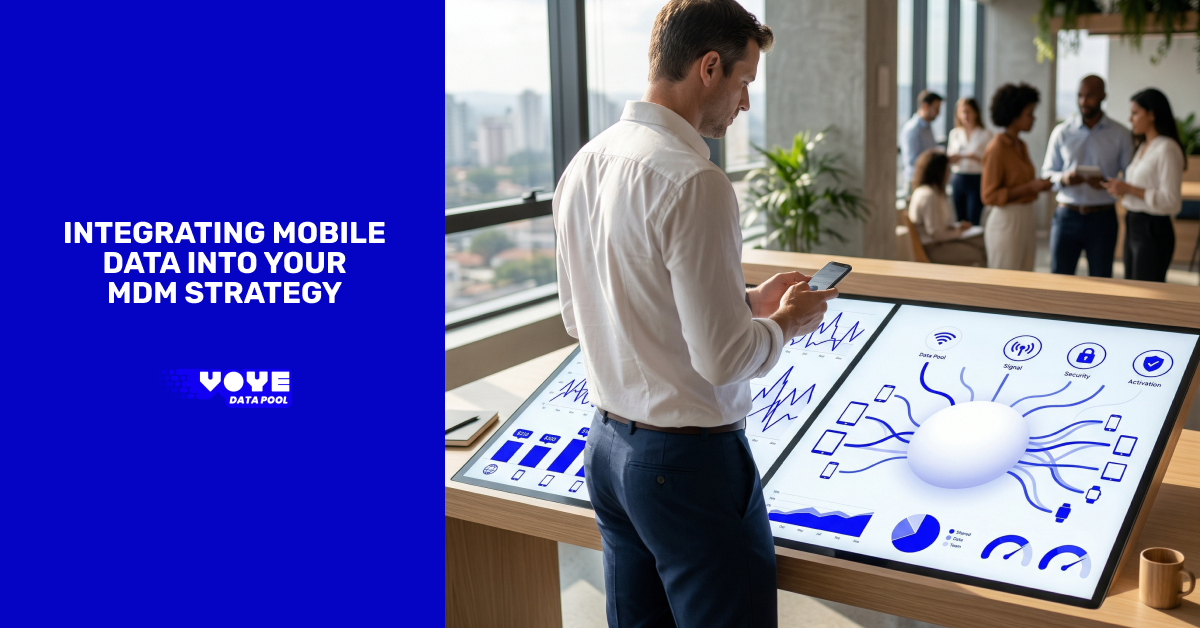
Integrating Mobile Data into Your MDM Strategy

Integrating mobile data into your MDM strategy is essential for modern enterprise IT environments. As organizations expand globally and rely on connected devices, managing both devices and connectivity through a unified approach becomes critical. By aligning mobile data with IT frameworks, businesses can improve visibility, enhance security, and optimize costs while ensuring seamless operations. Solutions like Voye Data Pool further simplify this process by enabling scalable, secure, and borderless connectivity for teams and devices worldwide.

Voye Data Pool Team
March 17, 2026 dot Read 7 min read
share Share
Integrating Mobile Data into Your MDM Strategy

Enterprise IT has moved far beyond traditional office networks. Today’s organizations operate across borders, time zones, and device ecosystems that demand constant connectivity. Mobile data is no longer just a utility. It has become a critical layer that supports communication, applications, and real-time operations.

As businesses scale, managing this connectivity efficiently becomes a challenge. Devices, users, and data plans are often handled separately, creating gaps in visibility and control. Bringing mobile data into a centralized management framework allows IT teams to operate with greater precision and efficiency.

The Growing Importance of Mobile Data in Enterprise IT

Mobile data is now central to how enterprises function. From remote employees accessing cloud systems to IoT devices transmitting operational data, connectivity is at the heart of modern workflows.

Key Drivers of Growth:

  • Expansion of hybrid and remote work models.
  • Increasing reliance on SaaS and cloud platforms.
  • Growth of IoT and connected devices.
  • Demand for real-time communication and analytics.
  • Global operations require seamless connectivity.

Without structured management, mobile data can quickly become fragmented and costly.

Understanding the Role of MDM in Mobile Data Integration

MDM solutions were originally designed to manage devices. However, enterprise needs have evolved, and so has the role of MDM.

Today, MDM must extend beyond hardware control and include:

  • Monitoring of data usage.
  • Enforcement of connectivity policies.
  • Integration with network management tools.
  • Alignment with enterprise security frameworks.

When mobile data is integrated into MDM, IT teams gain centralized control over both devices and connectivity.

Challenges in Managing Mobile Data at Scale

Managing mobile data across large and distributed environments comes with several complexities that can impact efficiency and control. Enterprises often face fragmented connectivity due to multiple carriers and regions, making it difficult to maintain consistency and visibility.

Limited real-time insights can prevent IT teams from accurately tracking usage, identifying issues, or optimizing data allocation. At the same time, security risks increase as more devices connect across different networks, raising concerns around data protection and compliance.

Scalability is another major challenge, as growing device fleets require more streamlined and automated management approaches to avoid operational inefficiencies.

Fragmented Connectivity

Organizations often work with multiple telecom providers across regions. This leads to:

  • Inconsistent policies.
  • Complex billing structures.
  • Limited centralized visibility.

Lack of Real-Time Insights

Without real-time monitoring, IT teams struggle to:

  • Detect unusual data consumption.
  • Optimize usage across devices.
  • Make informed decisions.

Security Risks

Mobile networks can introduce vulnerabilities such as:

  • Unauthorized access.
  • Data leakage.
  • Compliance issues.

Scalability Issues

Managing thousands of devices manually is inefficient and prone to error.

Key Components of a Mobile Data-Driven Strategy

A strong mobile data-driven strategy relies on a few essential components that ensure control, visibility, and scalability across enterprise environments.

Centralized connectivity management allows IT teams to oversee all devices and networks from a single platform, reducing complexity and improving consistency. Real-time monitoring provides visibility into data usage, helping detect issues early and optimize performance.

Policy-based control ensures that data usage, access, and security rules are consistently enforced across all devices. Automation further enhances efficiency by simplifying provisioning, monitoring, and management tasks.

Together, these components create a streamlined and scalable approach to managing mobile data across the organization.

This is where mobile device management plays a vital role by connecting device control with data governance in a unified strategy.

Unified Connectivity Management

A centralized platform is essential for managing global connectivity. This includes:

  • One interface for all devices and regions.
  • Consolidated reporting.
  • Standardized policies.

Real-Time Monitoring

Visibility enables control. Enterprises should implement:

  • Live dashboards.
  • Usage alerts.
  • Automated reports.

Policy Enforcement

Policies ensure consistency and compliance.

Examples

  • Data limits per device.
  • Roaming controls.
  • Application-specific restrictions.
  • Priority network access.

Automation

Automation improves efficiency by:

  • Reducing manual tasks.
  • Enabling dynamic provisioning.
  • Supporting scalability.

Benefits of Integration

Integrating mobile data into your IT framework improves visibility, cost control, and security. IT teams can monitor usage in real time, optimize data allocation, and reduce unnecessary expenses.

It also enables consistent policy enforcement, enhances protection across devices, and streamlines operations, making it easier to scale and manage growing connectivity needs efficiently.

Improved Visibility

  • Centralized insights into usage and performance.
  • Better planning and forecasting.

Cost Efficiency

  • Elimination of unused data.
  • Optimized allocation of resources.

Enhanced Security

  • Unified enforcement of policies.
  • Reduced exposure to risks.

Operational Efficiency

  • Faster deployment of devices.
  • Simplified management processes.

The Role of eSIM Technology

eSIM is reshaping enterprise connectivity by eliminating the reliance on physical SIM cards, allowing organizations to activate, manage, and switch networks remotely with greater speed and flexibility. This reduces deployment time, simplifies logistics, and removes the need for manual SIM handling across distributed teams.

It also enables enterprises to scale operations more efficiently by provisioning connectivity on demand and adapting to changing network requirements without hardware changes. With improved control, enhanced security, and seamless global coverage, eSIM technology supports a more agile and future-ready connectivity strategy.

Key Advantages

  • Remote provisioning of connectivity.
  • Instant activation of devices.
  • Flexibility to switch networks.
  • Simplified global operations.

For enterprises managing global teams or devices, eSIM enables seamless scalability.

Aligning Strategy with Business Goals

Aligning your mobile data strategy with business objectives ensures that connectivity supports productivity, scalability, and overall digital transformation. By connecting IT initiatives with organizational priorities, enterprises can drive efficiency, enable global operations, and create a more agile and future-ready infrastructure.

Key Considerations

  • Enabling global workforce productivity.
  • Supporting digital transformation initiatives.
  • Ensuring compliance with regional regulations.
  • Integrating with cloud infrastructure.

A well-aligned strategy ensures that connectivity becomes a business enabler rather than a challenge.

Best Practices for Implementation

A well-defined implementation approach ensures that mobile data integration is efficient, scalable, and aligned with business goals. By focusing on clear planning, the right technology, and continuous optimization, enterprises can streamline operations, enhance visibility, and maintain control over connectivity across devices and regions.

Assess Existing Systems

  • Review current MDM capabilities.
  • Identify gaps in connectivity management.
  • Analyze usage patterns.

Define Objectives

  • Set clear goals.
  • Align with business priorities.
  • Establish measurable outcomes.

Select the Right Platform

Choose a solution that offers:

  • Global coverage.
  • Real-time analytics.
  • Seamless integration.

Start Small and Scale

  • Begin with pilot deployments.
  • Expand gradually.
  • Optimize continuously.

Monitor Continuously

  • Use analytics to improve efficiency.
  • Adjust policies based on trends.

How Voye Data Pool Supports Enterprise Connectivity?

Voye Data Pool helps enterprises manage connectivity through a single, unified platform. With global coverage across 130+ countries and eSIM technology, it enables instant activation and seamless connectivity without relying on multiple carriers.

IT teams gain centralized visibility into data usage, making it easier to control costs, enforce policies, and maintain security. Its scalable design supports growing teams and connected devices, ensuring reliable and efficient operations worldwide.

Core Capabilities

  • Connectivity across 130+ countries.
  • Centralized eSIM management.
  • Secure and reliable network access.
  • Scalable solutions for teams and devices.

Simplified Deployment

  • Fast onboarding.
  • Easy activation.
  • Centralized control.

Enterprise Benefits

  • Streamlined operations.
  • Improved visibility.
  • Enhanced control over connectivity.

Future Trends in Mobile Data Management

Mobile data management is evolving rapidly as enterprises adopt smarter, more scalable technologies. From AI-driven optimization to the expansion of connected devices, the future will focus on automation, security, and seamless global connectivity. Organizations that adapt early will gain stronger control, better efficiency, and a competitive edge in an increasingly connected world.

IoT Expansion

  • Growth in connected devices.
  • Increased demand for scalable solutions.

AI-Driven Optimization

  • Predictive usage analysis.
  • Automated decision-making.

Advanced Security Models

  • Zero trust frameworks.
  • Real-time threat detection.

Global Connectivity Evolution

  • Increased reliance on borderless networks.
  • Reduced dependency on traditional carriers.

Building a Scalable Strategy with Custom Data Pool

As enterprises grow, flexibility becomes essential. A custom data pool allows organizations to manage data dynamically across devices and regions.

Key Advantages

  • Efficient distribution of data.
  • Reduced waste and costs.
  • Flexibility across global operations.
  • Better control over large device fleets.

This approach ensures that connectivity scales with business needs.

Plug Into the Future of Enterprise Mobility

Integrating mobile data into enterprise IT strategy is essential for achieving efficiency, scalability, and security. By unifying device and connectivity management, organizations can gain full control over their digital infrastructure.

With solutions like Voye Data Pool, enterprises can simplify connectivity, support global operations, and build a future-ready foundation for growth.

Enterprise IT has moved far beyond traditional office networks. Today’s organizations operate across borders, time zones, and device ecosystems that demand constant connectivity. Mobile data is no longer just a utility. It has become a critical layer that supports communication, applications, and real-time operations.

As businesses scale, managing this connectivity efficiently becomes a challenge. Devices, users, and data plans are often handled separately, creating gaps in visibility and control. Bringing mobile data into a centralized management framework allows IT teams to operate with greater precision and efficiency.

The Growing Importance of Mobile Data in Enterprise IT

Mobile data is now central to how enterprises function. From remote employees accessing cloud systems to IoT devices transmitting operational data, connectivity is at the heart of modern workflows.

Key Drivers of Growth:

  • Expansion of hybrid and remote work models.
  • Increasing reliance on SaaS and cloud platforms.
  • Growth of IoT and connected devices.
  • Demand for real-time communication and analytics.
  • Global operations require seamless connectivity.

Without structured management, mobile data can quickly become fragmented and costly.

Understanding the Role of MDM in Mobile Data Integration

MDM solutions were originally designed to manage devices. However, enterprise needs have evolved, and so has the role of MDM.

Today, MDM must extend beyond hardware control and include:

  • Monitoring of data usage.
  • Enforcement of connectivity policies.
  • Integration with network management tools.
  • Alignment with enterprise security frameworks.

When mobile data is integrated into MDM, IT teams gain centralized control over both devices and connectivity.

Challenges in Managing Mobile Data at Scale

Managing mobile data across large and distributed environments comes with several complexities that can impact efficiency and control. Enterprises often face fragmented connectivity due to multiple carriers and regions, making it difficult to maintain consistency and visibility.

Limited real-time insights can prevent IT teams from accurately tracking usage, identifying issues, or optimizing data allocation. At the same time, security risks increase as more devices connect across different networks, raising concerns around data protection and compliance.

Scalability is another major challenge, as growing device fleets require more streamlined and automated management approaches to avoid operational inefficiencies.

Fragmented Connectivity

Organizations often work with multiple telecom providers across regions. This leads to:

  • Inconsistent policies.
  • Complex billing structures.
  • Limited centralized visibility.

Lack of Real-Time Insights

Without real-time monitoring, IT teams struggle to:

  • Detect unusual data consumption.
  • Optimize usage across devices.
  • Make informed decisions.

Security Risks

Mobile networks can introduce vulnerabilities such as:

  • Unauthorized access.
  • Data leakage.
  • Compliance issues.

Scalability Issues

Managing thousands of devices manually is inefficient and prone to error.

Key Components of a Mobile Data-Driven Strategy

A strong mobile data-driven strategy relies on a few essential components that ensure control, visibility, and scalability across enterprise environments.

Centralized connectivity management allows IT teams to oversee all devices and networks from a single platform, reducing complexity and improving consistency. Real-time monitoring provides visibility into data usage, helping detect issues early and optimize performance.

Policy-based control ensures that data usage, access, and security rules are consistently enforced across all devices. Automation further enhances efficiency by simplifying provisioning, monitoring, and management tasks.

Together, these components create a streamlined and scalable approach to managing mobile data across the organization.

This is where mobile device management plays a vital role by connecting device control with data governance in a unified strategy.

Unified Connectivity Management

A centralized platform is essential for managing global connectivity. This includes:

  • One interface for all devices and regions.
  • Consolidated reporting.
  • Standardized policies.

Real-Time Monitoring

Visibility enables control. Enterprises should implement:

  • Live dashboards.
  • Usage alerts.
  • Automated reports.

Policy Enforcement

Policies ensure consistency and compliance.

Examples

  • Data limits per device.
  • Roaming controls.
  • Application-specific restrictions.
  • Priority network access.

Automation

Automation improves efficiency by:

  • Reducing manual tasks.
  • Enabling dynamic provisioning.
  • Supporting scalability.

Benefits of Integration

Integrating mobile data into your IT framework improves visibility, cost control, and security. IT teams can monitor usage in real time, optimize data allocation, and reduce unnecessary expenses.

It also enables consistent policy enforcement, enhances protection across devices, and streamlines operations, making it easier to scale and manage growing connectivity needs efficiently.

Improved Visibility

  • Centralized insights into usage and performance.
  • Better planning and forecasting.

Cost Efficiency

  • Elimination of unused data.
  • Optimized allocation of resources.

Enhanced Security

  • Unified enforcement of policies.
  • Reduced exposure to risks.

Operational Efficiency

  • Faster deployment of devices.
  • Simplified management processes.

The Role of eSIM Technology

eSIM is reshaping enterprise connectivity by eliminating the reliance on physical SIM cards, allowing organizations to activate, manage, and switch networks remotely with greater speed and flexibility. This reduces deployment time, simplifies logistics, and removes the need for manual SIM handling across distributed teams.

It also enables enterprises to scale operations more efficiently by provisioning connectivity on demand and adapting to changing network requirements without hardware changes. With improved control, enhanced security, and seamless global coverage, eSIM technology supports a more agile and future-ready connectivity strategy.

Key Advantages

  • Remote provisioning of connectivity.
  • Instant activation of devices.
  • Flexibility to switch networks.
  • Simplified global operations.

For enterprises managing global teams or devices, eSIM enables seamless scalability.

Aligning Strategy with Business Goals

Aligning your mobile data strategy with business objectives ensures that connectivity supports productivity, scalability, and overall digital transformation. By connecting IT initiatives with organizational priorities, enterprises can drive efficiency, enable global operations, and create a more agile and future-ready infrastructure.

Key Considerations

  • Enabling global workforce productivity.
  • Supporting digital transformation initiatives.
  • Ensuring compliance with regional regulations.
  • Integrating with cloud infrastructure.

A well-aligned strategy ensures that connectivity becomes a business enabler rather than a challenge.

Best Practices for Implementation

A well-defined implementation approach ensures that mobile data integration is efficient, scalable, and aligned with business goals. By focusing on clear planning, the right technology, and continuous optimization, enterprises can streamline operations, enhance visibility, and maintain control over connectivity across devices and regions.

Assess Existing Systems

  • Review current MDM capabilities.
  • Identify gaps in connectivity management.
  • Analyze usage patterns.

Define Objectives

  • Set clear goals.
  • Align with business priorities.
  • Establish measurable outcomes.

Select the Right Platform

Choose a solution that offers:

  • Global coverage.
  • Real-time analytics.
  • Seamless integration.

Start Small and Scale

  • Begin with pilot deployments.
  • Expand gradually.
  • Optimize continuously.

Monitor Continuously

  • Use analytics to improve efficiency.
  • Adjust policies based on trends.

How Voye Data Pool Supports Enterprise Connectivity?

Voye Data Pool helps enterprises manage connectivity through a single, unified platform. With global coverage across 130+ countries and eSIM technology, it enables instant activation and seamless connectivity without relying on multiple carriers.

IT teams gain centralized visibility into data usage, making it easier to control costs, enforce policies, and maintain security. Its scalable design supports growing teams and connected devices, ensuring reliable and efficient operations worldwide.

Core Capabilities

  • Connectivity across 130+ countries.
  • Centralized eSIM management.
  • Secure and reliable network access.
  • Scalable solutions for teams and devices.

Simplified Deployment

  • Fast onboarding.
  • Easy activation.
  • Centralized control.

Enterprise Benefits

  • Streamlined operations.
  • Improved visibility.
  • Enhanced control over connectivity.

Future Trends in Mobile Data Management

Mobile data management is evolving rapidly as enterprises adopt smarter, more scalable technologies. From AI-driven optimization to the expansion of connected devices, the future will focus on automation, security, and seamless global connectivity. Organizations that adapt early will gain stronger control, better efficiency, and a competitive edge in an increasingly connected world.

IoT Expansion

  • Growth in connected devices.
  • Increased demand for scalable solutions.

AI-Driven Optimization

  • Predictive usage analysis.
  • Automated decision-making.

Advanced Security Models

  • Zero trust frameworks.
  • Real-time threat detection.

Global Connectivity Evolution

  • Increased reliance on borderless networks.
  • Reduced dependency on traditional carriers.

Building a Scalable Strategy with Custom Data Pool

As enterprises grow, flexibility becomes essential. A custom data pool allows organizations to manage data dynamically across devices and regions.

Key Advantages

  • Efficient distribution of data.
  • Reduced waste and costs.
  • Flexibility across global operations.
  • Better control over large device fleets.

This approach ensures that connectivity scales with business needs.

Plug Into the Future of Enterprise Mobility

Integrating mobile data into enterprise IT strategy is essential for achieving efficiency, scalability, and security. By unifying device and connectivity management, organizations can gain full control over their digital infrastructure.

With solutions like Voye Data Pool, enterprises can simplify connectivity, support global operations, and build a future-ready foundation for growth.

Related Articles

  • Why Every Company Will Have a Data Pool by 2030?

    The future of business will be driven not just by artificial intelligence or cloud computing, but by unified data ecosystems. By 2030, organizations across industries will adopt data pools to connect employees, devices, customers, and operations into one intelligent framework. This article explains how IoT, remote work, analytics, and predictive automation are pushing companies toward centralized data infrastructures. It also explores the critical role of reliable global connectivity and enterprise eSIM management in ensuring uninterrupted data flow. Platforms such as Voye Data Pool are helping organizations activate, monitor, and manage connectivity across global teams and connected devices. Companies that implement data pooling early will gain faster decisions, stronger security, improved customer experience, and a significant competitive advantage in the digital economy.

  • How to Troubleshoot Common eSIM Issues Overseas?

    Managing eSIM connectivity overseas can be challenging due to network variations, device compatibility, and regional restrictions. This guide provides a structured approach to identifying and resolving common eSIM issues efficiently. It covers activation errors, network disruptions, and data usage concerns while offering practical solutions for both individuals and enterprise IT teams. With insights on optimizing performance and leveraging centralized data strategies, readers can ensure reliable global connectivity and minimize disruptions during international travel or business operations.

  • Benefits of Aggregated Data Usage for Large Corporations

    Large corporations generate vast volumes of data across global offices, cloud environments, IoT devices, and remote teams. When this information is centralized and analyzed collectively, enterprises gain stronger visibility, improved security, and smarter operational control. Discover how a structured data strategy empowers Enterprise IT leaders to optimize connectivity, reduce costs, and scale with confidence across international markets.

  • Future of Global Connectivity: Why Data Pools Are the Next Big Thing

    As businesses expand globally, traditional data plans often fail to keep up with the need for seamless, centralized connectivity. eSIM data pools are changing that — offering enterprises the ability to share, manage, and scale data across teams and regions effortlessly. This blog explores why data pools are redefining global connectivity and becoming the cornerstone of next-generation mobile infrastructure.

  • VPN on Mobile: Why You Need Encrypted Data Streams?

    Mobile VPNs have become essential for securing enterprise data in an increasingly connected world. By encrypting data streams, they protect sensitive business information from cyber threats, especially across public and unstable networks. Combined with strategies like custom data pool management and solutions such as Voye Data Pool, organizations can enhance both security and operational efficiency. This approach enables safe remote work, ensures compliance, and strengthens overall IT infrastructure, making mobile VPNs a critical component of modern enterprise security frameworks.

  • How IT Teams Can Reclaim Hours Lost in SIM Logistics with Voye Data Pool

    IT teams spend countless hours managing SIM cards, coordinating carriers, and troubleshooting roaming issues across regions. Voye Data Pool replaces these manual processes with a unified global eSIM solution that automates provisioning, monitoring, and cost control. By centralizing data management through a single dashboard, IT departments gain real-time visibility, optimize expenses, and reclaim valuable work hours. Discover how your organization can simplify connectivity, boost efficiency, and scale effortlessly with Voye Data Pool.