

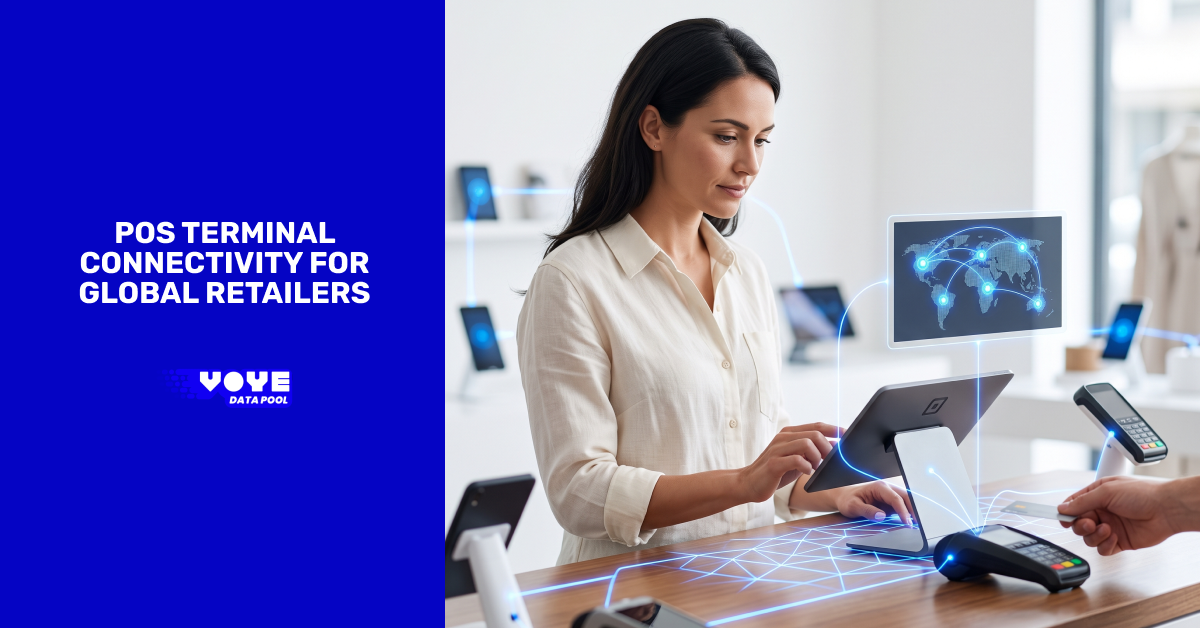
POS Terminal Connectivity for Global Retailers
Reliable POS terminal connectivity is essential for modern retail operations. This blog explains how eSIM-enabled connectivity helps retailers maintain uninterrupted payment processing, real-time inventory updates, and secure data transmission across multiple locations. Learn how scalable connectivity solutions from Voye Data Pool support efficient Retail Ops, improve customer experiences, and keep global retail businesses connected with dependable network coverage for stores, pop-up locations, and mobile point-of-sale terminals.


 8 min read
 Share
Share
In today’s retail environment, every transaction matters. Whether it’s a supermarket processing hundreds of payments every hour, a fashion retailer serving customers across multiple countries, or a pop-up store operating during a seasonal event, uninterrupted point-of-sale (POS) connectivity has become essential. A few seconds of downtime can result in lost sales, frustrated customers, and operational challenges.
As retailers expand internationally, managing Retail Ops becomes increasingly complex. Payment terminals, inventory systems, customer loyalty programs, and cloud-based retail platforms all depend on stable, secure, and reliable connectivity. Traditional network solutions may not always provide the flexibility required for stores operating across different regions or temporary retail locations.
This is where cellular connectivity and IoT-enabled solutions are transforming the retail landscape. With reliable mobile data connectivity, retailers can keep POS terminals online wherever business takes them. Solutions from Voye Data Pool help businesses simplify global connectivity while supporting modern retail operations.

Keep POS Terminals Always Connected
Maintain seamless payment processing worldwide with reliable eSIM connectivity.
Understanding POS Terminal Connectivity
A POS terminal does much more than process card payments. Modern retail systems connect multiple services through a single device, including:
- Payment processing
- Inventory synchronization
- Digital receipts
- Customer loyalty programs
- Sales reporting
- Tax calculations
- Product database updates
- Employee management systems
Every transaction relies on real-time communication between the POS device and cloud-based services. If connectivity fails, these services can become unavailable, slowing down or completely stopping sales.
For retailers operating internationally, maintaining consistent connectivity across multiple locations is often one of the biggest operational challenges.
Why Connectivity Is Critical for Retail Ops?
Efficient Retail Ops depend on fast communication between stores, warehouses, suppliers, and headquarters. Every sale generates valuable business data that supports inventory planning, demand forecasting, and customer service. Reliable connectivity helps retailers:
Process Payments Without Delays
Customers expect quick checkout experiences. Slow or disconnected payment terminals create long queues and may even lead customers to abandon their purchases.
Consistent connectivity keeps transactions moving smoothly throughout the day.
Maintain Accurate Inventory
Modern POS systems automatically update inventory after every sale.
Reliable connections help prevent:
- Overselling products
- Inventory mismatches
- Stock shortages
- Manual inventory corrections
Accurate inventory management allows retailers to make better purchasing decisions and improve customer satisfaction.
Enable Real-Time Reporting
Retail managers need immediate visibility into sales performance.
Connected POS terminals continuously upload sales data, allowing businesses to monitor:
- Daily revenue
- Store performance
- Product demand
- Peak shopping hours
- Employee productivity
This information supports faster business decisions and more effective planning.
Common Connectivity Challenges for Global Retailers
Managing POS connectivity becomes more difficult as businesses expand into multiple countries. Some common challenges include:
Multiple Network Providers
Different countries have different mobile network operators.
Managing multiple connectivity contracts can increase administrative complexity while making network management more difficult.
Temporary Retail Locations
Many retailers operate:
- Seasonal stores
- Pop-up shops
- Trade show booths
- Outdoor events
- Mobile retail units
Installing traditional wired internet may not be practical for these temporary locations.
Cellular connectivity offers faster deployment without requiring permanent infrastructure.
Remote Store Locations
Some retail outlets operate in shopping malls, airports, tourist destinations, rural communities, or transportation hubs where fixed internet may be unreliable or expensive.
Mobile connectivity provides an alternative that helps maintain consistent payment processing.
Business Continuity
Unexpected internet outages can disrupt entire retail operations.
Without backup connectivity, retailers may experience:
- Lost transactions
- Customer dissatisfaction
- Delayed reporting
- Interrupted inventory updates
A reliable mobile connection helps reduce downtime and supports continuous business operations.
How Cellular Connectivity Supports Modern Retail?
Mobile connectivity has become an important part of retail technology strategies.
Instead of depending solely on wired broadband, many retailers now use cellular networks for:
- Primary POS connectivity
- Backup internet connections
- Mobile payment terminals
- Self-service kiosks
- Smart vending machines
- Digital signage
- Inventory scanners
This flexible approach helps businesses remain connected even when traditional internet services experience disruptions.
For global retailers, centralized connectivity management also simplifies deployment across multiple countries while reducing operational complexity.
The Growing Role of IoT in Retail Operations
Retail is becoming increasingly connected through Internet of Things (IoT) technologies.
Today, retailers use connected devices far beyond payment terminals.
Examples include:
- Smart shelves
- Digital price labels
- Security cameras
- Temperature monitoring systems
- Inventory tracking sensors
- Self-checkout systems
- Interactive customer displays
These devices continuously exchange information with cloud platforms. Reliable connectivity through an industrial IoT SIM ensures that data flows securely and efficiently between retail locations and business management systems.
As retailers continue adopting automation and real-time analytics, dependable network connectivity becomes even more important for supporting efficient Retail Ops.
Power Smarter Retail Operations
Enable secure, uninterrupted POS connectivity with scalable eSIM solutions for global retailers.
Benefits of Scalable Connectivity for Global Retailers
As retail businesses grow, their connectivity requirements become more complex. Expanding into new markets often means managing additional stores, payment terminals, and connected devices. A scalable connectivity solution allows businesses to add new locations without redesigning their entire network infrastructure. Some key benefits include:
Faster Store Deployment
Opening a new retail location traditionally involves coordinating internet installation, which can take days or even weeks. Cellular-enabled POS terminals can be deployed much faster, allowing businesses to start operations with minimal delays.
This is especially useful for seasonal stores, exhibitions, and temporary retail spaces where speed and flexibility are important.
Centralized Connectivity Management
Managing hundreds or thousands of connected POS terminals across different regions can become challenging without a centralized approach.
A unified connectivity platform helps businesses:
- Monitor device connectivity
- Manage data usage
- Track network performance
- Troubleshoot issues remotely
- Simplify administration across multiple locations
This reduces operational overhead while improving efficiency.
Improved Customer Experience
Customers expect quick, hassle-free checkout experiences. Reliable connectivity minimizes payment failures, reduces waiting times, and helps ensure transactions are completed smoothly.
When POS systems remain connected, retailers can also offer services such as digital receipts, loyalty rewards, and real-time promotions without interruption, creating a more seamless shopping experience.
Security Considerations for Connected POS Systems
POS terminals process sensitive payment information, making security a top priority for retailers.
Along with secure payment software, businesses should implement reliable connectivity solutions that support secure data transmission and reduce the risk of communication interruptions.
Best practices include:
- Using encrypted data connections
- Keeping POS software updated
- Monitoring connected devices regularly
- Restricting unauthorized device access
- Implementing secure network management policies
A well-managed connectivity strategy complements existing security measures and helps businesses maintain customer trust.
Why Reliable Connectivity Supports Better Retail Ops?
Strong Retail Ops depend on consistent communication between stores, warehouses, payment systems, and business management platforms.
Reliable connectivity helps retailers:
- Reduce operational downtime
- Improve inventory accuracy
- Enable faster payment processing
- Support real-time business reporting
- Simplify multi-location management
- Enhance customer satisfaction
- Improve overall operational efficiency
As businesses continue investing in automation and digital transformation, connectivity becomes an essential foundation for everyday retail operations.
How Voye Data Pool Supports Connected Retail Businesses?
Modern retailers require connectivity solutions that can adapt to changing business needs. Whether operating a single chain of stores or managing retail locations across multiple countries, dependable mobile connectivity helps maintain smooth business operations.
Voye Data Pool provides global IoT connectivity solutions designed to support businesses with reliable, scalable, and flexible data connectivity. These solutions help retailers keep POS terminals, payment devices, kiosks, inventory systems, and other connected equipment online across different regions.
With centralized connectivity management and global network coverage, businesses can simplify deployments while maintaining consistent performance for their connected retail infrastructure.
Preparing Retail Operations for the Future
Retail technology continues to evolve with innovations such as AI-powered analytics, cashier-less stores, smart shelves, and connected customer experiences. As more retail devices become internet-enabled, dependable connectivity will play an even greater role in supporting daily operations.
Businesses that invest in reliable, scalable connectivity today will be better prepared to adapt to future technologies while delivering consistent customer experiences across every location.
Building resilient network infrastructure is no longer just an IT decision—it has become a strategic investment that directly impacts operational efficiency, customer satisfaction, and long-term business growth.
Expand Retail Without Network Limits
Support every store and POS terminal with dependable global eSIM connectivity.
Conclusion
Reliable POS terminal connectivity has become a critical component of modern Retail Ops. From processing payments and synchronizing inventory to supporting real-time reporting and connected retail technologies, uninterrupted connectivity enables businesses to operate efficiently in an increasingly digital marketplace.
For global retailers, flexible mobile connectivity offers the scalability, reliability, and operational simplicity needed to support stores across multiple locations and changing business environments. By adopting future-ready connectivity solutions, retailers can minimize downtime, improve customer experiences, and create a stronger foundation for continued growth.