

How to Split Data Costs Across Multiple Project Codes?
Managing telecom expenses becomes difficult when multiple teams, devices, and projects share the same connectivity. Without proper usage tracking, businesses rely on estimates and manual spreadsheets, leading to inaccurate project costing. By assigning connectivity usage to cost centers and project codes, organizations gain clearer financial visibility, improve billing accuracy, and simplify accounting workflows.


 7 min read
 Share
Share
Telecom expenses used to be simple. One office, one connection, one invoice. That model no longer exists. Today, our companies operate with remote employees, field teams, contractors, international travel, and connected devices. All of them generate mobile connectivity expenses. The problem is not the bill itself. The problem is allocation.
Finance teams must assign every cost to a cost center, department, client, or project code. When mobile connectivity is unmanaged, telecom invoices become accounting nightmares. If you cannot attribute expenses correctly, you cannot understand profitability. This is why accurate telecom allocation has become an important part of financial operations.
Why Data Allocation Matters in Financial Accounting?
Every organization tracks profitability differently:
- Agencies track client projects.
- Construction firms track job sites.
- Consulting firms track billable hours.
- Logistics companies track routes.
- Tech companies track product teams.
Connectivity is used by all of them. Yet telecom bills usually arrive as a single monthly invoice or scattered reimbursements.
Without allocation:
- Projects appear less profitable.
- Departments exceed budgets.
- Client billing becomes inaccurate.
- Forecasting fails.
- Internal audits become difficult.
Correct allocation converts telecom spending from overhead into measurable operational cost.
The Traditional Problem with Mobile Data Billing
Most companies still rely on one of the following systems:
Employee Reimbursement
Employees purchase local SIM cards and submit expense claims.
Issues:
- No usage verification.
- Different currencies.
- Missing receipts.
- Time spent on approval workflows.
Department Managed SIMs
Each team manages its own carrier contract.
Issues:
- Duplicate plans.
- Different rates.
- No consolidated reporting.
- Hard to audit.
Corporate Carrier Contracts
The company signs a contract with a telecom provider.
Issues:
- Lump sum invoices.
- No user-level detail.
- No project mapping.
- Manual allocation required.
Finance teams then manually divide the bill into spreadsheets. This is where errors start.
The Real Accounting Challenge
The difficulty is not paying the telecom invoice.
The difficulty is assigning the cost correctly.
Example:
A field engineer travels to three client sites in one month and uses 18 GB of mobile data.
Finance needs to answer:
- Which client should be charged?
- How much data was used per project?
- Was the usage business related?
- Is it billable or internal?
Without usage level reporting, allocation becomes estimation. Estimation creates accounting risk.
Cost Centers vs Project Codes
Understanding the difference is important.
Cost Centers
Internal departments such as:
- Sales.
- Support.
- Marketing.
- Engineering.
These track operational expenses.
Project Codes
Revenue-linked work, such as:
- Client implementations.
- Consulting engagements.
- Construction sites.
- Installation jobs.
These affect profit margins.
Connectivity often belongs to both. A support engineer may assist multiple client projects in one week.
The Accounting Scenario
When finance teams attempt to split data bill expenses manually, they often rely on employee reporting or approximations. This leads to incorrect client invoicing and distorted project profitability because actual usage data is missing.
Accurate allocation requires measurable usage data, not estimates.

Manage Teams And Devices
Monitor distributed workforce connectivity from one secure management platform dashboard.
Methods Companies Currently Use
Before adopting structured connectivity management, most organizations rely on basic allocation techniques to divide telecom expenses. These methods appear practical at first, but usually create accounting inaccuracies and reporting gaps.
1. Equal Distribution
Divide the bill equally across departments.
Problem:
Completely inaccurate and discourages cost accountability.
2. Headcount Allocation
Assign costs based on the number of employees.
Problem:
Heavy users and light users are treated the same.
3. Self-Reporting
Employees estimate usage per project.
Problem:
Time-consuming and unreliable.
4. Manual Spreadsheet Tracking
Finance manually adjusts the invoice.
Problem:
Labor-intensive and prone to errors.
All four methods fail audits and distort financial reporting.
What Finance Teams Actually Need?
To allocate telecom costs properly, finance requires:
- User-level usage reporting.
- Time-based activity logs.
- Device-level identification.
- Project tagging capability.
- Exportable billing reports.
- Predictable monthly billing.
This turns connectivity data into accounting data.
Role of Centralized Connectivity Platforms
Modern connectivity platforms allow companies to assign each SIM or eSIM to:
- Employee.
- Device.
- Department.
- Project.
- Client.
Every MB of usage becomes traceable.
Instead of estimating cost, finance calculates cost.
Example: Consulting Firm
A consulting company has:
- 40 consultants
- 12 simultaneous client projects
- International travel every month
With traditional billing:
Finance receives a $4,800 invoice.
They must manually distribute it across 12 clients.
Result:
Inaccurate billing and revenue leakage.
With centralized tracking:
Each consultant’s usage is tagged to a project code. The invoice is automatically broken into project-based cost reports.
Finance immediately knows:
- Billable vs non billable usage.
- Client-specific telecom cost.
- Actual project margin.
Example: Construction Company
Construction firms rely heavily on:
- Site supervisors.
- IoT monitoring devices.
- Remote cameras.
- Equipment sensors.
Each site is a separate project.
Without allocation:
All connectivity appears as corporate overhead.
With project mapping:
Each site receives its exact telecom cost, and profitability becomes clear.
Automation Changes Everything
Manual accounting processes create hidden labor costs:
- Reconciliation time.
- Approval workflows.
- Dispute resolution.
- Audit corrections.
Automation removes:
- Spreadsheet dependency.
- Employee reporting.
- Manual calculations.
Finance teams can export a ready-to-post report directly into accounting software.
Benefits for Financial Reporting
When connectivity expenses are properly tracked and assigned to departments or project codes, telecom spending shifts from a vague overhead into a structured financial metric. This directly improves reporting accuracy, budgeting, and compliance. Finance teams gain measurable data instead of assumptions.
- Accurate Client Billing
Charge customers for real usage.
- Better Budget Forecasting
Predict telecom spend per department.
- Margin Visibility
Know true project profitability.
- Audit Readiness
Provide verifiable usage records.
- Internal Accountability
Departments manage their own consumption.
Where eSIM Management Helps?
eSIM connectivity platforms allow instant assignment of connectivity to a project.
Finance and IT can:
- Activate a device for a specific job.
- Deactivate when the project ends.
- Prevent inactive charges.
- Track lifecycle cost.
This is particularly useful for temporary workforces and contract projects.
How Voye Data Pool Supports Allocation?
Voye Data Pool provides centralized eSIM connectivity management designed for modern distributed businesses.
Key capabilities include:
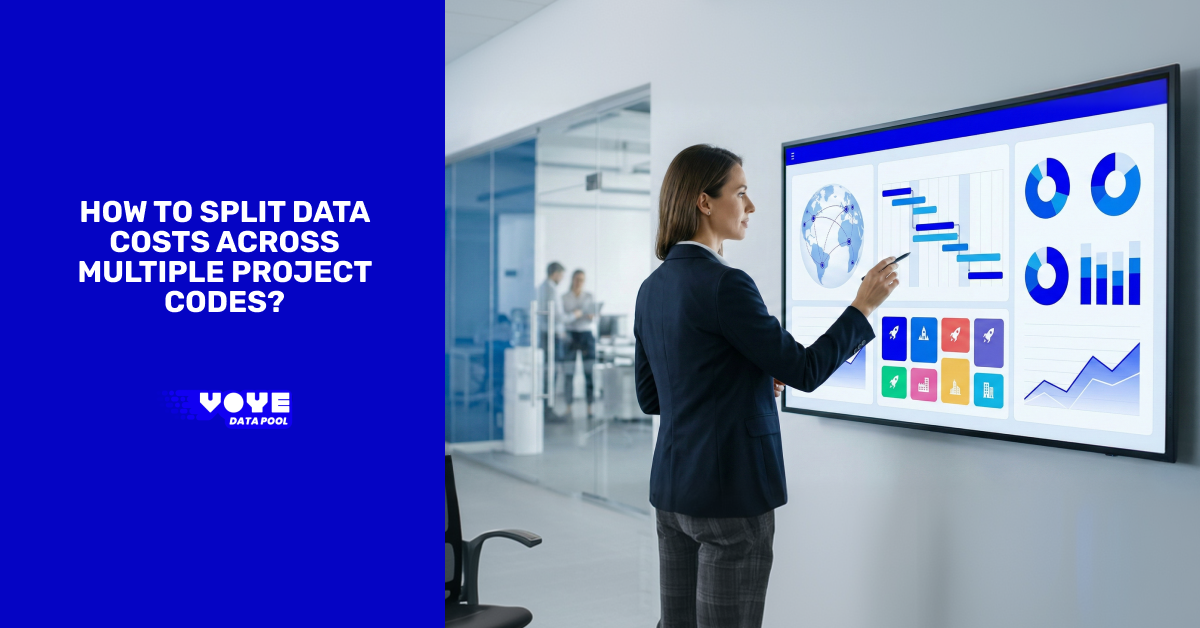
- Central Dashboard
Monitor every device, employee, and connection in one place.
- Usage Visibility
Track usage in real time per user or device.
- Project Mapping
Assign connections to departments or project codes.
- Global Operations
Operate across 130+ countries without changing carriers.
- Secure Control
Instantly suspend lost or unused devices.
Finance teams gain accurate reporting while IT gains operational control.
Allocate Costs With Accuracy
Map connectivity consumption directly to project codes and departments easily.
Implementation Steps
- Identify all devices and employees using mobile data.
- Assign each to a project or department.
- Activate centralized connectivity.
- Set usage policies and limits.
- Generate monthly allocation reports.
- Import reports into accounting systems.
Within one billing cycle, telecom expenses become structured financial data.
Best Practices for Finance Departments
- Create standard project code tags.
- Require device assignment before activation.
- Review monthly usage analytics.
- Monitor inactive connections.
- Establish internal usage policies.
- Align IT and accounting workflows.
Common Mistakes to Avoid
- Treating connectivity as overhead.
- Allowing unmanaged employee SIM purchases.
- Ignoring device usage tracking.
- Relying on reimbursement claims.
- Using estimates instead of real data.
Each mistake leads to inaccurate financial statements.
From Expense to Measurable Cost
Mobile connectivity is no longer just an IT service. It is a billable operational resource. If it is not allocated correctly, it hides true project profitability and weakens financial planning.
Companies that implement usage-based allocation gain:
- Accurate client invoicing.
- Clear project margins.
- Controlled telecom spending.
- Faster accounting processes.
Voye Data Pool enables organizations to assign, monitor, and control connectivity across teams and devices using secure, scalable eSIM management in more than 130+ countries.
When connectivity data becomes financial data, finance teams finally gain full visibility into one of the fastest-growing operational expenses.