

North America Data Pools: US, Canada, and Mexico
North America data pools provide a shared connectivity solution for business travellers across the US, Canada, and Mexico. This guide explains how US, Canada, US/Canada, and broader North America data pools work, their benefits for cross-border travel, and how businesses can manage data usage, roaming, eSIMs, network access, and employee connectivity more efficiently.


 13 min read
 Share
Share
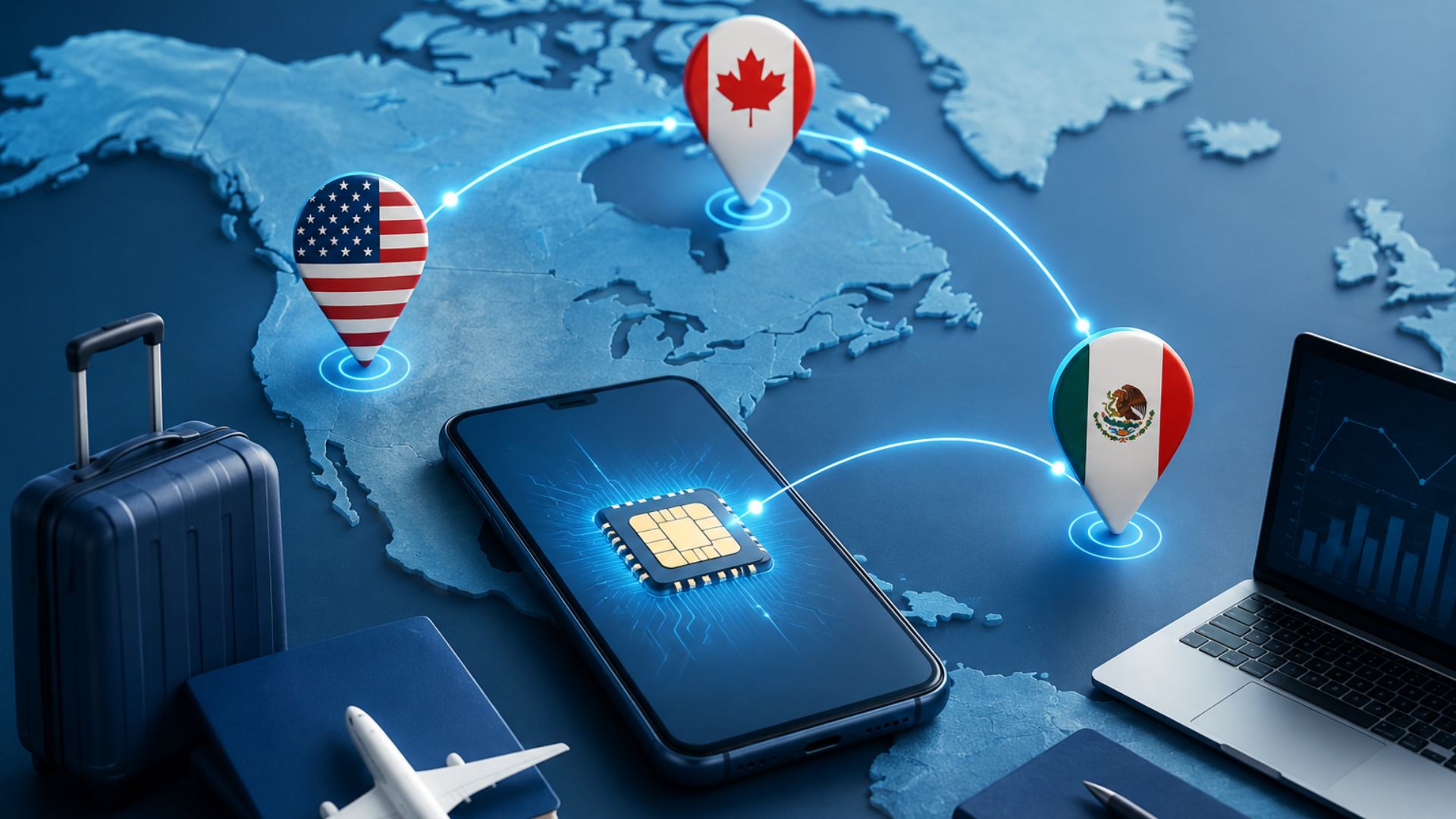
US/Canada data pool can make cross-border business travel much easier by giving travelling employees access to shared mobile data without managing separate plans for every destination. Instead of buying a new eSIM or paying roaming charges each time an employee crosses a border, businesses can use a pooled connectivity model that lets multiple users draw from a shared allowance. For companies with employees moving between the United States, Canada, and Mexico, this approach can simplify connectivity, improve cost control, and reduce travel-related admin.
What Is a North America Data Pool?
A North America data pool is a shared mobile data allowance that can support users across multiple countries in the region.
The basic idea is simple. Instead of giving every employee a fixed amount of data, a company creates a shared pool. Eligible users consume data from that common allowance as they travel.
For example, imagine a sales team with five employees travelling between New York, Toronto, and Mexico City. One employee may use very little data during a trip, while another may rely heavily on maps, video calls, cloud applications, email, and mobile hotspots.

Stay Connected Across North America
Reliable eSIM connectivity across the US, Canada, and Mexico.
With individual plans, unused data can remain locked to one user while another user needs more. A pooled model can make the available allowance more flexible across the team.
US Mobile uses a similar shared-data concept for its international by-the-gig plans, including a North America option covering Canada and Mexico.
What Is a US Data Pool?
A US data pool is a shared mobile data allowance designed for connectivity within the United States.
It can be useful for companies sending several employees to different US cities. Instead of purchasing separate data packages for every traveller, the organisation can manage connectivity under a central plan.
Business travellers can use mobile data for:
- Email and messaging
- Google Maps and navigation
- Video meetings
- CRM access
- Cloud documents
- Travel applications
- Mobile hotspots
- Online presentations
- Customer communication
- Remote work
The main advantage is flexibility. Data usage does not always follow a predictable pattern, especially when employees have different schedules and workloads.
A pooled model gives businesses a better way to manage that variation.
What Is a Canada Data Pool?
A Canada data pool works on the same shared-data principle but supports connectivity for employees travelling or working in Canada.
Canada presents a common challenge for companies with North American operations. A US-based employee may travel to Toronto for a meeting, Vancouver for a customer visit, or Montreal for an industry event.
Using a separate connectivity plan for every trip creates additional administration. Employees may also forget to activate the correct roaming option before crossing the border.
A Canada data pool can provide a more structured approach.
Businesses can allocate connectivity to the employees who need it while monitoring overall consumption from a central system.
What Is a US/Canada Data Pool?
A US/Canada data pool connects the two most common North American business-travel markets under a shared connectivity strategy.
This setup is particularly useful for companies with regular cross-border travel.
Consider a consulting company with employees based in Chicago, New York, Toronto, and Vancouver. Their travel schedule may change every week. One consultant could spend most of the month in the US, while another may travel between Canada and the US several times.
A US/Canada data pool can help the company manage these users without treating every border crossing as a separate connectivity purchase.
The employee simply needs a compatible eSIM-enabled device and an active service profile. The business handles the broader connectivity strategy.
Why Businesses Need a North America Data Pool in 2026?
Business travel requires more mobile data than simply sending messages.
Employees now use smartphones as mobile workstations. They check dashboards, join video calls, access cloud software, upload files, communicate with clients, and use navigation throughout the day.
The need for reliable connectivity becomes even more important when a trip covers multiple countries.
A 2026 mobile plan comparison from Topicks shows that several Canadian plans now offer data that can be used across Canada, the US, and Mexico, demonstrating the growing demand for regional connectivity rather than country-by-country service.
For businesses, the bigger question is not only how much data is available. It is how easily that data can be managed across people, destinations, and devices.
US Data Pool vs Canada Data Pool vs US/Canada Data Pool
These terms can sound similar, but the use case is different.
| Data pool | Best suited for | Main advantage |
| US data pool | Employees travelling within the United States | Centralised US connectivity |
| Canada data pool | Employees travelling within Canada | Shared Canadian data usage |
| US/Canada data pool | Employees crossing the US-Canada border | One regional connectivity strategy |
| North America data pool | Teams travelling across the US, Canada and Mexico | Wider regional coverage |
The right option depends on where employees travel and how the business manages connectivity.
For teams that frequently cross the US-Canada border, a regional pool can be more practical than maintaining separate country-specific plans.
How Does Data Pooling Work for Business Travellers?
The process is easier to understand with a simple example.
Suppose a company provides its travelling team with a shared 100 GB data allowance.
Five employees are connected to the business account.
During the month:
- Employee A uses 12 GB
- Employee B uses 28 GB
- Employee C uses 8 GB
- Employee D uses 34 GB
- Employee E uses 10 GB
The team has used 92 GB in total.
The remaining 8 GB stays available within the shared allowance, subject to the plan’s terms.
This model can be more efficient than giving each employee exactly 20 GB. A fixed allocation might leave one employee with unused data while another reaches a limit early.
Pooling allows usage to follow actual business needs.
Benefits of a US/Canada Data Pool for Business Travel
1. Reduce Roaming Complexity
International roaming can create confusion when employees cross borders.
A traveller may need to check whether Canada is included in a US plan or whether a US trip is covered by a Canadian plan.
A regional data pool reduces the number of decisions employees need to make before a trip.
2. Share Data Across Travelling Employees
Business travel does not produce equal data usage.
A salesperson may spend hours on video calls. An executive may mostly use email and messaging. A field engineer could need large amounts of data for cloud systems and file transfers.
A shared pool can accommodate those differences.
3. Improve Cost Visibility
Centralised connectivity gives businesses a clearer view of data consumption.
Administrators can identify:
- High-data users
- Unused allocations
- Frequent travellers
- Unexpected usage
- Department-level consumption
- Potential cost leaks
That information can support better travel and telecom budgeting.
4. Simplify Employee Connectivity
Employees should not have to become telecom experts before every business trip.
With an eSIM-based setup, the connectivity profile can be installed before departure. Once the traveller arrives, the appropriate mobile data service can be enabled according to the plan and device configuration.
Voye Data Pool is designed around this model, allowing businesses to activate eSIMs, assign them to users, set usage policies, and monitor connectivity from a central dashboard.
5. Support Cross-Border Travel
US and Canadian business travel often involves short trips.
An employee may fly from Toronto to New York for two days, return to Canada, and travel back to the US the following week.
Switching between separate connectivity products for every journey creates unnecessary friction.
A regional strategy can make those trips easier to manage.
Simplify Cross-Border Business Travel
Manage business eSIMs and shared data in one place.
What About Mexico?
Mexico is an important part of the wider North American connectivity picture.
A company may have an employee travelling from Los Angeles to Mexico City, a sales representative visiting Monterrey, or an operations team moving between all three countries.
For those businesses, a US/Canada-only solution may not be enough.
A broader North America data pool can bring the United States, Canada, and Mexico into one regional connectivity strategy.
This is especially useful for organisations involved in:
- Manufacturing
- Logistics
- Consulting
- Technology
- Automotive
- Retail
- Financial services
- Events
- Field services
- International sales
Several current mobile plans already combine Canada, the US, and Mexico, showing that three-country connectivity is becoming a practical requirement for cross-border users.
Data Pool vs Separate eSIMs for Every Country
Both approaches can provide connectivity, but the management experience is different.
Separate country eSIMs
An employee travelling from the US to Canada may need to:
- Purchase a Canada eSIM
- Install it
- Configure mobile data
- Switch profiles
- Monitor a separate allowance
That process may be manageable for one traveller.
It becomes harder when an IT or travel team manages dozens of employees.
Regional data pool
A regional data pool can provide a more centralised model.
The company manages the connectivity setup while employees use their assigned eSIMs during travel.
This reduces the need for employees to make connectivity decisions on every trip.
Data Pool vs Traditional Roaming
Traditional roaming allows a traveller to use their existing mobile service abroad.
The problem is that roaming terms vary widely by carrier and plan.
Some plans include international usage. Others provide limited data. Certain plans may require a travel pass or add-on.
Business travellers can also use significant amounts of data without realising how quickly usage is accumulating.
An eSIM data pool provides another approach. Rather than relying entirely on the employee’s home carrier, the company can use a dedicated connectivity platform designed for international usage and centralised control.
Voye Data Pool states that its platform is built to reduce roaming costs while providing centralised usage controls and visibility for business teams.
How to Choose the Right North America Data Pool?
Before selecting a solution, businesses should review several factors.
1. Coverage
Check whether the service supports every country employees visit.
Coverage should also be reviewed at the network level. A plan that covers a country does not automatically guarantee the same performance everywhere.
2. Data Sharing
Confirm whether data is genuinely shared across eligible users or whether each eSIM receives a separate allowance.
The distinction matters when employee usage varies.
3. Network Access
Look at the networks available in each destination.
Sixfab’s data-pool network documentation, for example, lists operators such as T-Mobile and AT&T in the US and Bell and Telus in Canada under its North America group.
4. Usage Monitoring
A business should be able to see how much data each user consumes.
Real-time or near-real-time visibility can help prevent unexpected usage and identify unusual patterns.
5. User Controls
Look for features such as:
- Data limits
- Usage alerts
- User groups
- Department controls
- Remote activation
- Remote deactivation
- Central billing
- Usage reporting
6. Device Compatibility
Most modern smartphones support eSIM technology, but businesses should confirm device compatibility before deployment.
Locked devices, older phones, and some regional device models may have limitations.
Who Benefits Most From a US/Canada Data Pool?
A US/Canada data pool is especially useful for businesses with employees who travel frequently between both countries.
- Sales Teams
Sales representatives need maps, CRM access, email, video calls, and customer communication throughout the day.
- Consultants
Consultants often move between client offices and may work from hotels, airports, and temporary locations.
- Executives
Senior leaders need reliable connectivity without spending time dealing with SIM cards and roaming settings.
- Field Service Teams
Field employees may work in different cities and require mobile access to work orders, technical documents, photos, and communication tools.
- Remote Employees
Distributed teams can use mobile connectivity as a backup when travelling or working outside their normal location.
Example: A Business Trip Across Three Countries
Imagine a US-based technology company sending three employees on a North American business trip.
The itinerary looks like this:
Day 1–3: New York
The team meets a customer and uses mobile data for navigation, email, video calls, and cloud applications.
Day 4–6: Toronto
The employees cross into Canada for a partner meeting. Their connectivity needs remain the same.
Day 7–9: Mexico City
The team travels to Mexico for an industry event and continues using mobile data for presentations, messaging, maps, and business applications.
With country-specific connectivity, the team may need to manage multiple plans.
With a broader regional solution, the company can manage connectivity as part of one North American travel strategy.
That difference becomes more important as the number of travelling employees grows.
How Voye Data Pool Supports North American Business Travel?
Voye Data Pool is built for companies that need more than a basic travel eSIM.
The platform provides a centralised approach to business connectivity. Companies can add travelling users, assign eSIMs, establish usage policies, and monitor data consumption from one system.
That approach is useful for organisations where employees regularly move between countries.
Instead of asking each employee to find a new SIM before every trip, the business can establish its connectivity rules once and apply them across its travelling workforce.
Voye Data Pool also supports connectivity across more than 130 countries, making it possible to extend the same broader strategy beyond North America when employees travel to other regions.
Best Practices for Managing Business Data Pools
A good data pool still needs proper management.
1. Set Usage Policies
Define reasonable limits for different employee groups.
For example, sales teams may need more data than employees who mainly use email.
2. Monitor Usage Regularly
Look for unusual spikes rather than waiting until the end of the billing cycle.
3. Review Travel Patterns
Identify which countries employees visit most often.
This can help determine whether a US-only, US/Canada, or broader North America solution makes sense.
4. Separate Business and Personal Usage
Clear policies can help employees understand what company connectivity is intended to cover.
5. Keep Backup Connectivity in Mind
Important travellers may need a backup option for critical meetings or field operations.
6. Check Device Compatibility Before Travel
An eSIM cannot solve a device compatibility problem after an employee has already landed.
Testing devices before departure reduces avoidable issues.
Final Thoughts
North American business travel does not have to mean managing a new connectivity plan at every border.
A US data pool can simplify connectivity within the United States. A Canada data pool can support employees travelling across Canada. For companies with frequent cross-border movement, a US/Canada data pool can provide a more practical way to manage shared connectivity.
Adding Mexico creates an even broader North America strategy for teams that operate across all three markets.
The key is to look beyond the amount of data available. Businesses should also consider coverage, network access, shared usage, monitoring, user controls, device compatibility, and ease of management.
For companies that want one central system for travelling employees, Voye Data Pool provides an eSIM-based approach that combines deployment, usage policies, monitoring, and international connectivity in one platform.
As business travel continues to evolve in 2026, reliable mobile connectivity is no longer just a convenience. It is part of the infrastructure that keeps employees productive when they are away from the office.
Manage Your Global Data Pool
Monitor eSIM usage and connectivity from one platform.