

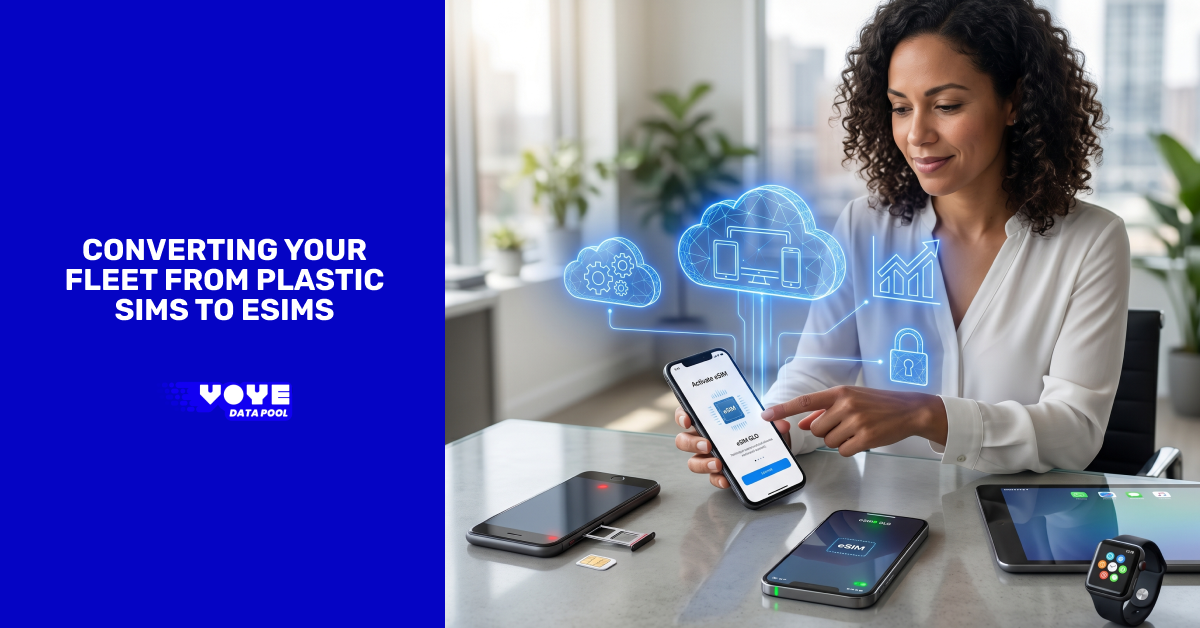
Converting Your Fleet from Plastic SIMs to eSIMs
Fleet connectivity is evolving rapidly as businesses shift to smarter, scalable solutions. The move to convert SIM to eSIM helps fleet managers improve operational efficiency, reduce downtime, and gain better control over data usage. With features like remote provisioning, multi-network access, and integration with a custom data pool and Voye Data Pool, fleets can streamline connectivity management. This transition supports cost optimization, enhances security, and prepares fleet operations for future technologies and expansion across regions with seamless network performance.


 7 min read
 Share
Share
Fleet operations are becoming increasingly data-driven, connected, and dependent on reliable mobile communication. From GPS tracking to telematics, route optimization, and driver safety systems, connectivity is now a core operational layer. Traditional plastic SIM cards have supported fleets for years, but they are quickly being replaced by eSIM technology, which offers flexibility, scalability, and operational efficiency.
For fleet managers, the transition is not just a technical upgrade. It is a strategic move that can streamline operations, reduce downtime, and enable better control over connectivity across vehicles, devices, and regions.
Understanding the Shift from Plastic SIMs to eSIMs
The transition from plastic SIM cards to eSIM technology marks a fundamental shift in how fleet connectivity is deployed, managed, and scaled.
What is an eSIM?
An eSIM, or embedded SIM, is a programmable SIM that is built directly into a device. Unlike physical SIM cards, it does not need to be inserted or replaced manually. Instead, network profiles can be downloaded, updated, or switched remotely.
Why Plastic SIMs Fall Short in Fleet Environments?
Plastic SIM cards were designed for individual consumer use. In large-scale fleet deployments, they introduce several limitations:
- Manual installation and replacement
- Risk of damage, theft, or misplacement
- Complex logistics when managing multiple operators
- Delays in activation and provisioning
- Limited flexibility for international operations
These challenges become more pronounced as fleets grow in size and geographic coverage.
Key Benefits of eSIM for Fleet Management
By removing the limitations of physical SIM cards, eSIM unlocks powerful capabilities that enhance connectivity, reduce costs, and streamline fleet operations.
Remote Provisioning and Management
eSIM technology allows fleet managers to provision and manage connectivity remotely. There is no need to physically access vehicles to change SIMs or switch carriers.
Advantages include:
- Instant activation of new devices
- Remote updates to network profiles
- Reduced operational downtime
- Centralized control over connectivity
Multi-Network Flexibility
With eSIM, devices can connect to multiple network providers without needing physical SIM swaps. This ensures better coverage and redundancy.
- Seamless switching between operators
- Improved connectivity in remote or cross-border routes
- Reduced dependency on a single carrier

Upgrade Fleet Connectivity Today
Switch faster, manage devices remotely, and optimize fleet network performance.
Improved Security
eSIMs are embedded within the device, making them less vulnerable to theft or tampering.
- No physical SIM removal
- Enhanced data protection
- Secure profile management
Scalability for Growing Fleets
As fleets expand, managing connectivity across hundreds or thousands of devices becomes complex. eSIM simplifies scaling.
- Bulk provisioning capabilities
- Automated deployment workflows
- Easier onboarding of new vehicles and IoT devices
Operational Efficiency Gains
Operational efficiency improves significantly with eSIM as it enables faster issue resolution, simplified logistics, and smarter cost management.
Reduced Downtime
Vehicle downtime directly impacts profitability. eSIM eliminates delays caused by SIM replacement or connectivity issues.
- Faster issue resolution through remote diagnostics
- No need for technician visits for SIM-related problems
Streamlined Logistics
Fleet managers no longer need to manage SIM inventory, shipping, or installation.
- Elimination of physical SIM logistics
- Reduced administrative overhead
- Simplified device lifecycle management
Cost Optimization
eSIM enables better control over data usage and network selection.
- Choose cost-effective networks dynamically
- Avoid roaming charges through local profiles
- Optimize plans using a custom data pool
Steps to Transition Your Fleet to eSIM
A structured and well-planned approach ensures a smooth transition to eSIM without disrupting ongoing fleet operations.
Assess Current Fleet Infrastructure
Before transitioning, evaluate your existing setup:
- Number of connected devices
- Current SIM providers and contracts
- Data usage patterns
- Geographic coverage requirements
Choose eSIM-Compatible Devices
Not all devices support eSIM technology. Ensure your fleet hardware is compatible.
- Check telematics systems and GPS devices
- Upgrade legacy hardware if needed
- Prioritize future-ready equipment
Select an eSIM Connectivity Provider
A reliable provider is critical for a smooth transition. Look for:
- Global coverage
- Strong network partnerships
- Centralized management platform
- Flexible data plans, including custom data pool options
Plan the Migration Strategy
Migration should be phased to avoid disruptions.
- Start with a pilot group of vehicles
- Monitor performance and connectivity
- Gradually scale across the fleet
Execute Remote Provisioning
Once devices are ready, begin provisioning eSIM profiles remotely.
- Assign network profiles to each device
- Configure data plans
- Test connectivity and performance
Many fleet operators look for ways to convert SIM to eSIM efficiently without disrupting daily operations. This typically involves integrating a robust management platform that supports remote provisioning and real-time monitoring.
Leveraging Custom Data Pool for Fleet Connectivity
Data usage across a fleet is rarely uniform. Some vehicles consume more data due to route complexity or advanced telematics, while others use less.
A custom data pool allows fleet managers to:
- Share data across multiple devices
- Avoid overage charges on individual SIMs
- Maximize utilization of allocated data
- Simplify billing and cost tracking
This approach ensures that connectivity resources are used efficiently across the entire fleet rather than being restricted to individual devices.
Integrating Voye Data Pool into Fleet Operations
Modern fleet connectivity solutions are evolving beyond simple SIM management. Voye Data Pool introduces a flexible and scalable way to manage data across connected assets.
Key Features of Voye Data Pool
- Centralized data allocation across all fleet devices
- Real-time usage monitoring and analytics
- Dynamic data distribution based on demand
- Seamless integration with eSIM platforms
Benefits for Fleet Managers
- Improved visibility into data consumption
- Reduced costs through optimized usage
- Simplified management of large-scale deployments
- Enhanced operational control
By integrating Voye Data Pool with eSIM technology, fleet managers can create a unified connectivity ecosystem that supports both efficiency and scalability.
Simplify Fleet Data Management
Control usage efficiently with a custom data pool and smart allocation.
Addressing Common Challenges During Transition
While transitioning to eSIM offers significant advantages, fleet managers may encounter a few challenges that require careful planning and mitigation.
Compatibility Issues
Older devices may not support eSIM.
Solution:
- Conduct a hardware audit
- Replace or upgrade incompatible devices
Network Coverage Concerns
Switching providers may raise concerns about coverage.
Solution:
- Choose providers with multi-network capabilities
- Test connectivity in key operational areas
Data Management Complexity
Managing data across multiple devices can be challenging.
Solution:
- Implement a centralized platform
- Use custom data pool solutions for optimization
Change Management
Transitioning to a new system requires training and adaptation.
Solution:
- Train staff on new tools and workflows
- Provide clear documentation and support
Best Practices for a Successful eSIM Deployment
Following proven best practices helps ensure a smooth eSIM deployment while maximizing performance, reliability, and long-term value.
Start Small and Scale Gradually
Begin with a pilot program to test performance and identify issues before full deployment.
Monitor Performance Continuously
Use analytics tools to track:
- Network performance
- Data usage
- Device connectivity
Optimize Data Plans Regularly
Review usage patterns and adjust plans to ensure cost efficiency.
Maintain Strong Vendor Relationships
Work closely with your eSIM provider to:
- Resolve issues quickly
- Access new features
- Stay updated on network improvements
Future-Proofing Your Fleet Connectivity
The shift to eSIM is part of a broader trend toward digital transformation in fleet management. As technologies like IoT, AI, and real-time analytics continue to evolve, connectivity will play an even more critical role.
eSIM positions fleets to:
- Integrate advanced telematics systems
- Support autonomous and semi-autonomous vehicles
- Enable real-time decision-making
- Expand into new markets without connectivity barriers
Combining eSIM with solutions like Voye Data Pool ensures that fleets are not only connected but also optimized for performance and cost efficiency.
Conclusion
Transitioning from plastic SIMs to eSIMs is a strategic move that delivers operational efficiency, scalability, and cost control for fleet managers. By eliminating the limitations of physical SIM cards, fleets gain the flexibility to manage connectivity remotely, adapt to changing requirements, and optimize data usage through solutions such as Voye Data Pool’s custom data pool.
A well-planned migration, supported by the right technology and provider, ensures minimal disruption and maximum benefit. As fleet operations continue to evolve, eSIM technology provides a strong foundation for future growth, innovation, and competitive advantage.
Scale Fleet Without Limits
Enable global coverage and seamless connectivity with Voye Data Pool.