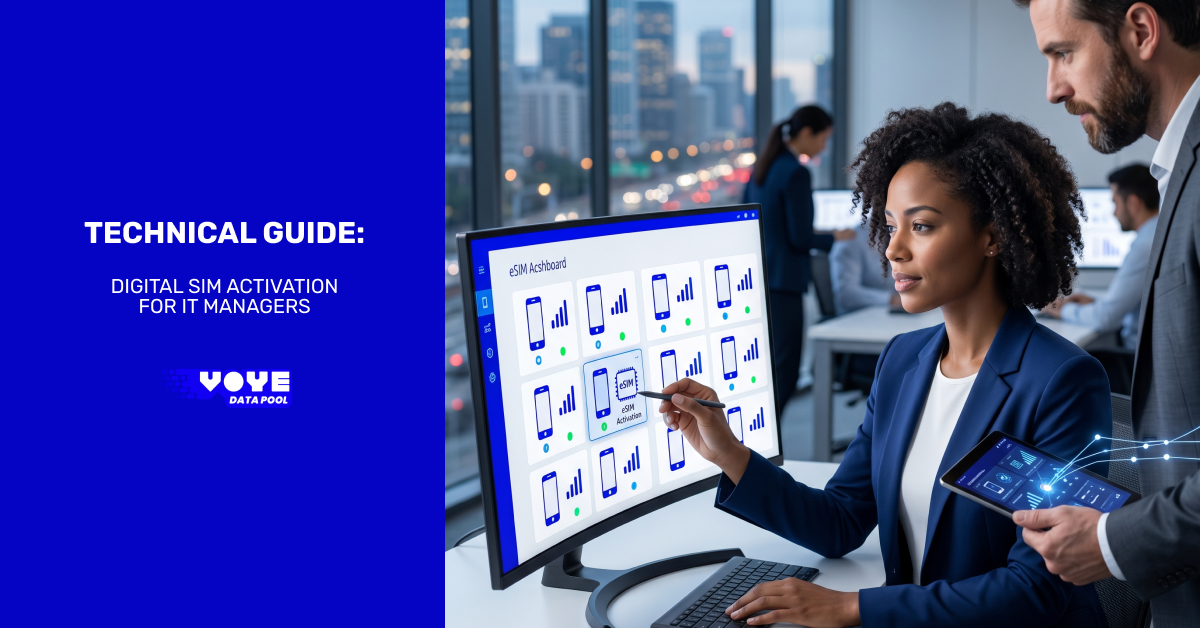
Technical Guide: Digital SIM Activation for IT Managers
Enterprise connectivity is rapidly evolving with eSIM technology and remote provisioning frameworks. This guide provides IT managers with a clear understanding of activation workflows, architecture, and deployment strategies required for scalable operations. It highlights how organizations can optimize connectivity, improve security, and manage global device fleets efficiently. With insights into intelligent data management and enterprise integration, this content equips decision-makers to build future-ready connectivity strategies that align with business growth and digital transformation goals.


 7 min read
 Share
Share
Enterprise connectivity is undergoing a structural transformation driven by embedded SIM technology and remote provisioning standards. Traditional SIM logistics, involving physical handling, distribution, and manual configuration, are increasingly inefficient for modern IT environments. Organizations now require scalable, software-driven connectivity that aligns with distributed workforces, IoT ecosystems, and global operations.
Embedded SIM technology, powered by GSMA-defined Remote SIM Provisioning frameworks, enables IT managers to remotely deploy and manage network profiles across devices. This transition eliminates physical dependencies and introduces centralized control, enhanced security, and operational agility.
Foundations of eSIM and Remote Provisioning
A clear understanding of eSIM technology and remote provisioning is essential for building a scalable and future-ready enterprise connectivity strategy.
What is eSIM and eUICC?
An eSIM is a programmable chip embedded directly into a device, replacing removable SIM cards. It operates on an eUICC, which securely stores multiple network operator profiles and enables over-the-air updates.
Unlike traditional SIMs, eSIMs can download, switch, and manage profiles remotely, supporting multiple carriers without hardware changes.
Remote SIM Provisioning Explained
Remote SIM Provisioning (RSP) is the standardized process that allows operators to securely deliver and manage SIM profiles over IP networks.
Key capabilities include:
- Remote profile installation and activation
- Profile switching without device access
- Lifecycle management, including enable, disable, and delete
- Secure communication between the device and the operator
This architecture forms the backbone of enterprise-grade connectivity systems.

Simplify eSIM Deployment
Streamline activation, provisioning, and device connectivity with enterprise-ready solutions.
Core Architecture Behind eSIM Activation
Understanding the underlying architecture is essential for IT managers to effectively deploy, manage, and troubleshoot eSIM-based connectivity at scale.
Key Components in GSMA Architecture
The GSMA framework defines a set of interconnected components that enable seamless provisioning:
SM-DP+ (Subscription Manager Data Preparation Plus)
- Stores and prepares encrypted operator profiles
- Acts as the central hub for profile lifecycle management
- Delivers profiles securely to devices upon request
SM-DS (Discovery Server)
- Provides the device with the correct SM-DP+ address
- Enables profile discovery and download initiation
LPA (Local Profile Assistant)
- Software on the device that manages profile downloads
- Interfaces with users or enterprise systems for activation
eUICC (Embedded Secure Element)
- Stores multiple profiles securely
- Executes authentication and encryption processes
Architecture Evolution
Earlier M2M systems used separate SM-DP and SM-SR components, but modern consumer and enterprise models combine these into SM-DP+ for simplified deployment.
This consolidation reduces complexity and improves scalability for enterprise use cases.
Activation Workflow for Enterprise IT
A well-defined workflow helps IT teams streamline provisioning while maintaining security, consistency, and operational efficiency across all connected devices.
Pre-Deployment Checklist
Before initiating provisioning, IT managers should ensure:
- Device compatibility with eSIM standards
- Access to the provisioning platform or the connectivity provider
- Defined security and compliance policies
- Integration with enterprise mobility systems
Step-by-Step Activation Flow
A structured activation workflow ensures secure, efficient, and scalable deployment of connectivity across enterprise devices.
Step 1: Profile Creation
The mobile operator generates a profile containing credentials such as IMSI and authentication keys. This profile is encrypted and stored in the SM-DP+ server.
Step 2: Triggering Activation
Activation can be initiated through:
- QR codes
- Activation codes
- API-based enterprise triggers
These methods link the device to the appropriate SM-DP+ server.
Step 3: Secure Profile Download
The device establishes a secure connection using TLS and certificate-based authentication. The Local Profile Assistant downloads the encrypted profile into the eUICC.
Step 4: Installation and Enablement
- Profile is installed in the secure element
- Device activates the selected network profile
- Connectivity is established with the carrier
Step 5: Lifecycle Management
IT teams can remotely:
- Switch carriers
- Update profiles
- Disable or delete subscriptions
This entire process eliminates the need for physical SIM replacement.
Enterprise Deployment Models
Choosing the right deployment model is essential for aligning connectivity strategies with organizational structure, geographic presence, and operational complexity.
Centralized Deployment
Best suited for controlled environments with uniform devices:
- Single provisioning system
- Bulk activation workflows
- Unified policy enforcement
Distributed Deployment
Ideal for multinational enterprises:
- Regional carrier integrations
- Compliance with local telecom regulations
- Flexible provisioning models
Hybrid Deployment
Combines centralized governance with regional flexibility:
- Central visibility and control
- Local execution capabilities
- Optimized performance and cost
Scale Global Connectivity
Manage multi-country deployments with secure and flexible eSIM infrastructure.
Security and Compliance Framework
Robust security and strict compliance standards are critical to ensuring that enterprise connectivity remains protected against evolving threats and regulatory risks.
Built-In Security Mechanisms
eSIM architecture is designed with strong security foundations:
- Certificate-based trust chains
- Secure hardware storage within eUICC
- End-to-end encryption using TLS protocols
- Mutual authentication between the device and the server
GSMA certification processes further ensure interoperability and security across ecosystem components.
Compliance Considerations
- Telecom regulatory compliance
- Audit trails for provisioning and usage
- Secure credential storage and handling
- Adherence to regional data privacy laws
Role of Connectivity Intelligence in Enterprises
Modern IT environments require more than just connectivity. They demand intelligent data allocation, monitoring, and optimization.
Custom Data Pool for Efficient Management
A custom data pool allows enterprises to distribute data usage dynamically across multiple devices.
Benefits
- Predictable cost management
- Flexible scaling for peak usage
- Reduced unused data wastage
- Shared data across device fleets
Implementation Strategy
- Monitor consumption patterns
- Integrate analytics for forecasting
- Align with business-critical applications
- Define usage thresholds per department
This approach ensures efficient utilization of enterprise connectivity resources.
Voye Data Pool in Enterprise Connectivity
Voye Data Pool enhances enterprise connectivity by combining provisioning capabilities with intelligent data orchestration.
Key Capabilities
- Centralized visibility into device usage
- Real-time analytics for decision making
- Dynamic allocation of bandwidth across devices
- Seamless integration with enterprise IT systems
Strategic Advantages
- Enhances operational efficiency
- Eliminates over-provisioning of data plans
- Enables cost transparency across departments
- Supports scalable IoT and mobile deployments
By integrating provisioning workflows with data pooling, enterprises gain both control and flexibility in managing connectivity.
Scaling Across IoT and Global Operations
As enterprises expand their digital footprint, scalable and flexible connectivity becomes essential to support diverse devices, regions, and operational demands.
IoT Device Management
eSIM enables large-scale IoT deployments by:
- Automating provisioning across thousands of devices
- Supporting remote updates and maintenance
- Reducing operational overhead
Devices can automatically connect and download profiles on first boot, enabling rapid deployment across regions.
Global Connectivity
- Reduced roaming complexities
- Seamless switching between networks
- Multi-carrier support for better coverage
Remote Workforce Enablement
- Simplified onboarding processes
- Secure access to enterprise networks
- Instant connectivity for distributed employees
In large-scale environments, digital SIM activation becomes a critical enabler of seamless connectivity and operational continuity.
Optimize Data Usage
Control enterprise data consumption with intelligent and scalable eSIM solutions.
Performance Monitoring and Optimization
Effective monitoring ensures that enterprise connectivity remains reliable, cost-efficient, and aligned with business objectives in real time.
Key Metrics for IT Managers
- Cost per device
- Data usage efficiency
- Activation success rates
- Network uptime and latency
Optimization Techniques
- Automate alerts for unusual usage patterns
- Use predictive analytics for demand forecasting
- Optimize carrier selection based on performance
Platforms like Voye Data Pool provide actionable insights that allow IT teams to continuously refine connectivity strategies.
Why Voye Data Pool is Surprisingly Awesome?
Voye Data Pool does not just manage connectivity. It makes it smarter.
What Makes It Different?
- Real-time adjustments keep everything running smoothly
- No more stranded data sitting unused on inactive devices
- It quietly optimizes costs while IT teams focus on bigger priorities
- Think of it as a data buffet where devices only take what they need
It transforms connectivity from a static expense into a dynamic, optimized resource.
Conclusion
Enterprise connectivity is no longer about inserting SIM cards and hoping for stable coverage. It is about orchestrating a complex ecosystem of devices, networks, and data with precision.
eSIM technology and remote provisioning frameworks provide the technical foundation, while intelligent solutions like Voye Data Pool bring operational efficiency and cost control into the equation.
For IT managers, the opportunity lies in leveraging these technologies not just to simplify operations, but to create a scalable, future-ready connectivity strategy that evolves with business demands.