

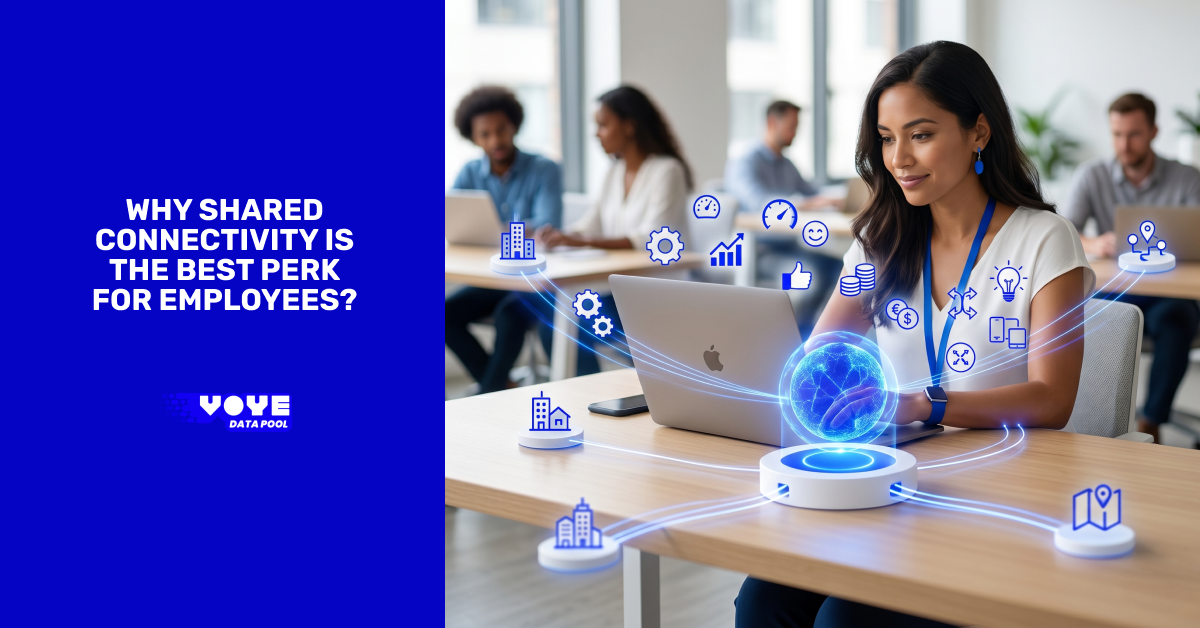
Why Shared Connectivity is the Best Perk for Employees?
Shared connectivity helps enterprises support modern employees working across locations. By providing reliable access to enterprise systems and collaboration tools, organizations improve productivity, simplify connectivity management, and ensure teams stay connected wherever work happens.


 6 min read
 Share
Share
The modern workplace has changed significantly. Employees are no longer limited to a single office location. Teams work across cities, countries, and time zones while relying heavily on digital tools to collaborate and complete daily tasks. As organizations adopt hybrid work models and distributed teams, reliable connectivity has become essential for productivity.
For enterprise IT teams, supporting employees across multiple environments presents new challenges. Workers may operate from home, shared offices, or while traveling internationally. Without reliable connectivity, communication slows, workflows become inefficient, and the employee experience suffers.
Providing consistent internet access across locations has therefore become a critical priority. At Voye Data Pool, we support enterprises with scalable connectivity that keeps employees connected wherever work happens. By enabling flexible connectivity management across global teams and devices, organizations can ensure employees stay productive without technical interruptions.
The Evolving Needs of Today’s Workforce
Workplace expectations have evolved rapidly over the past few years. Employees now rely on digital collaboration tools, cloud platforms, and mobile devices to perform their daily responsibilities.
Several workplace trends have increased the demand for dependable connectivity.
1. Hybrid and Remote Work
Many organizations operate with hybrid work environments where employees split their time between offices and remote locations. Reliable internet access ensures employees can participate in meetings, access business applications, and collaborate effectively.
2. Global Talent Distribution
Enterprises increasingly hire talent across different regions. Teams may work together from multiple countries, making seamless connectivity essential for communication and project coordination.
3. Cloud-Based Workflows
Modern enterprises depend on cloud platforms for data storage, project management, and communication. These systems require stable internet access to function properly.
Supporting these workplace trends requires connectivity infrastructure that adapts to different environments while maintaining consistent performance.
Connectivity as a Valuable Employee Benefit
Traditional employee perks focused on workplace facilities, travel allowances, or physical office benefits. However, digital infrastructure has now become a key factor influencing employee productivity and satisfaction.
Reliable connectivity plays an important role in supporting employees.
1. Greater Work Flexibility
Employees can work efficiently from different locations without worrying about unstable networks or connectivity disruptions.
2. Seamless Collaboration
Stable connectivity allows employees to communicate effectively through video conferencing, messaging platforms, and shared collaboration tools.
3. Reduced Technical Barriers
Connectivity issues can disrupt workflows and create unnecessary stress. Providing dependable connectivity reduces these disruptions.
4. Consistent Productivity
When employees have uninterrupted access to enterprise applications and systems, they can focus on their work rather than troubleshooting connectivity problems.
Organizations that prioritize connectivity support create more productive and efficient work environments.

Power Your Global Workforce
Keep employees connected across countries with secure and scalable eSIM connectivity.
Why Enterprises Are Adopting Shared Connectivity Models?
Managing individual connectivity plans for each employee can become complex and inefficient. Enterprise IT teams must monitor multiple plans, manage roaming issues, and ensure reliable network performance across different locations.
A shared connectivity approach simplifies this process by allowing organizations to distribute connectivity resources across employees and devices through a centralized system.
This model provides several advantages.
- Centralized Connectivity Control
IT teams can manage connectivity usage and policies from a unified environment rather than handling separate plans.
- Efficient Resource Distribution
Connectivity resources can be allocated based on real-time demand instead of fixed individual limits.
- Simplified Network Administration
A centralized connectivity system reduces administrative complexity for enterprise IT teams.
- Better Support for Distributed Workforces
Employees working across different regions can maintain consistent connectivity access without additional configuration.
This approach allows enterprises to support growing workforces without increasing operational complexity.
Supporting Employees Who Work Across Locations
Many enterprise employees operate across multiple environments during the course of their work. They may attend client meetings, travel between regional offices, or work remotely while on business trips.
Maintaining connectivity in these situations is essential for uninterrupted productivity.
Through shared connectivity, enterprises ensure employees remain connected regardless of location. Instead of relying on multiple regional network solutions, connectivity resources are distributed through a unified system that supports employees across different environments.
This ensures employees maintain secure access to enterprise applications, communication tools, and business systems wherever they work.
Role of eSIM Technology in Employee Connectivity
eSIM technology has significantly improved the way enterprises manage connectivity for employees and devices. Unlike traditional SIM cards, eSIM profiles can be activated and managed digitally without requiring physical distribution.
At Voye Data Pool, we use advanced eSIM management to help enterprises simplify connectivity deployment and management.
1. Remote Device Activation
Devices can be activated instantly without requiring physical SIM cards, allowing employees to connect quickly wherever they are located.
2. Multi-Network Connectivity
eSIM-enabled devices can connect to available networks depending on the region, ensuring more reliable connectivity.
3. Simplified Device Management
Enterprise administrators can manage connectivity profiles remotely, reducing operational workload.
4. Faster Global Deployment
Organizations can deploy devices to employees across multiple regions without complex logistics or delays.
These capabilities help enterprises support modern work environments where mobility and flexibility are essential.
Enhancing Employee Experience Through Reliable Connectivity
Employee experience has become a major focus for many organizations. Businesses increasingly recognize that reliable digital infrastructure directly influences employee satisfaction and productivity.
Providing stable connectivity contributes to a better work experience in several ways.
1. Reliable Access to Work Tools
Employees can access enterprise systems, communication platforms, and productivity tools without interruptions.
2. Improved Team Collaboration
Teams can communicate and collaborate more effectively when connectivity remains stable across locations.
3. Increased Work Mobility
Employees gain the freedom to work from multiple environments while maintaining access to the resources they need.
Investing in connectivity infrastructure helps organizations create a more supportive and productive workplace.
Manage Global Workforce Networks
Activate, manage, and scale eSIMs with ease.
How We Simplify Employee Connectivity with Voye Data Pool?
Managing connectivity for a global workforce requires scalable and reliable infrastructure. At Voye Data Pool, we provide enterprises with a centralized connectivity platform that simplifies how teams and devices stay connected.
Our platform enables organizations to manage connectivity across more than 130+ countries while maintaining full administrative control. Enterprise IT teams can activate devices, allocate connectivity resources, and monitor usage through a unified management environment.
By combining secure eSIM connectivity with centralized control, we help enterprises support employees across regions while reducing the complexity of connectivity management.
Empowering Employees with Smarter Connectivity
Connectivity has become one of the most important resources supporting modern employees. Teams rely on stable internet access to communicate, collaborate, and perform their daily responsibilities.
Providing reliable connectivity, therefore, goes beyond basic infrastructure. It becomes an important factor that influences employee productivity, flexibility, and workplace satisfaction.
Through scalable connectivity solutions and advanced eSIM management, we help enterprises deliver reliable connectivity experiences for employees across global operations. By enabling organizations to manage connectivity efficiently, Voye Data Pool supports a modern workforce that can stay connected wherever work happens.