

Prepaid vs. Postpaid: Which Business Data Model Wins?
As global teams expand, traditional prepaid and postpaid mobile data models struggle to deliver cost control, visibility, and scalability. This guide breaks down both approaches and explains why centralized, pooled data is emerging as the smarter model for modern businesses.


 7 min read
 Share
Share
Mobile data has quietly become a line item that many global organizations underestimate. What once supported a handful of traveling executives now underpins distributed workforces, cloud-based operations, customer-facing apps, and IoT deployments. As teams spread across borders, managing mobile data costs has shifted from an operational detail to a financial and governance challenge.
For most enterprises, the discussion still starts with a familiar dilemma: prepaid vs postpaid business data. Prepaid data plans for business promise cost control. Postpaid mobile plans for enterprises offer flexibility and perceived simplicity. Both models are deeply entrenched in telecom procurement processes.
Yet neither was designed for the reality of globally distributed teams that need instant connectivity, real-time visibility, and predictable spend. As organizations scale internationally, the limitations of both models become increasingly visible.
This article examines prepaid and postpaid business data models through a modern enterprise lens and explains why many organizations are moving beyond this binary choice toward pooled and centralized approaches to global business connectivity.
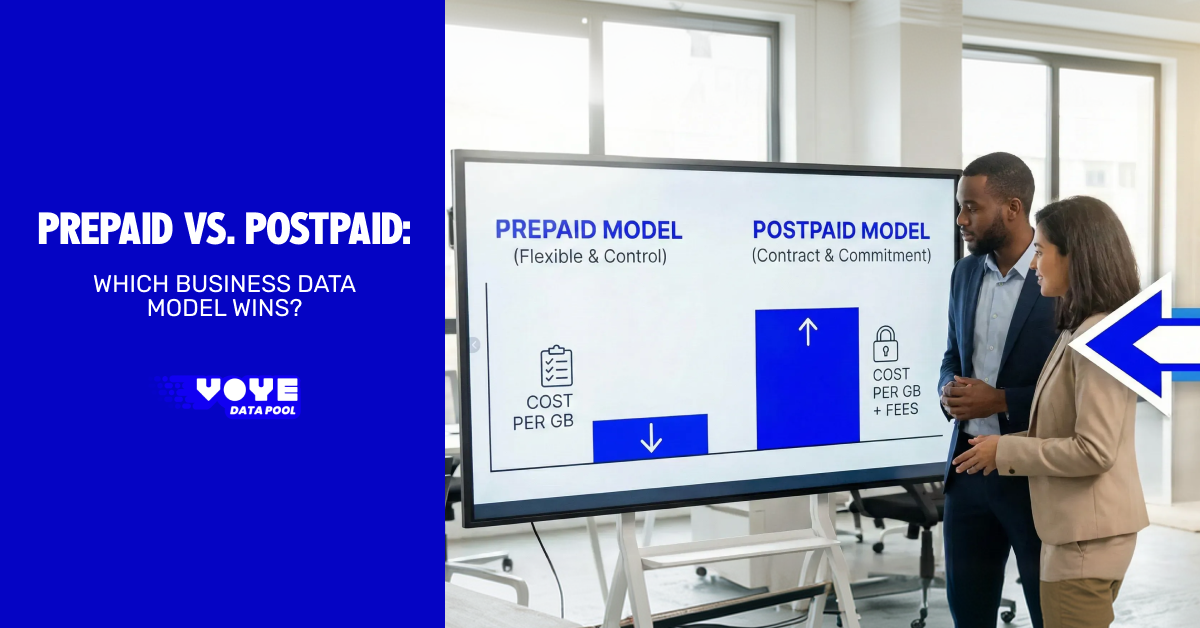
What Is Prepaid Business Data?
How prepaid models work
Prepaid business data operates on a pay-before-you-use basis. Companies purchase a fixed amount of data per SIM, device, or user. Once that data is consumed, connectivity stops unless additional data is manually topped up.
Prepaid data plans for business are often used for short-term needs such as project-based travel, temporary staff, or devices with predictable usage patterns.
Typical advantages for businesses
Prepaid models gained popularity because they offer:
- Upfront cost certainty
Spend is capped at the purchased amount, which appeals to finance teams managing tight budgets. - No long-term contractual commitment
Many prepaid plans avoid multi-year carrier contracts, offering flexibility for small teams or pilots. - Reduced risk of bill shock
Usage stops when the data allowance runs out.
Limitations at scale
While prepaid plans look attractive on paper, challenges emerge as organizations grow:
- Data fragmentation
Each employee or device has its own data allowance. Unused data expires while other users may run out. - Operational overhead
IT teams must monitor usage, manage top-ups, and respond to connectivity issues manually. - Poor suitability for global teams
Prepaid plans are often country-specific, requiring multiple vendors and inconsistent policies.
In practice, prepaid works best for small, controlled deployments, not for dynamic international operations.
What Is Postpaid Business Data?
How postpaid enterprise plans operate
Postpaid mobile plans for enterprises follow a pay-after-you-use model. Employees consume data throughout the billing cycle, and the organization receives an aggregated invoice at the end of the month.
This model dominates traditional enterprise telecom agreements, particularly with national and regional carriers.
Where postpaid works well
Postpaid plans can be effective when:
- Teams operate primarily within a single country or region
- Usage patterns are stable and predictable
- Enterprises have dedicated telecom management resources
- Roaming is limited or infrequent
For mature organizations with long-standing carrier relationships, postpaid feels familiar and administratively straightforward.
Where postpaid fails at scale
As global complexity increases, weaknesses become clear:
- Unpredictable costs
Roaming charges, overages, and inconsistent local tariffs make forecasting difficult. - Delayed visibility
Usage insights often arrive weeks after consumption, limiting corrective action. - Limited control
IT teams struggle to enforce usage limits or compliance policies in real time. - Vendor sprawl
Managing multiple carriers across regions increases procurement and operational burden.
Postpaid plans were built for centralized offices, not globally distributed workforces.

Scale Connectivity Without Friction
Onboard global teams instantly with centralized data control.
Prepaid vs Postpaid: A Business Comparison
The table below highlights how both models perform across key enterprise criteria.
| Criteria | Prepaid Business Data | Postpaid Enterprise Data |
|---|---|---|
| Cost predictability | High upfront but inefficient over time | Low due to variable usage and roaming |
| Data wastage | High due to unused allowances | Moderate but hidden in pooled invoices |
| Scalability | Manual and fragmented | Contract-dependent and slow |
| Administrative overhead | High with frequent top-ups | High with reconciliation and audits |
| Control and security | Limited real-time enforcement | Limited visibility until billing cycle ends |
| Suitability for global teams | Low | Medium but costly |
Neither model consistently delivers cost efficiency, control, and scalability at the same time.
Why Traditional Models Break for Global Teams
Hidden costs and inefficiencies
Global teams expose the structural weaknesses of per-user data plans:
- Roaming premiums inflate postpaid bills
- Unused data expires in prepaid plans
- Local carrier inconsistencies create pricing and policy gaps
- Delayed billing cycles prevent proactive cost management
What looks manageable at 50 employees becomes ungovernable at 500 across multiple regions.
Lack of real-time control
Both models struggle with:
- No centralized, real-time view of global usage
- Limited ability to set granular limits by role or geography
- Reactive rather than proactive governance
As mobile connectivity becomes mission-critical, this lack of control represents operational risk, not just financial inefficiency.
The Shift Toward Pooled and Centralized Data Models
Moving beyond per-user plans
Modern enterprises are questioning why mobile data is still managed as isolated allowances rather than a shared resource. Cloud infrastructure, compute, and storage have already moved to pooled consumption models. Connectivity is following the same path.
A global shared data pool aggregates mobile data into a single allowance accessible by all employees or devices, regardless of location.
Why businesses are adopting pooled models
Organizations are moving toward pooled and centralized mobile data management because it enables:
- Higher utilization efficiency
Data is consumed where needed, eliminating waste. - Real-time visibility
Usage is monitored continuously, not retroactively. - Policy-driven control
Limits, alerts, and compliance rules can be enforced centrally. - Faster global scaling
New users and devices can be onboarded instantly without renegotiating contracts.
This approach aligns mobile connectivity with how modern IT organizations already manage cloud resources.
How Voye Data Pool Solves the Prepaid vs Postpaid Debate
Traditional prepaid and postpaid models force businesses to choose between control and flexibility. Voye Data Pool represents an evolution beyond that trade-off.
Instead of managing hundreds or thousands of individual data plans, organizations access a single shared global data pool that supports employees across more than 150 countries.
Key characteristics of this model include:
- Zero data waste
Unused data automatically flows to where it is needed most. - Centralized oversight
A single dashboard provides real-time visibility, usage analytics, and policy enforcement across the entire organization. - Instant scalability
Employees can be onboarded globally without contracts, local carriers, or logistical delays. - Predictable spend
Mobile connectivity shifts from an unpredictable expense to a controllable, strategic asset.
By abstracting connectivity from geography and individual users, this approach resolves the core limitations of both prepaid and postpaid business data models.
Who Benefits Most from a Global Data Pool?
A pooled approach is particularly effective for organizations with variable usage patterns and international reach.
- Remote and hybrid teams
Distributed employees require reliable connectivity regardless of location. A shared pool ensures consistent access without managing individual plans.
- Frequent business travelers
Teams that move across borders avoid roaming complexity while maintaining predictable costs.
- Startups scaling globally
High-growth companies can expand into new markets instantly without renegotiating telecom contracts.
- Large enterprises
Centralized governance reduces vendor sprawl and improves compliance across regions.
- IoT and connected devices
Devices with uneven usage patterns benefit from shared capacity rather than fixed allowances.
In each case, pooled data aligns cost with actual consumption.
Conclusion
The question is no longer whether prepaid vs postpaid business data is the better option. Both models were designed for a different era of work.
For modern organizations, the real winner is a centralized, pooled approach that treats mobile data as a shared enterprise resource. By eliminating waste, improving visibility, and enabling instant global scale, pooled models address the structural inefficiencies that prepaid and postpaid plans cannot.
As mobile connectivity becomes foundational to global operations, businesses that manage it strategically will gain not only cost control but also operational resilience.
For organizations evaluating their next step in enterprise eSIM data solutions and global business connectivity, exploring a unified data pool can be a practical path toward clarity, control, and sustainable scale.
Take Control of Global Data
Simplify mobile connectivity with pooled, centralized eSIM data.