How to Manage Multi-Country Data Plans from a Single Dashboard
Managing data plans across multiple countries has become one of the biggest operational challenges for global enterprises. Fragmented carrier portals, roaming inefficiencies, and lack of real-time oversight create financial and compliance risks. This guide explains how a unified dashboard eliminates telecom complexity, strengthens governance, and ensures reliable connectivity for distributed teams. With platforms like Voye Data Pool, enterprises gain centralized control, actionable analytics, automated provisioning, and better cost efficiency. Learn how to transform global connectivity into a streamlined, secure, and scalable system.


 8 min read
 Share
Share
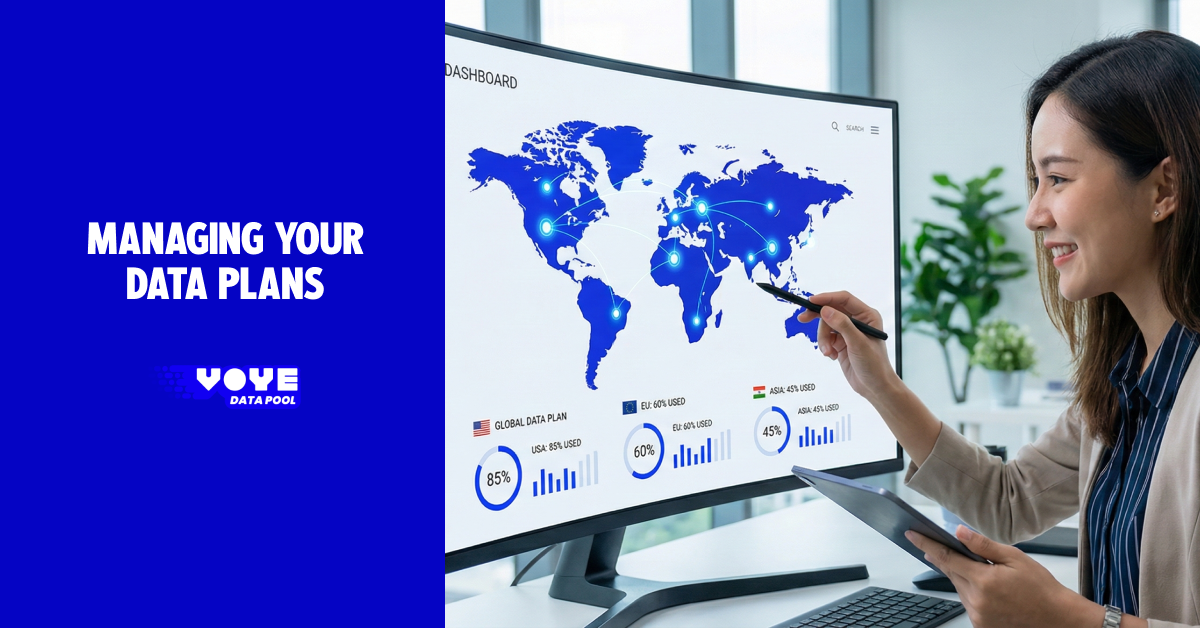
In most enterprises today, connectivity has advanced much faster than how it’s managed. Workforces are global, IoT footprints are cross-border, and connectivity requirements change every month. Meanwhile, telecom management remains fragmented across dozens of carriers, local contracts, roaming agreements, and spreadsheets.
The result is predictable and costly: finance teams lack a unified view of spend, IT teams operate reactively, and compliance officers lack visibility into how and where data plans are being used.
A single, unified dashboard for multi-country data plans changes this model completely. Platforms like Voye Data Pool simplify management, deliver real-time visibility, strengthen governance, and help enterprises make telecom an operational advantage rather than a liability.
Why Global Teams Struggle with Fragmented Telecom Management
Multiple carriers, no consolidated source of truth
A multinational organization may maintain:
- Local carrier plans across various countries
- Roaming packages for employees who travel
- Separate setup for IoT devices, routers, or field equipment
- Regional resellers and contracts with different billing formats
Each carrier operates with its own portal, billing cycle, reporting format, and support process. This means basic questions—such as “How much data did we use in APAC last month?” or “Which department triggered last quarter’s roaming spike?”—become extremely difficult to answer.
Spreadsheets, scattered portals, and inconsistent reporting create significant operational overhead and financial blind spots.
Manual provisioning and deprovisioning
Without a centralized system, provisioning new data plans or assigning eSIMs involves:
- Contacting local vendors
- Handling manual activation
- Updating spreadsheets or tickets
- Chasing confirmations for days
Deprovisioning tends to fail entirely, leaving inactive SIMs quietly generating recurring charges for months. Large companies routinely pay for lines no one uses simply because they lack visibility.
Lack of real-time visibility
Most carrier systems provide only delayed CDRs or summary reports. Alerts may not exist, or they may not integrate well with enterprise tools. This leaves teams without:
- Real-time usage snapshots
- Automated alerts
- Behavioral anomaly detection
- Immediate insight into roaming events
By the time a usage anomaly is discovered, it’s usually after the invoice arrives—too late for remediation.
Compliance and data residency challenges
Telecom connectivity intersects with regulatory and compliance requirements:
- Certain jurisdictions impose strict obligations on telecom data
- Roaming can trigger unexpected data transfer implications
- Sensitive industries require visibility into communications channels
Without a global, centralized dashboard, compliance teams cannot verify whether usage aligns with corporate policy or legal obligations.

Centralize Your Data Plans
Manage multi-country data with one intelligent dashboard.
How a Unified Dashboard Transforms Multi-Country Data Management
A unified dashboard—exemplified by Voye Data Pool—centralizes management, insights, compliance, and provisioning. This creates an operational model that replaces manual, ticket-based workflows with intelligent, policy-based management.
A single source of truth for all global data plans
Instead of navigating multiple portals, your teams access a single dashboard showing:
- Global usage across all countries and carriers
- Regional, departmental, and project-level breakdowns
- Individual user or device analytics
- Real-time and historical consumption data
This consolidated view becomes the enterprise’s authoritative system of record for connectivity.
Policy-based management instead of manual operations
With a unified dashboard, connectivity is managed like cloud infrastructure:
- Global usage policies define caps, roaming permissions, or thresholds
- Policies can be assigned to groups (regional teams, job roles, project units)
- Automation enforces rules and triggers alerts
- Provisioning and deprovisioning are executed at scale
This eliminates repetitive manual work and reduces operational risk.
Connecting spend to business outcomes
Because usage is mapped to BUs, cost centers, and projects, enterprise leaders can:
- Attribute spend accurately
- Identify waste (inactive lines, oversized plans)
- Optimize regional allocations
- Support budgeting with real data
Instead of guessing telecom costs, you gain actionable insights.
Key Features Enterprises Should Expect in a Unified Dashboard
Robust usage analytics
Usage data must be:
- Real-time or near real-time
- Segmented by region, group, user, and device
- Exportable for finance and compliance teams
- Capable of highlighting trends, anomalies, and high-consumption zones
Strong analytics prevent overspend and enable proactive optimization.
Centralized provisioning and lifecycle management
A unified platform should allow admins to:
- Activate eSIMs and plans remotely
- Provision users in bulk
- Suspend or terminate lines instantly
- Automate deprovisioning during offboarding
This reduces onboarding delays and ensures unused lines aren’t incurring charges.
Cost control and budget governance
An enterprise-grade dashboard supports:
- Shared cross-country data pools like Voye Data Pool
- Regional or group-level spending caps
- Automated enforcement such as throttling or blocking
- Notifications for budget overruns
Intelligent allocation prevents waste and enables more predictable spending.
Alerting and automated notifications
Alerts should trigger based on:
- Usage thresholds
- Spend limits
- Unusual activity (e.g., sudden roaming)
These alerts must integrate with enterprise systems such as Slack, Teams, or email to ensure timely action.
Group-level management capabilities
Administrators can assign users and devices into groups such as:
- Departments
- Geographies
- Project teams
- Device categories
Policies and data allocations can then apply automatically to each group. This drastically minimizes administrative burden.
Compliance, governance, and auditability
The dashboard must support:
- Full audit logs
- Role-based permissions
- Region-specific rules
- Data retention controls
- Integration with SIEM systems
Enterprises need to demonstrate connectivity governance to auditors and regulators, making compliance capabilities non-negotiable.
Step-by-Step Guide: Managing Multi-Country Data Plans Through a Unified Dashboard
Step 1: Onboard carriers, users, and devices
- Integrate existing carrier accounts or import plans
- Sync users from Azure AD, Okta, or other identity platforms
- Map devices from MDM or endpoint systems
- Organize users/devices into groups tied to cost centers
This creates an accurate global view from day one.
Step 2: Define policies and data plan structures
- Create usage tiers for different roles (standard, power users, IoT)
- Apply policies to relevant groups
- Assign shared data from Voye Data Pool
- Set usage thresholds, roaming permissions, and alert logic
Policies now drive connectivity automatically.
Step 3: Provision data plans at scale
- Bulk provision new hires
- Automate provisioning based on HR system triggers
- Deliver eSIMs instantly to user devices
- Suspend or deactivate lines when roles change or employees leave
Provisioning becomes frictionless and secure.
Step 4: Monitor usage and control costs in real time
- Track live consumption in each region
- Identify overspend trends
- Receive alerts for spikes or anomalies
- Adjust policies or redistributions as needed
Continuous insight enables continuous optimization.
Step 5: Enforce governance and compliance
- Configure admin roles and access boundaries
- Use audit logs to document policy enforcement
- Generate compliance-ready reports
- Align regional usage with regulatory requirements
Connectivity management becomes transparent and accountable.
Step 6: Integrate with enterprise infrastructure
- Identity platforms (for authentication)
- MDM solutions (for device visibility)
- ITSM tools (for workflows)
- Finance systems (for cost allocation)
This ensures connectivity control is fully unified with your IT and governance stack.
Use Cases and Benefits for Remote and Distributed Teams
Global remote employee onboarding
A single dashboard enables rapid provisioning of workers across multiple countries. With Voye Data Pool, new hires receive secure, policy-driven connectivity on day one without local carrier delays.
Traveling executive and sales support
Travel-heavy employees receive automated roaming profiles and proactive alerts, eliminating bill shock and ensuring reliable cross-border connectivity.
IoT and field device management
Organizations deploying thousands of IoT devices can centrally allocate data pools, track anomalies, and ensure consistent always-on connectivity.
M&A integration and global expansion
Telecom assets from newly acquired entities can be migrated into the unified dashboard, normalized, and governed immediately.
Enterprise-Level Security and Compliance Requirements
Identity and access control
- SSO enforcement
- Multi-factor authentication
- Role-based access segmentation
This ensures only authorized personnel can manage connectivity.
Data protection standards
- Encryption at rest and in transit
- Segmentation of customer data
- Optional masking of sensitive identifiers
These safeguards maintain confidentiality and integrity.
Full auditability
Admins must be able to produce complete records showing:
- Who changed which policy
- Who provisioned what
- Which alerts were triggered and addressed
Audit trails are crucial during compliance reviews.
Regulatory alignment
A unified dashboard must support:
- Jurisdiction-specific rules
- Telecom data retention policies
- Incident reporting workflows
Enterprises operating across borders need flexible compliance mechanisms.
Vendor security posture
A partner like Voye Data Pool should demonstrate:
- Security certifications
- Penetration testing
- Clear shared responsibility models
This ensures enterprise-grade reliability.
Why Enterprises Choose Voye Data Pool
Voye Data Pool gives enterprises a scalable connectivity control layer that is:
- Centralized
- Real-time
- Policy-driven
- Secure
- Fully auditable
- Globally unified
With features spanning provisioning, analytics, cost control, and compliance, Voye Data Pool transforms telecom from a fragmented overhead into a streamlined, strategic asset.
Final Takeaway
Managing multi-country data plans does not need to remain a fragmented, inefficient process. The real issue is not complexity—it is the absence of a centralized architecture. A unified dashboard replaces siloed carrier portals, scattered spreadsheets, and reactive workflows with intelligent, policy-based oversight.
With Voye Data Pool, enterprises gain:
- Full global visibility
- Automated provisioning
- Real-time usage analytics
- Strong governance and compliance controls
- Reduced cost and operational risk
For organizations with distributed workforces, international IoT deployments, or global expansion plans, unified connectivity management is no longer optional—it is foundational.
Smarter Controls for Enterprises
Use real-time analytics to optimize usage and reduce costs.