

Why Connectivity Will Be the Fourth Pillar of Digital Transformation by 2030?
Connectivity is rapidly becoming the fourth pillar of digital transformation, standing alongside cloud, data, and AI as a critical driver of business performance. By 2030, always-on, intelligent, and global-ready connectivity will determine how effectively organizations operate, innovate, and compete. As companies move toward real-time AI, borderless teams, connected devices, and global expansion, connectivity shifts from a background utility to a strategic foundation. This blog explores why the future of digital transformation depends on a robust connectivity strategy – and how businesses can prepare now.


 15 min read
 Share
Share
For the past decade, digital transformation has usually been framed around three core pillars:
- Cloud – shifting infrastructure and applications off-premise
- Data & Analytics – turning information into insight
- Automation & AI – using software and algorithms to scale work
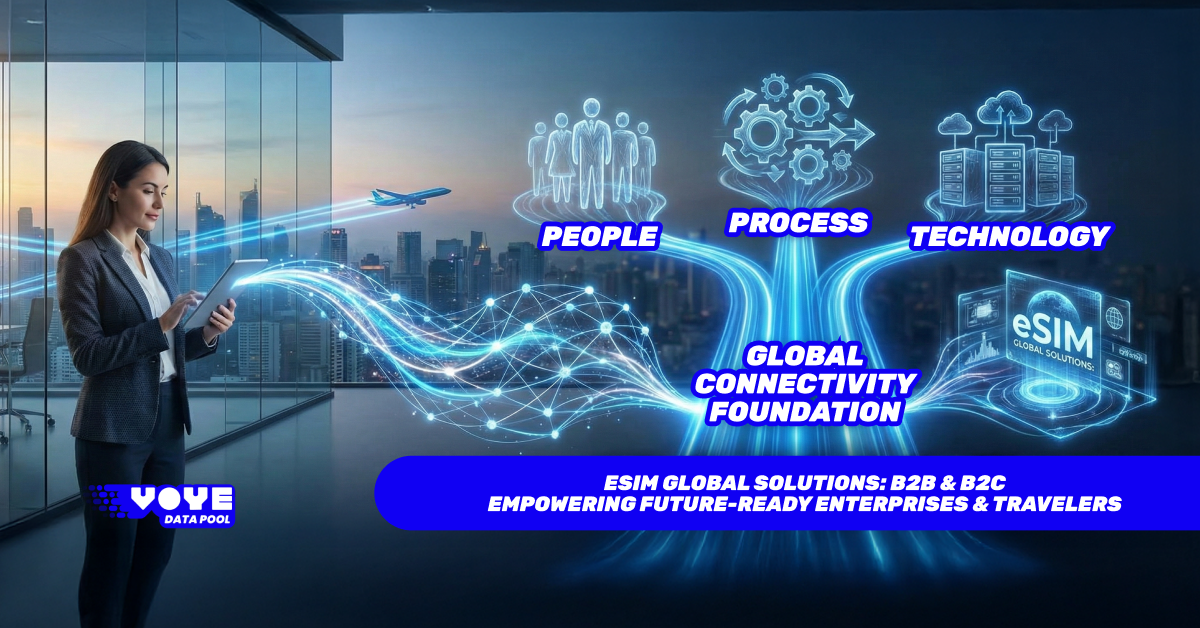
These three pillars have reshaped how organizations operate, compete, and grow. Yet as we move toward 2030, a fourth pillar is rapidly emerging as just as critical: connectivity.
This is not just about “good internet.” Connectivity is becoming an intelligent, programmable, and strategic layer that determines whether your digital initiatives succeed or stall. As more of your business moves into apps, APIs, edge devices, AI agents, and global teams, reliable and flexible connectivity becomes the silent power source behind every digital experience.
On Voye Data Pool, where connectivity, eSIM technology, and data access sit at the heart of the value proposition, understanding this shift is crucial. By 2030, businesses that treat connectivity as a strategic pillar, rather than a basic utility, will be the ones that win.
In this guide, we will explore:
- How digital transformation is evolving toward a four-pillar model
- Why connectivity is becoming foundational to every digital initiative
- The technologies transforming connectivity by 2030
- Practical ways businesses can prepare their connectivity strategy today
- The role of intelligent, flexible data access (including eSIM-driven connectivity) in this new landscape
From three pillars to four: how digital transformation is changing
Most digital transformation roadmaps until now have focused on:
- Modernizing infrastructure with cloud platforms
- Creating data lakes and analytics capabilities
- Automating processes and integrating AI into workflows
Connectivity was usually assumed to be “good enough” as long as employees could access apps and services. It lived under the IT or network team, focused mainly on uptime and cost control.
But the landscape has changed dramatically:
- Customers expect instant, always-on digital experiences on any device, anywhere.
- Workforces are distributed and mobile, often spanning multiple countries and networks.
- Businesses rely on APIs, SaaS tools, IoT sensors, mobile apps, and edge devices that all need continuous, secure connectivity.
- New product models – such as connected hardware, data-as-a-service, and platform ecosystems – are built on constant, reliable network access.
Suddenly, connectivity is no longer a background utility. It is the live bloodstream of the business.
By 2030, the companies that thrive will treat connectivity as:
- A design constraint when they imagine new products
- A strategic asset when they expand to new markets
- A performance driver when they optimize customer and employee experiences
That is what makes it the fourth pillar of digital transformation.
What do we mean by “connectivity” in 2030?
When we talk about connectivity as a pillar, we are not only referring to traditional Wi-Fi or mobile data. The 2030 view of connectivity includes:
- Global mobile connectivity – seamless data access across countries using technologies like eSIM
- Programmable networks – where bandwidth, routing, and quality of service can be dynamically controlled through APIs
- Edge connectivity – reliable links between edge devices, sensors, and central systems
- Secure, segmented connectivity – ensuring data flows are protected no matter where users and devices are located
- Multi-cloud and hybrid connectivity – connecting workloads across different providers and environments
In other words, connectivity is evolving from “pipes” into an intelligent fabric that you can configure, optimize, and integrate directly into your products and operations.
Why connectivity will be the fourth pillar by 2030
Let’s look at the forces driving connectivity into core-pillar status.
1. Explosion of connected devices and data sources
By 2030, the average enterprise will rely not only on laptops and smartphones, but also on:
- Industrial IoT sensors
- Smart retail displays and kiosks
- Connected vehicles and logistics trackers
- Wearables used by employees
- Customer-facing mobile apps and devices in the field
Each of these devices generates data that is valuable for:
- Real-time monitoring
- Predictive maintenance
- Personalized customer experiences
- Operational optimization
But without trusted, affordable, and stable connectivity, that data is delayed, incomplete, or lost. This undermines the other three pillars:
- Cloud systems receive stale or missing data.
- Analytics models underperform due to poor input quality.
- Automation and AI cannot act in real time.
Connectivity, therefore, becomes the foundation that sustains data quality and availability.
2. The rise of real-time, AI-driven experiences
AI is rapidly moving from batch processing to real-time intelligence. By 2030, your customers and employees will expect:
- Instant responses from AI assistants and support bots
- Dynamic pricing or recommendations based on up-to-the-second behavior
- Real-time fraud detection, compliance checks, and operational decisioning
All of these require low-latency, high-reliability connectivity. Any lag or drop affects:
- Customer satisfaction
- Conversion rates
- Risk and compliance outcomes
In this sense, connectivity becomes part of the AI pipeline. It is not just a channel – it is a performance lever.
3. Distributed work as the default, not the exception
The 2020s normalized remote and hybrid work. By 2030:
- Teams will often be spread across continents and time zones.
- Many roles will be by default remote or field-based.
- Organizations will tap into global talent pools across new markets.
Connectivity will determine:
- How fast teams can collaborate on cloud tools and digital workspaces
- Whether critical meetings, training sessions, and sales calls are seamless or frustrating
- How secure remote access is, especially for sensitive data
If your connectivity strategy is weak, your digital workplace – no matter how advanced your tools are – will feel slow and unreliable.
4. Global expansion with local-ready operations
Ambitious companies are no longer limited by geography. But entering new markets is increasingly about how quickly you can “plug in” your operations:
- Setting up local teams and remote operations
- Connecting to local partners, logistic providers, and regulatory systems
- Providing local customers with smooth digital experiences
Relying only on legacy roaming or patchy local networks can be:
- Expensive – unpredictable roaming fees
- Unreliable – inconsistent coverage in key areas
- Hard to manage – multiple providers, contracts, and SIMs
By contrast, digital-first connectivity solutions like eSIM-based data plans allow businesses to:
- Give teams an instant, local-like data presence in new markets
- Maintain centralized control and visibility over connectivity usage
- Move faster than competitors whose networks are stuck in old models
Connectivity thus becomes a growth accelerator and a key part of market-entry strategy.
5. Customer experiences that depend on “invisible” connectivity
From a customer’s perspective, connectivity is rarely the star – but it is always the stage.
By 2030, many digital experiences will silently depend on robust connectivity:
- Location-aware offers and services
- On-the-go banking, insurance, and fintech apps
- Seamless travel apps that cover boarding passes, navigation, and live support
- Connected retail experiences where inventory, offers, and payments sync in real time
If connectivity fails, the customer blames your brand, not the network. That is why connectivity becomes a customer experience pillar, not a technical detail.
How connectivity interacts with the other three pillars
Understanding connectivity as the fourth pillar also means seeing how it integrates with the original three.
Connectivity + Cloud: the anywhere infrastructure
Cloud made it possible to run infrastructure and applications from anywhere. Connectivity makes it possible to reach that infrastructure from everywhere.
By 2030, cloud and connectivity will be tightly intertwined:
- SaaS and PaaS platforms will expect stable, low-latency connections from end users and edge devices.
- Multi-cloud strategies will rely on high-capacity interconnects between providers and regions.
- Edge computing will push workloads closer to users but still require continuous data exchange with central clouds.
If your connectivity is weak, your cloud ROI drops, because users cannot fully benefit from the services you are paying for.
Connectivity + Data: the “live feed” of your business
Data is often described as the new oil, but by 2030, streaming data will be closer to the truth. Connectivity determines:
- How often your business data is updated
- Whether you can react to events instantly or only in hindsight
- How much contextual data (location, device behavior, usage patterns) you can collect from the edge
High-quality connectivity transforms your data strategy from a static snapshot into a continuous, real-time feed that powers:
- Operational dashboards
- Customer personalization
- Supply chain responsiveness
- Risk and compliance management
Connectivity + Automation & AI: the nervous system of the enterprise
Automation and AI thrive on timely inputs and outputs. The more your workflows depend on:
- Trigger-based alerts
- Automated approvals and routing
- Real-time anomaly detection and responses
- AI agents interacting with customers and systems
…the more your connectivity determines their effectiveness.
Think of connectivity as the nervous system of your digital enterprise. Without it, AI and automation cannot “sense” or “act” properly in the real world.
The technologies reshaping connectivity by 2030
To understand why connectivity is becoming a pillar, it helps to see the major technology shifts that will define the decade.
1. eSIM and software-defined mobile connectivity
eSIM (embedded SIM) technology is transforming how individuals and businesses access mobile data:
- No physical SIM cards
- Instant activation via QR codes or apps
- Ability to switch carriers or plans digitally
- Support for multiple plans on a single device
For businesses, especially those with cross-border teams, travelers, or distributed devices, eSIM enables:
- Quick onboarding of new employees, contractors, or devices in any supported country
- Centralized management of data usage across a fleet of devices
- Better cost control compared to traditional roaming
- Faster responsiveness when entering new markets or scaling operations
By 2030, software-defined connectivity powered by eSIMs and centralized management platforms will be standard for agile, global businesses.
2. 5G (and early 6G) driving bandwidth and low latency
5G networks are already rolling out globally, offering:
- Higher bandwidth for data-heavy applications
- Lower latency for real-time interactions
- Greater device density, enabling large IoT deployments
As 6G research matures, the vision moves toward:
- Ultra-low latency for mission-critical, immersive experiences
- More energy-efficient and intelligent networking
For businesses, the net effect is:
- The ability to build new categories of products and services that rely on real-time data and rich media
- A stronger case for replacing legacy connectivity models with advanced, mobile-first or hybrid approaches
3. Edge computing and local intelligence
Edge computing moves processing closer to where data is generated. But this does not eliminate the need for connectivity – in fact, it increases the sophistication of connectivity needs:
- Edge nodes must sync with central systems regularly.
- Data pipelines become more complex, involving local and cloud flows.
- New connectivity patterns emerge between devices, local gateways, and global applications.
By 2030, edge + connectivity will be treated as a joint design problem, especially in:
- Manufacturing and Industry 4.0
- Logistics and smart mobility
- Retail and on-site customer experiences
4. Network-as-a-Service and programmable connectivity
Networks are becoming more dynamic and consumable:
- Provision bandwidth and quality of service via simple APIs
- Spin up secure, temporary connections for specific workflows or events
- Integrate connectivity logic directly into applications
This “Network-as-a-Service” approach turns connectivity into a programmable resource, much like cloud computing. That is a major reason it rises to pillar status – it becomes part of your architecture and product design, not only infrastructure.
How businesses should rethink connectivity strategy before 2030
If connectivity is becoming the fourth pillar, what should businesses do now?
1. Elevate connectivity to board and C-suite conversations
Connectivity decisions should no longer sit entirely at the IT operations level. They touch:
- Customer experience
- Revenue growth and product strategy
- Cost control and operational resilience
- Global expansion planning
Practical steps:
- Include connectivity readiness in digital transformation and AI roadmaps.
- Ensure your CIO/CTO, CDO (Chief Digital/Data Officer), and business unit leaders assess connectivity’s role in outcomes.
- Treat major connectivity changes (for example, adopting eSIM at scale) as strategic initiatives, not small IT projects.
2. Map current and future connectivity dependencies
Start by answering:
- Where do our employees work from – office, home, field, or on the move?
- Which customer journeys rely heavily on mobile or on-the-go experiences?
- How many devices and endpoints are we connecting today, and what will that number look like by 2030?
- Which of our products and services are already dependent on reliable connectivity – and where are the failure points?
Create a connectivity dependency map:
- Mark every critical workflow, channel, device, or service that requires connectivity.
- Note the type of connectivity (mobile, Wi-Fi, enterprise network, IoT) and its current pain points.
- Identify the strategic areas where improved connectivity would unlock measurable value.
3. Design for global mobility from day one
Even if your business is currently local or regional, by 2030:
- Your customers may be global.
- Your talent pool may be global.
- Your supply chain may be global.
Design your connectivity stack so it can:
- Support mobile employees and devices in multiple countries
- Scale to remote teams, international events, or pop-up operations without weeks of planning
- Handle short-term deployments (for example, teams traveling for projects, inspections, or installations) with minimal friction
This is where eSIM-driven connectivity can become a competitive advantage. Instead of wrestling with local SIM cards and complex roaming contracts, you can:
- Provision data plans digitally
- Offer reliable connectivity to your teams and devices, anywhere supported
- Keep your connectivity strategy agile as your footprint changes
4. Make connectivity part of your resilience and risk planning
Digital resilience is no longer just about backups and disaster recovery. Connectivity failures can impact:
- Transaction volumes and revenue
- Customer trust and brand reputation
- Operational safety and compliance in regulated industries
By 2030, robust organizations will:
- Have multi-path connectivity strategies (for example, multiple networks, backup options, or edge-to-cloud redundancy).
- Use connectivity analytics to monitor performance and detect anomalies.
- Incorporate connectivity scenarios into their business continuity plans.
5. Turn connectivity data into strategic insight
Connectivity itself generates data:
- Usage patterns across teams, locations, and devices
- Correlation between connectivity quality and productivity or customer satisfaction
- Cost trends and optimization opportunities
By analyzing this connectivity data, you can:
- Identify where poor connectivity is silently eroding performance
- Optimize data plan allocation and provider choices
- Support business cases for entering new markets or investing in new products
Platforms that bring connectivity analytics into one pane of glass – unifying usage and performance insights – will become core tools for digital leaders.
What connectivity-first organizations will look like in 2030
By 2030, businesses that treat connectivity as the fourth pillar will share some common characteristics.
1. Borderless teams and operations
- Employees can work, travel, and collaborate across borders without worrying about network access.
- Devices deployed in different regions (for example, kiosks, sensors, fleet trackers) can be provisioned and managed centrally.
- Pop-up operations – from events to field projects – can be connected instantly and securely.
2. Seamless hybrid and on-the-go experiences
- Customer interactions remain smooth when moving across channels (in-store, app, web, call center) and locations.
- Sales, support, and field teams have reliable access to the same systems whether they are in headquarters, at home, or on-site.
- Connectivity quality is continuously monitored and optimized for critical journeys.
3. Products and services with connectivity “built in”
- Physical products may ship with connectivity embedded via eSIM and managed centrally.
- Subscription and service models will depend on always-on data flows.
- New monetization models (usage-based, performance-based, data-as-a-service) will be enabled by reliable connectivity.
4. Measurably higher digital ROI
Connectivity-first organizations will see:
- Higher adoption and engagement for digital channels
- Better performance from AI, analytics, and automation
- Faster and more confident global expansion
- Reduced operational friction and fewer “invisible” digital failures
All of this translates into stronger returns from every other pillar of digital transformation.
Preparing your organization for the connectivity-driven 2030
To make connectivity your fourth pillar, consider a practical roadmap:
Step 1: Audit and baseline
- Evaluate current connectivity setups for employees, branches, and devices.
- Identify pain points – dropped connections, patchy coverage, high roaming costs, poor visibility.
- Quantify how these issues affect productivity, customer experience, and costs.
Step 2: Define connectivity goals aligned to business outcomes
Rather than only targeting technical metrics (for example, bandwidth), tie connectivity improvements to:
- Faster time-to-market for new digital products
- Higher satisfaction scores on key customer journeys
- Reduced downtime for critical operations
- Lower cost per connected employee or device
This framing gains executive buy-in and keeps connectivity clearly positioned as a strategic pillar.
Step 3: Modernize your connectivity foundation
Depending on your starting point, modernization could involve:
- Moving from traditional roaming or fragmented local SIMs to digital-first, centrally managed connectivity
- Complementing fixed networks with flexible mobile or eSIM-based solutions
- Introducing monitoring and analytics for connectivity performance
The goal is to build a flexible, software-defined connectivity layer that can grow with the rest of your digital architecture.
Step 4: Integrate connectivity into digital product and service design
When designing new digital offerings, ask:
- What connectivity assumptions does this product make about the user?
- How will performance degrade in low-connectivity environments?
- Can we embed connectivity into the product (for example, using eSIM) to control the experience end-to-end?
- How do we monitor and support connectivity once the product is in the field?
Treating connectivity as a design dimension – not just a deployment concern – will differentiate your experiences by 2030.
Step 5: Create governance and accountability
- Define roles and responsibilities for connectivity planning and performance.
- Provide regular reports that show how connectivity is impacting key business metrics.
- Encourage collaboration between network teams, product teams, and business leaders.
Connectivity as the fourth pillar: what this means for your next move
By 2030, digital transformation will no longer be only about moving to the cloud, mining data, and automating processes. Those capabilities will be expected – table stakes.
The real competitive edge will come from how intelligently and reliably you connect:
- People to tools
- Devices to platforms
- Markets to opportunities
Connectivity will be the fourth pillar that:
- Keeps your data streams alive
- Makes your AI and automation effective in real time
- Enables your teams to work together from anywhere
- Lets you expand globally with confidence
For organizations planning their next decade, the question is not whether connectivity matters. It is how quickly you elevate it from background utility to strategic pillar.
On Voye Data Pool, this shift is especially relevant: businesses that embrace digital-first, flexible connectivity models – including eSIM-driven solutions for teams, travelers, and devices – will be better equipped to build the truly global, always-on operations that 2030 demands.
If you start redefining your connectivity strategy today, you are not just upgrading a network. You are strengthening the foundation of every other digital investment you make.

Seamless eSIM Connectivity for Enterprises
Activate, manage, and scale eSIMs with ease.